
Russian Twist
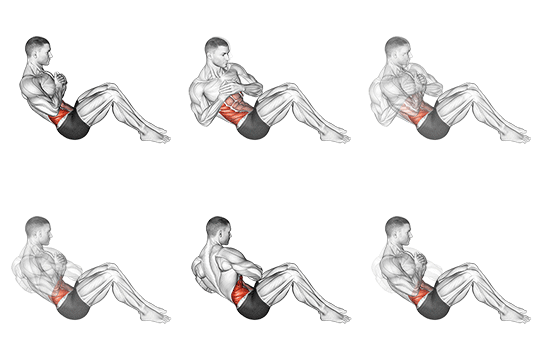
How to Do a Russian Twist
Sit with the knees bent and feet planted.
Lean back slightly until the core is working while keeping control.
Clasp the hands or hold a light weight close to the chest.
Brace and keep the pelvis relatively stable.
Rotate the rib cage and shoulders toward one side.
Return through center and rotate to the other side.
Alternate smoothly without bouncing or swinging the load.
Form Check & Technique
DO THIS (Technique Tips)
- Feet down first.
- Lean back only as far as you can control.
- Rotate shoulders and ribs, not just hands.
- Keep the pelvis relatively stable.
- Use a manageable range.
- Add weight gradually.
- Avoid momentum.
- Breathe throughout.
AVOID THIS (Common Mistakes)
- Moving Only the Hands — Fix: rotate the rib cage and shoulders.
- Leaning Back Too Far — Fix: use a controllable torso angle.
- Using Heavy Weight Too Soon — Fix: master bodyweight rotation first.
- Bouncing Side to Side — Fix: slow the tempo.
- Feet Flying Around — Fix: keep them planted until balance improves.
- Holding the Breath — Fix: breathe continuously.
- Forcing Painful Rotation — Fix: shorten the range or use an anti-rotation alternative.
About Russian Twist
The Russian twist is a seated rotational core exercise that primarily trains the internal and external obliques while the rectus abdominis and deeper core stabilize the trunk. Sit with the knees bent, lean back slightly while staying controlled, rotate the rib cage and shoulders from side to side, and keep the movement driven by the torso rather than simply moving the hands. It can be performed with the feet planted or elevated and progressed with a medicine ball, dumbbell, or plate.
Russian Twist Muscles Worked
The obliques are the main rotational muscles during Russian twists.
- The rectus abdominis and deeper abdominal musculature help maintain the reclined torso and control the pelvis.
- Hip flexors contribute more when the feet are elevated.
Sets & Reps Guidance
Technique / Learning
Technique: 2–3 sets of 6–10 rotations per side with feet planted.
Strength Focus
Loaded core work: 3–4 sets of 6–12 controlled rotations per side.
Muscle Growth (Hypertrophy)
Muscle / endurance work: 3–4 sets of 10–20 rotations per side.
General training baseline. Need.fit automatically adjusts exact sets, reps, and working weight based on your individual fitness level, recovery, and progress over time.
Exercise Variations & Alternatives
Bicycle Crunch
A rotational crunch with alternating leg movement.
Plank
A static anti-extension core exercise.
Cable Crunch
A loaded trunk-flexion exercise.
Mountain Climber
A dynamic plank with alternating knee drives.
Crunch
Master abdominal crunch form, upper ab isolation, crunch vs sit-up differences, proper neck position, common mistakes, and sets and reps.
Sit-Up
Master full-range sit-up form, abdominal & hip flexor muscles worked, sit-up vs crunch differences, common mistakes, and sets and reps.
Should Your Feet Be on the Floor or Elevated?
Feet down provide more stability and are the best starting point. Elevating them increases balance and hip-flexor demand but is only useful if torso control remains strong.
Russian Twist vs Bicycle Crunch
Russian twists emphasize seated torso rotation; bicycle crunches combine rotation with trunk flexion and alternating hip movement.
Do Russian Twists Work the Obliques?
Yes. The internal and external obliques contribute directly to trunk rotation while the rest of the core stabilizes the reclined position.
Should You Touch the Floor on Every Rep?
No.
- Floor contact is optional.
- Rotate through the range you can control without collapsing or using momentum.
Weighted vs Bodyweight Russian Twists
Start bodyweight. Add a light medicine ball, plate, or dumbbell only when the torso—not the arms—continues to drive the motion.
Are Russian Twists Bad for Your Back?
They are not automatically harmful, but rotational tolerance varies. Use a comfortable range and manageable load, and choose another exercise if rotation repeatedly causes pain.
Russian Twist Alternatives
Alternatives include bicycle crunches, cable chops, Pallof presses, side planks, and loaded carries.
Russian Twist Benefits
Russian twists require little equipment, directly train rotational control, and are easy to scale by changing foot support, torso angle, tempo, and load.
Sources & References
- [1]
- [2]
- [3]