
Sit-Up
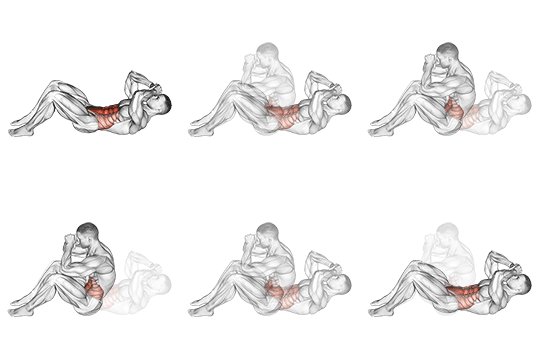
How to Do a Sit-Up
Starting setup: lie flat on your back on a mat with your knees bent at ~90 degrees and feet flat on the floor (anchored under a pad or unanchored).
Hand placement: cross your arms over your chest or place your hands lightly beside your head.
Initiate spine curl: exhale as you engage your abs, curling your head, shoulders, and chest up off the mat.
Raise full torso: continue flexing your hips and spine until your entire upper body is lifted up to an upright sitting position near your knees.
Squeeze at top: pause briefly at the top upright position.
Lower under control: inhale as you lower your torso back down to the mat segment by segment over a 2–3 second eccentric phase.
Form Check & Technique
DO THIS (Technique Tips)
- Bend knees at 90 degrees.
- Exhale as you sit up tall.
- Roll spine down smoothly on eccentric.
- Cross arms over chest to avoid neck strain.
AVOID THIS (Common Mistakes)
- Yanking Neck Forward — Fix: cross arms on chest or keep hands light.
- Bouncing Back Off Floor — Fix: lower under 2–3 second control.
- Arching Lower Back — Fix: roll spine up smoothly segment by segment.
About Sit-Up
The sit-up is a full-range abdominal and trunk flexion exercise that targets the rectus abdominis, hip flexors (iliopsoas, tensor fasciae latae), and obliques. Performed by flexing the spine and raising the entire torso from a lying position to an upright sitting position, the sit-up builds functional trunk flexion power used in athletics, military physical fitness tests, and daily movement.
Sit-Up Muscles Worked
The initial phase of the sit-up (lifting shoulder blades) uses the rectus abdominis.
- As the torso rises past 30 degrees, the hip flexor complex (iliopsoas) takes over to pull the pelvis and spine into upright seating.
Sets & Reps Guidance
Muscle Growth (Hypertrophy)
Hypertrophy: 3–4 sets of 12–15 reps with controlled tempo.
General training baseline. Need.fit automatically adjusts exact sets, reps, and working weight based on your individual fitness level, recovery, and progress over time.
Exercise Variations & Alternatives
Crunch
Abdominal isolation exercise lifting only upper back.
Hanging Leg Raise
Hanging ab and hip flexor exercise.
Russian Twist
Rotational sit-up variation for obliques.
Plank
Anti-extension core stability exercise.
Ab Wheel Rollout
Advanced rollout exercise.
Bicycle Crunch
Learn bicycle crunch form, muscles worked, neck and rotation cues, common mistakes, crunch differences, variations, progressions, and practical sets and reps.
Sit-Up vs Crunch Difference
Crunches only lift the upper back off the floor, isolating the abs without hip flexors. Sit-ups lift the full torso up to the knees, recruiting hip flexors to complete the movement.
Anchored vs Unanchored Sit-Ups
Hooking your feet under a bar or dumbbell (anchored) allows your hip flexors to pull harder, making the exercise easier for the abs but increasing lower back shear. Unanchored sit-ups force higher abdominal work.
Protecting the Lower Back
Avoid arching your lower back or yanking your head forward. If you have lower back issues, crunches or planks are safer alternatives.
Sit-Up Benefits
Builds functional trunk flexion, tests endurance for athletic/military standards, strengthens hip flexors, and requires no equipment.