
Bicycle Crunch
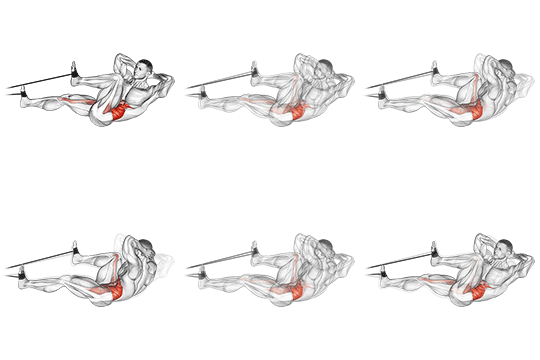
How to Do a Bicycle Crunch
Lie on your back with hips and knees bent and fingertips lightly near the head.
Brace and lift the shoulder blades slightly from the floor.
Bring one knee toward the torso as the opposite rib cage rotates toward it.
Extend the other leg without letting the lower back arch excessively.
Switch sides smoothly through center.
Keep the neck quiet and avoid pulling the head forward.
Use deliberate alternating reps instead of fast pedaling.
Form Check & Technique
DO THIS (Technique Tips)
- Rotate ribs toward opposite knee.
- Keep hand pressure light.
- Move slowly first.
- Extend only as low as you can control.
- Keep shoulder blades lightly elevated.
- Do not chase elbow contact.
- Alternate smoothly.
- Progress tempo only after form is stable.
AVOID THIS (Common Mistakes)
- Pulling on the Neck — Fix: use light fingertip support.
- Pedaling Too Fast — Fix: slow down until each side includes torso rotation.
- Elbows Folding In — Fix: keep the upper body open without forcing width.
- Straight Leg Dropping Too Low — Fix: raise it until the lower back stays controlled.
- Shoulder Blades Resting Between Reps — Fix: maintain light abdominal tension.
- Touching Elbow to Knee With Arm Motion — Fix: move the torso.
- Holding the Breath — Fix: breathe rhythmically.
About Bicycle Crunch
The bicycle crunch is a bodyweight abdominal exercise that combines trunk flexion, torso rotation, and alternating hip movement. It trains the rectus abdominis and obliques while the hip flexors assist the leg action. Lie on your back, keep the head supported without pulling the neck, rotate the rib cage toward the opposite knee, extend the other leg, and alternate sides under control. The goal is coordinated trunk rotation—not simply touching an elbow to a knee as fast as possible.
Bicycle Crunch Muscles Worked
Bicycle crunches combine abdominal flexion with rotation, making the rectus abdominis and obliques major contributors.
- The hip flexors move the legs as they alternate.
- The exercise is most useful when the rib cage visibly rotates rather than when the arms simply chase the knees.
Sets & Reps Guidance
Technique / Learning
Technique: 2–3 sets of 6–10 reps per side.
Strength Focus
Harder core work: 3–4 sets of 6–12 controlled reps per side.
Muscle Growth (Hypertrophy)
Muscle / endurance work: 3–4 sets of 10–20 reps per side.
General training baseline. Need.fit automatically adjusts exact sets, reps, and working weight based on your individual fitness level, recovery, and progress over time.
Exercise Variations & Alternatives
Crunch
A shorter-range trunk-flexion exercise.
Russian Twist
A seated core rotation exercise.
Plank
A static anti-extension exercise.
Mountain Climber
A dynamic plank with alternating knee drives.
Sit-Up
Master full-range sit-up form, abdominal & hip flexor muscles worked, sit-up vs crunch differences, common mistakes, and sets and reps.
Hanging Leg Raise
Learn hanging leg raise form, muscles worked, grip and pelvic-control cues, common mistakes, beginner progressions, lying-raise differences, and sets and reps.
Bicycle Crunch vs Regular Crunch
A regular crunch mainly uses trunk flexion. A bicycle crunch adds rotation and alternating hip movement, increasing coordination and oblique involvement.
Bicycle Crunch vs Russian Twist
Bicycle crunches combine flexion and rotation while lying down. Russian twists use seated torso rotation with less repeated trunk flexion.
Should Your Elbow Touch Your Knee?
It can, but contact is not the goal. Rotate the rib cage toward the opposite thigh and use the range your torso can control.
How Low Should the Straight Leg Go?
Extend the leg only as low as you can without losing trunk control or allowing the lower back to arch excessively.
Why Bicycle Crunches Hurt the Neck
Neck strain often comes from pulling with the hands or leading with the head. Keep fingertip contact light and think rib-cage rotation.
Slow vs Fast Bicycle Crunches
Slow reps improve control.
- Faster reps increase conditioning demand but often reduce range and rotation.
- Learn slowly first.
Bicycle Crunch Progressions
Start with alternating knee-to-elbow marches or bent-knee cross-body crunches, then progress leg extension, pauses, tempo, or light load.
Bicycle Crunch Benefits
They require no equipment, train both trunk flexion and rotation, and can be used for abdominal strength, endurance, or circuits.
Sources & References
- [1]
- [2]
- [3]