
Mountain Climber
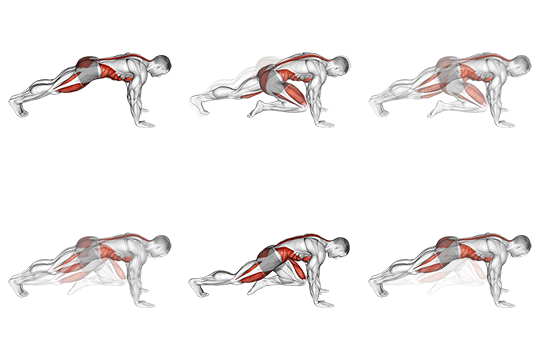
How to Do Mountain Climbers
Start in a high plank with hands around shoulder width directly under the shoulders.
Brace the trunk and keep the hips roughly in line with the shoulders.
Drive one knee toward the chest without letting the supporting hip rotate excessively.
Return that foot to the plank position.
Drive the opposite knee forward while the hands stay planted.
Begin slowly enough to maintain alignment, then increase pace only when the hips stay controlled.
Continue for reps or time and stop when the shoulders collapse or hips rise.
Form Check & Technique
DO THIS (Technique Tips)
- Hands under shoulders.
- Brace before moving.
- Keep hips relatively level.
- Drive knees under control.
- Stay light on the feet.
- Learn slowly first.
- Increase speed gradually.
- Use timed intervals only while form stays consistent.
AVOID THIS (Common Mistakes)
- Hips Piking High — Fix: slow down and keep the pelvis closer to shoulder height.
- Hips Sagging — Fix: brace the trunk and shorten the set.
- Hands Too Far Forward — Fix: stack shoulders over wrists.
- Bouncing Side to Side — Fix: reduce speed.
- Tiny Knee Drives — Fix: use the largest controllable range.
- Feet Slamming the Floor — Fix: stay light and deliberate.
- Going Fast Before Learning Form — Fix: master slow reps first.
About Mountain Climber
The mountain climber is a dynamic bodyweight exercise performed from a high-plank position while alternating knee drives toward the torso. It trains core stability while the shoulders and triceps support the upper body and the hip flexors and quadriceps move the legs. Faster mountain climbers also create a substantial conditioning demand. Good mountain climber form keeps the hands under the shoulders, hips relatively level, trunk braced, and knee drives controlled instead of letting the body bounce or pike.
Mountain Climber Muscles Worked
Mountain climbers combine a high-plank stabilization demand with repeated hip flexion.
- The core resists unwanted trunk and pelvic motion while the shoulders and triceps support bodyweight.
- Hip flexors and quadriceps drive the alternating knees, and the glutes and hamstrings help stabilize and return the legs.
Sets & Reps Guidance
Technique / Learning
Technique: 2–3 sets of 6–10 slow knee drives per side or incline mountain climbers.
Strength Focus
Harder core work: 3–4 sets of 8–15 controlled knee drives per side.
Muscle Growth (Hypertrophy)
Conditioning / endurance: 3–5 rounds of 20–45 seconds at a pace that preserves plank alignment.
General training baseline. Need.fit automatically adjusts exact sets, reps, and working weight based on your individual fitness level, recovery, and progress over time.
Exercise Variations & Alternatives
Plank
A static version of the high-plank core-stability demand.
Bicycle Crunch
A floor-based alternating core exercise with trunk rotation.
Burpee
A full-body conditioning exercise that moves between standing and plank.
Hanging Leg Raise
A hanging hip-flexion and core-control exercise.
Crunch
Master abdominal crunch form, upper ab isolation, crunch vs sit-up differences, proper neck position, common mistakes, and sets and reps.
Sit-Up
Master full-range sit-up form, abdominal & hip flexor muscles worked, sit-up vs crunch differences, common mistakes, and sets and reps.
Mountain Climbers for Core vs Cardio
Slow mountain climbers emphasize plank control and deliberate knee drives. Faster mountain climbers increase heart rate and conditioning demand.
Where Should Your Hips Be?
Keep the hips roughly in line with the shoulders rather than piking high or sagging. Small movement is normal, but the trunk should remain controlled.
Should Your Knee Touch Your Chest?
No. Bring the knee as far forward as you can without rounding excessively, lifting the hips, or losing hand pressure.
Slow vs Fast Mountain Climbers
Use slow reps to learn alignment. Increase speed only after you can alternate knees without bouncing or shifting the hands.
Mountain Climbers vs Plank
A plank is static. Mountain climbers add repeated hip flexion and alternating limb movement, making the exercise more dynamic and metabolically demanding.
Beginner Mountain Climber Modifications
Use hands on a bench, perform slower step-in knee drives, or shorten the range. These regressions reduce load while teaching the same trunk position.
Mountain Climber Variations
Options include cross-body, slow, slider, incline, and suspended mountain climbers. Each changes rotation, friction, or stability demands.
Mountain Climber Benefits
They require no equipment, train core and shoulder stability, involve the legs dynamically, and work well in conditioning circuits and warm-ups.
Sources & References
- [1]
- [2]