
Cable Crunch
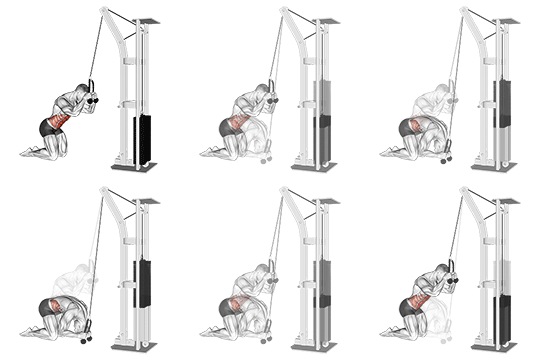
How to Do a Cable Crunch
Attach a rope to a high pulley and select a controllable load.
Kneel a short distance from the stack and hold the rope beside the head or upper shoulders.
Keep the hips relatively fixed instead of sitting back toward the heels.
Brace and keep the arms from pulling the rope downward.
Flex the trunk by bringing the rib cage toward the pelvis.
Reach a controlled bottom position without turning the rep into a hip hinge.
Return slowly until the abdominals lengthen and repeat without letting the stack slam.
Form Check & Technique
DO THIS (Technique Tips)
- High pulley setup.
- Rope beside the head.
- Hips relatively fixed.
- Ribs toward pelvis.
- Do not pull with arms.
- Use controlled spinal flexion.
- Return slowly.
- Progress load gradually.
AVOID THIS (Common Mistakes)
- Sitting the Hips Back — Fix: keep them relatively fixed and flex the trunk.
- Pulling With the Arms — Fix: hold the rope still and move from the rib cage.
- Using Too Much Weight — Fix: reduce load until the abs control the range.
- Turning It Into a Hip Hinge — Fix: think ribs toward pelvis.
- Letting the Stack Slam — Fix: control the return.
- Holding the Rope Far From the Head — Fix: keep it close.
- Tiny Partial Reps — Fix: use a repeatable trunk-flexion range.
About Cable Crunch
The cable crunch is a loaded abdominal exercise usually performed kneeling in front of a high pulley with a rope attachment. It primarily trains the rectus abdominis through trunk flexion while the obliques and deeper core help control the torso. Unlike a bodyweight crunch, cable resistance can be increased in small increments, making the exercise easy to progressively overload. Strong cable crunch form keeps the hips relatively stable, the rope near the head, and the movement driven by bringing the rib cage toward the pelvis rather than sitting the hips back toward the heels.
Cable Crunch Muscles Worked
Cable crunches load trunk flexion directly.
- The rectus abdominis is the main target, while the obliques and other core muscles stabilize the trunk.
- Cable resistance makes progressive loading easier than with an unweighted floor crunch.
Sets & Reps Guidance
Technique / Learning
Technique: 2–3 sets of 8–15 light-load reps.
Strength Focus
Loaded strength work: 3–4 sets of 6–12 reps.
Muscle Growth (Hypertrophy)
Muscle growth: 3–4 sets of 10–20 reps with progressive cable resistance.
General training baseline. Need.fit automatically adjusts exact sets, reps, and working weight based on your individual fitness level, recovery, and progress over time.
Exercise Variations & Alternatives
Crunch
A bodyweight trunk-flexion exercise.
Ab Wheel Rollout
An anti-extension core exercise.
Plank
A static core-stability exercise.
Bicycle Crunch
A crunch variation that adds rotation.
Sit-Up
Master full-range sit-up form, abdominal & hip flexor muscles worked, sit-up vs crunch differences, common mistakes, and sets and reps.
Hanging Leg Raise
Learn hanging leg raise form, muscles worked, grip and pelvic-control cues, common mistakes, beginner progressions, lying-raise differences, and sets and reps.
Cable Crunch vs Regular Crunch
Both train trunk flexion, but cable crunches make progressive resistance easier. Floor crunches are simpler and equipment-free.
Where Should Your Hips Be?
Keep the hips relatively stable instead of rocking backward toward the heels. Large hip travel shifts the exercise away from focused trunk flexion.
Where Should You Hold the Rope?
Keep the rope beside the head or upper shoulders rather than pulling it down with the arms.
Should Your Back Round During Cable Crunches?
Yes. Controlled trunk flexion is the purpose of a crunch; the torso should not stay rigid like a plank.
Kneeling vs Standing Cable Crunch
Kneeling is easier to standardize. Standing versions add balance and different cable angles but should still be driven by trunk flexion.
How Heavy Should Cable Crunches Be?
Use enough resistance to challenge the abs without turning the rep into a hip hinge or arm pull.
Cable Crunch Alternatives
Alternatives include weighted floor crunches, machine crunches, reverse crunches, sit-ups, and ab-wheel rollouts.
Cable Crunch Benefits
Cable crunches allow precise load progression, consistent resistance, and direct trunk-flexion training.
Sources & References
- [1]
- [2]
- [3]
- [4]