
Plank
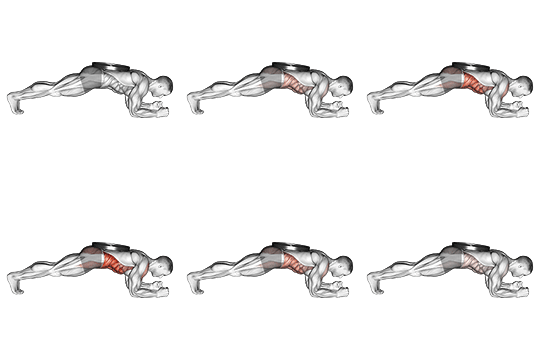
How to Do a Plank
Elbow setup: lie face-down on a mat. Place your forearms flat on the floor with elbows positioned directly beneath your shoulders, hands parallel or clasped.
Leg and toe setup: extend your legs straight behind you, supporting your lower body on your toes hip-width apart.
Engage core and lift hips: brace your abdominal muscles as if preparing for a punch and press through your forearms to raise your torso and legs off the floor.
Align body: form a completely straight line from your head down through your shoulders, hips, knees, and ankles.
Pelvic tilt & glute squeeze: squeeze your glutes and perform a subtle posterior pelvic tilt (tuck your tailbone slightly) to prevent your lower back from sagging.
Breathing: breathe steadily into your diaphragm while maintaining isometric tension. Hold for the target duration.
Form Check & Technique
DO THIS (Technique Tips)
- Elbows stacked directly under shoulders.
- Squeeze glutes and quads tight.
- Pull belly button into spine.
- Keep neck neutral, looking down at hands.
- Quality hold time beats long sloppy holds.
- Stop set immediately if lower back sags.
AVOID THIS (Common Mistakes)
- Sagging Hips (Lower Back Arching) — Fix: squeeze glutes, brace abs, and tuck tailbone slightly.
- Piking Hips in Air — Fix: lower hips until body forms a flat, straight line.
- Looking Up or Forward — Fix: keep gaze down at floor to keep neck neutral.
- Holding Breath — Fix: take slow, controlled breaths into your belly while keeping abs tight.
- Elbows Placed Too Far Forward — Fix: stack elbows directly under shoulder joints.
About Plank
The forearm plank is the ultimate isometric core stability exercise that targets the transverse abdominis, rectus abdominis, obliques, and deep spinal stabilizers. By resisting spinal extension and lumbar sagging while supporting the body on forearms and toes, the plank builds anti-extension core strength, improves posture, and protects the lower back against injury. Proper form requires keeping shoulders, hips, and ankles in a straight line with a braced core.
Plank Muscles Worked
The plank requires isometric anti-extension strength.
- The deep transverse abdominis acts like a natural weight belt to pull the navel toward the spine, while the rectus abdominis and obliques prevent gravity from pulling the pelvis into anterior tilt.
Sets & Reps Guidance
Strength Focus
RKC High-Tension Plank: 3–4 sets of 15–30 second max-effort holds.
Muscle Growth (Hypertrophy)
Core Endurance: 3 sets of 45–60 second controlled holds.
General training baseline. Need.fit automatically adjusts exact sets, reps, and working weight based on your individual fitness level, recovery, and progress over time.
Exercise Variations & Alternatives
Crunch
Flexion-based upper ab exercise.
Sit-Up
Full-range abdominal and hip flexor movement.
Ab Wheel Rollout
Advanced dynamic anti-extension core exercise.
Mountain Climber
Dynamic plank variation adding knee drives.
Hanging Leg Raise
Lower ab and hip flexor exercise.
Russian Twist
Learn Russian twist form, muscles worked, torso and foot-position cues, common mistakes, weighted variations, alternatives, and practical sets and reps.
RKC Plank (High-Tension Plank)
Instead of holding a passive plank for minutes, the RKC (Russian Kettlebell Challenge) plank maximizes tension.
- Actively pull your elbows toward your toes and squeeze your glutes as hard as possible.
- A 20-second RKC plank generates far higher core activation than a 2-minute relaxed plank.
Preventing Lower Back Sagging
When your core fatigues, your hips sag toward the floor, putting extreme compression on your lower back (lumbar spine). The moment your hips sag, drop your knees to the mat or end the set.
Side Plank Progression for Obliques
Combine forearm planks with side planks (supporting your body on one forearm on your side) to build complete 360-degree core stability and strengthen the quadratus lumborum.
Plank Benefits
Strengthens deep core muscles, improves spinal posture, reduces lower back pain risk, requires zero equipment, and enhances stability for heavy compound lifts.