
Running
How to Run With Proper Form
Set a relaxed posture: run tall with the head and neck neutral, eyes looking ahead, shoulders relaxed, and the torso naturally stacked rather than hunched.
Use a small whole-body lean when appropriate: allow a subtle forward orientation from the ankles instead of bending sharply at the waist.
Keep the arm swing efficient: bend the elbows comfortably, keep the hands relaxed, and swing the arms mainly forward and backward instead of aggressively across the torso.
Let the stride land close to the body: avoid reaching the foot far out in front. A shorter, smoother step often reduces braking compared with obvious over-striding.
Do not force one foot-strike pattern: rearfoot, midfoot, and forefoot striking all occur in runners. Land quietly and comfortably rather than deliberately changing strike pattern without a reason.
Use your natural cadence as the baseline: if gait retraining is needed, small step-rate increases can be tested rather than forcing every runner toward one steps-per-minute target.
Match breathing and pace to the session: easy runs should feel sustainable enough for controlled breathing, while faster intervals require more recovery and greater technique focus.
Increase training gradually: add running time, distance, frequency, and faster work progressively so your cardiovascular system and tissues have time to adapt.
Form Check & Technique
DO THIS (Technique Tips)
- Run tall but relaxed.
- Keep the hands and shoulders loose.
- Let the arms swing mainly forward and back.
- Avoid reaching the foot far ahead of the body.
- Use your natural foot strike unless a change is justified.
- Treat cadence as individual, not a universal number.
- Build easy running before frequent speed work.
- Increase training load gradually.
AVOID THIS (Common Mistakes)
- Over-Striding — Fix: let the foot land closer to the body instead of reaching far forward.
- Forcing a Specific Foot Strike — Fix: keep your natural strike unless there is a clear reason to retrain it.
- Chasing 180 Steps per Minute — Fix: use your preferred cadence as the baseline and make only small changes when useful.
- Hunched Shoulders — Fix: keep the chest and shoulders relaxed rather than rigid.
- Arms Crossing Excessively — Fix: swing mainly forward and backward.
- Increasing Mileage Too Quickly — Fix: build weekly duration and distance progressively.
- Every Run Becoming Hard — Fix: keep most beginner running controlled and reserve faster work for planned sessions.
- Ignoring Persistent Pain — Fix: reduce aggravating load and seek qualified assessment when pain is recurring or worsening.
About Running
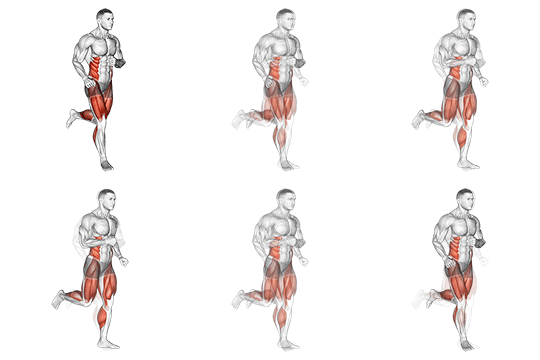
Running is a weight-bearing cardiovascular exercise built from repeated single-leg stance, flight, landing, and push-off phases. The quadriceps, glutes, calves, hamstrings, hip flexors, and trunk all contribute as speed and terrain change. Good running form is not one identical posture or foot strike for every person: aim for a tall, relaxed torso, an arm swing that moves mainly forward and backward, a stride that lands close to your center of mass, and a rhythm you can maintain without excessive braking or tension. Beginners should build duration and frequency gradually rather than forcing speed, mileage, a particular foot strike, or a universal cadence number.
Running Muscles Worked
Running distributes work across the lower body and trunk rather than targeting one muscle.
- The quadriceps help control landing and extend the knee, the glutes contribute to hip support and propulsion, the calves manage ankle stiffness and push-off, and the hamstrings and hip flexors help cycle the leg.
- The trunk stabilizes the pelvis and torso while the arms counterbalance lower-body rotation.
- Muscle demand changes with speed, incline, stride mechanics, fatigue, and individual anatomy.
Sets & Reps Guidance
Technique / Learning
Beginner technique: 20–30 minutes alternating short easy runs with walking, 2–3 days per week, focusing on relaxed posture and repeatable stride mechanics.
Strength Focus
Speed / interval work: after building an aerobic base, use 4–8 short work intervals with generous easy jogging or walking recovery while maintaining good running mechanics.
Muscle Growth (Hypertrophy)
Aerobic endurance: begin around 20–40 minutes of easy running or run-walk work and progress total time gradually according to fitness and recovery.
General training baseline. Need.fit automatically adjusts exact sets, reps, and working weight based on your individual fitness level, recovery, and progress over time.
Exercise Variations & Alternatives
Jump Rope
A compact plyometric cardio exercise emphasizing rhythm, lower-leg stiffness, and coordination.
Rowing Machine
A machine-based full-body cardio option with no running stride or ground-impact phase.
Mountain Climber
A bodyweight conditioning exercise combining high-plank stability with alternating knee drives.
Burpee
A full-body conditioning movement that cycles between standing, floor support, and jumping.
Barbell Back Squat
Learn barbell back squat form, muscles worked, rack setup, stance, bracing, squat depth, common mistakes, variations, and practical sets and reps.
Goblet Squat
Learn proper goblet squat form, muscles worked, dumbbell or kettlebell setup, stance and depth cues, common mistakes, variations, and sets and reps.
What Is Good Running Form?
Good running form is efficient, repeatable, and appropriate for your body and pace.
- Common useful cues include relaxed shoulders, a stable trunk, forward-and-back arm swing, controlled foot contact, and avoiding obvious over-striding.
- Form normally changes between easy jogging, faster running, hills, and sprinting.
Do You Need a Midfoot Strike to Run Correctly?
No.
- Rearfoot, midfoot, and forefoot strike patterns all occur in healthy runners.
- Systematic reviews have not established one strike pattern as universally safer, and forcing a habitual rearfoot runner to change strike can shift loading toward the ankle and calf.
- Prioritize comfortable contact and avoid reaching the foot far ahead of the body.
Running Cadence: Is 180 Steps per Minute Required?
No universal cadence is required.
- Cadence varies with height, pace, terrain, and experience.
- Research suggests a modest increase from a runner's preferred step rate can shorten stride length and change several biomechanical loading measures, but long-term injury and performance effects are less certain.
- Treat cadence as an individual adjustment rather than a fixed target.
How to Avoid Over-Striding
Over-striding describes reaching the foot too far ahead of the body and often increases braking.
- Think about quick, comfortable steps and letting the foot land closer to your center of mass.
- Do not artificially shorten the stride so much that running becomes tense or inefficient.
How Beginners Should Start Running
Run-walk intervals are an effective way to build tolerance.
- Start with two or three easy sessions per week, separate demanding sessions with recovery, and gradually increase the amount of continuous running.
- Avoid increasing distance, frequency, and speed aggressively at the same time.
Easy Runs vs Tempo Runs vs Intervals
Easy running develops sustainable aerobic volume.
- Tempo-style running uses a comfortably hard continuous effort, while intervals alternate faster work with recovery.
- Beginners should first establish consistent easy running before adding frequent high-intensity sessions.
Running on a Treadmill vs Outdoors
Both can build cardiovascular fitness.
- Treadmills provide predictable speed and surface conditions, while outdoor running adds changing terrain, turns, weather, and pacing demands.
- Form should remain relaxed in either setting; avoid holding treadmill rails unless balance requires it.
Strength and Mobility for Runners
Running can be supported by strength and mobility work for the calves, quadriceps, hamstrings, glutes, hips, and trunk.
- Running-specific drills and multidirectional exercises can also improve coordination.
- Use supplementary work to address individual needs rather than assuming every runner needs the same corrective routine.
Sources & References
- [1]
- [2]
- [3]
- [4]What Is the Effect of Changing Running Step Rate on Injury, Performance and Biomechanics? A Systematic Review and Meta-analysis — PubMed (PMID: 36057913)View Source
- [5]Risk Factors for Injuries in Runners: A Systematic Review of Foot Strike Technique — PubMed (PMID: 34527750)View Source
- [6]Benefits and Risks Associated With Changing Foot Strike Pattern During Running: A Systematic Review and Meta-analysis — PubMed (PMID: 31823338)View Source