
Barbell Back Squat
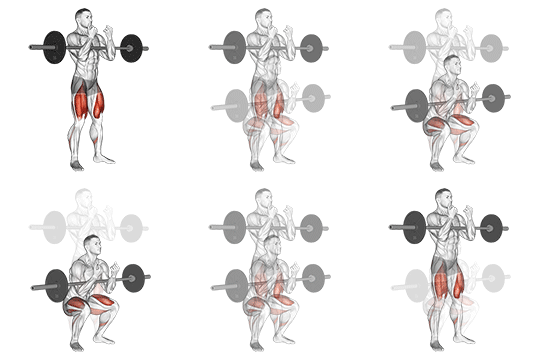
How to Do a Barbell Back Squat
Set the rack: position the J-hooks so the bar sits slightly below your standing shoulder height, then load the bar evenly and set safety arms or pins when available.
Create a secure bar position: step under the bar and place it across the muscular upper back rather than directly on the neck. Use a high-bar or low-bar position that you can hold securely and repeatably.
Unrack with control: brace the trunk, stand the bar up using both legs, then take only the steps needed to clear the rack and establish your stance.
Set your stance: use roughly shoulder-width as a starting point, then adjust stance width and toe angle to your hip structure, ankle mobility, and comfort.
Brace before descending: take a breath, create circumferential trunk tension, keep the bar balanced over your base of support, and begin bending the hips and knees together.
Squat through your controlled range: let the knees track in the same general direction as the toes while the hips descend between the legs. Use the deepest range you can control without losing balance or bar position.
Drive the floor away: reverse the movement by extending the knees and hips together while maintaining whole-foot pressure and keeping the bar path controlled.
Finish and reset: stand tall with the hips and knees extended, take another breath if needed, and repeat while preserving the same stance, brace, and bar position.
Form Check & Technique
DO THIS (Technique Tips)
- Set safeties before heavy work.
- Bar on the upper-back shelf, not the neck.
- Brace before every rep.
- Keep pressure through the whole foot.
- Let knees track with the toes.
- Use a stance that fits your anatomy.
- Keep the bar balanced over your base of support.
- Drive hips and chest up together.
AVOID THIS (Common Mistakes)
- Bar Resting on the Neck — Fix: create a secure shelf on the muscular upper back rather than loading the cervical spine directly.
- Walking Too Far From the Rack — Fix: use only enough steps to clear the hooks and establish your stance.
- Losing Whole-Foot Pressure — Fix: keep heel, big-toe side, and little-toe side connected to the floor.
- Knees Collapsing Inward — Fix: reduce the load and keep the knees tracking in a stable direction with the toes.
- Hips Shooting Up First — Fix: maintain balance and coordinate hip and knee extension during the ascent.
- Forcing One Universal Stance — Fix: adjust stance width and toe angle to anatomy, mobility, and comfort.
- Cutting Depth Because the Load Is Too Heavy — Fix: use a load that allows the intended controlled range of motion.
- Relaxing the Trunk at the Bottom — Fix: maintain brace and bar control through the turnaround.
About Barbell Back Squat
The barbell back squat is a compound lower-body strength exercise performed with a barbell supported across the upper back. It trains the quadriceps and gluteus maximus while the adductors, hamstrings, calves, spinal erectors, and trunk musculature contribute to movement and stability. Good back squat form uses a secure bar position, a stance that matches your anatomy, strong trunk bracing, knees that track with the feet, controlled depth, and a balanced drive through the whole foot.
Barbell Back Squat Muscles Worked
The back squat is a multi-joint lower-body exercise rather than a quadriceps-only movement.
- The quadriceps contribute strongly to knee extension, the gluteus maximus and adductor magnus contribute to hip extension, and the hamstrings, calves, spinal erectors, abdominal muscles, and other trunk stabilizers help control the load and body position.
- Muscle demand changes with load, squat depth, stance, bar position, and individual anatomy.
Sets & Reps Guidance
Technique / Learning
Technique: 2–4 sets of 3–5 reps with a manageable load, prioritizing stance, bracing, depth, and rack consistency.
Strength Focus
Strength: 3–5 sets of 3–6 reps using a load that preserves depth, bracing, and a repeatable bar path.
Muscle Growth (Hypertrophy)
Muscle growth: 3–5 sets of 5–10 reps when you can maintain lower-body control and recover appropriately from the larger systemic demand.
General training baseline. Need.fit automatically adjusts exact sets, reps, and working weight based on your individual fitness level, recovery, and progress over time.
Exercise Variations & Alternatives
Front Squat
Moves the bar to the front rack, usually creating a more upright torso and different joint-loading demands.
Goblet Squat
Uses a dumbbell or kettlebell held in front of the torso and is often easier to learn than a barbell back squat.
Bulgarian Split Squat
A rear-foot-elevated unilateral squat pattern that trains one leg at a time.
Leg Press
A machine-based compound leg press that reduces balance and bar-support demands.
Hack Squat
A machine-guided squat variation commonly used for high-volume lower-body training.
Dumbbell Lunge
Learn proper dumbbell lunge form, muscles worked, step length and knee cues, common mistakes, forward vs reverse variations, plus practical sets and reps.
High Bar vs Low Bar Back Squats
High bar squats position the bar across the upper traps, keeping the torso more upright and placing greater emphasis on the quadriceps. Low bar squats rest the bar lower across the rear deltoids, encouraging more forward torso lean and heavier hip/glute recruitment.
Squat Depth and Mobility Guidance
Aim for a depth where the hip crease drops slightly below the top of the knee. Adequate ankle dorsiflexion and hip mobility allow full depth without forcing the lower back to round (butt wink) at the bottom.
Preventing Knee Valgus (Knee Collapse)
Cueing your knees outward over your middle toes engages the gluteus medius and keeps knee joints tracking smoothly during both the descent and drive phases.
Proper Breathing and Bracing Techniques
Inhale deeply into your belly before each rep and create intra-abdominal pressure (the Valsalva maneuver) to support your lumbar spine under heavy loads.
How to Safely Fail a Squat in a Power Rack
Set safety pins at chest height in the rack. If you cannot complete a rep, lower the bar onto the safety pins under control rather than twisting or jumping out from under the weight.
Sources & References
- [1]
- [2]Muscle Activation in the Loaded Free Barbell Squat: A Brief Review — PubMed (PMID: 22373894)View Source
- [3]A Biomechanical Comparison of Back and Front Squats in Healthy Trained Individuals — PubMed (PMID: 19002072)View Source
- [4]Effect of External Load on Muscle Activation During the Barbell Back Squat — PubMed (PMID: 35603722)View Source