
Burpee
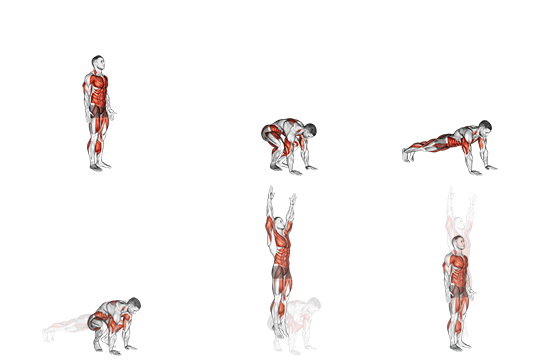
How to Do a Burpee
Start standing: use a comfortable stance and brace before moving quickly.
Lower to the floor: bend the knees and hips and place both hands on the floor around shoulder width.
Move to plank: jump or step the feet back until the body reaches a stable high-plank position.
Use your chosen burpee style: perform a controlled push-up or chest-to-floor phase if your version includes it; otherwise maintain the plank briefly.
Bring the feet forward: jump or step them back toward the hands into a stable crouch.
Stand and jump: extend the hips and knees and leave the floor in a controlled vertical jump if using the full version.
Land softly and repeat: absorb the landing through the feet, knees, and hips before starting the next repetition.
Form Check & Technique
DO THIS (Technique Tips)
- Move smoothly through each phase.
- Use step-backs if needed.
- Keep the plank stable.
- Push-up depth is scalable.
- Return the feet to a stable stance.
- Use a repeatable jump.
- Land softly.
- Stop when coordination breaks down.
AVOID THIS (Common Mistakes)
- Hips Sagging in the Plank — Fix: brace and shorten the set or use an incline.
- Hands Landing Too Far Forward — Fix: place them around shoulder width under a stable shoulder position.
- Feet Landing Narrow and Unstable — Fix: return them to a stance that lets you stand comfortably.
- Chest Dropping Without Control — Fix: use a push-up depth you can manage or omit it temporarily.
- Maximal Jump Every Rep — Fix: use a repeatable jump height for conditioning sets.
- Hard, Noisy Landings — Fix: absorb the landing through the ankles, knees, and hips.
- Speed Before Technique — Fix: learn the sequence slowly first.
About Burpee
The burpee is a full-body bodyweight conditioning exercise that moves between standing, a crouch, a plank position, and a jump. Many standard burpee versions also include a push-up or chest-to-floor phase, while easier half burpees omit it. The movement challenges the legs, chest, shoulders, triceps, core, and cardiovascular system. Good burpee form prioritizes stable hand placement, a controlled plank, efficient foot return, and a landing you can repeat safely instead of racing through sloppy repetitions.
Burpee Muscles Worked
Burpees spread work across the whole body.
- The crouch and jump use the legs and glutes, the plank and optional push-up use the chest, shoulders, triceps, and core, and repeated transitions create a large cardiovascular demand.
- Research comparing common exercises found bodyweight burpee protocols produced high acute oxygen consumption relative to several traditional resistance exercises.
Sets & Reps Guidance
Technique / Learning
Technique: 2–4 sets of 3–5 step-back or half burpees while learning the sequence.
Strength Focus
Power / skill: 3–5 sets of 3–6 crisp burpees with full recovery and a controlled jump.
Muscle Growth (Hypertrophy)
Conditioning: 4–8 rounds of 20–45 seconds or 5–12 reps at a sustainable pace.
General training baseline. Need.fit automatically adjusts exact sets, reps, and working weight based on your individual fitness level, recovery, and progress over time.
Exercise Variations & Alternatives
Mountain Climber
A plank-based conditioning exercise with less transition between floor and standing.
Kettlebell Swing
A loaded ballistic hinge for posterior-chain power and conditioning.
Thruster
A loaded squat-to-overhead conditioning and strength exercise.
Plank
A static core exercise useful for building the plank position used inside burpees.
Tricep Pushdown
Learn tricep pushdown form, muscles worked, cable and bar setup, elbow and wrist cues, common mistakes, attachment differences, variations, sets and reps.
Close-Grip Bench Press
Learn close-grip bench press form, muscles worked, grip width, elbow and bar-path cues, common mistakes, standard-bench differences, variations, sets and reps.
Does a Burpee Include a Push-Up?
Burpee definitions vary.
- A common full burpee includes a chest-to-floor or push-up phase, while half burpees and beginner versions move from plank directly back to the feet.
- Need.fit treats both as valid variations and specifies the version in programming.
Burpee vs Half Burpee
Half burpees remove the push-up or chest-to-floor portion and are easier to repeat. They reduce upper-body fatigue while keeping the crouch-to-plank and jump transitions.
Step-Back vs Jump-Back Burpees
Stepping the feet back reduces impact and speed, making the exercise easier for beginners. Jumping back increases pace and conditioning demand.
Burpees for Cardio and Conditioning
Burpees use large muscle groups and repeated whole-body transitions. Research has shown high acute oxygen consumption during bodyweight burpee protocols, supporting their use as a demanding conditioning movement.
How to Land a Burpee Jump
Land with the feet under control and allow the ankles, knees, and hips to absorb force. You do not need a maximal-height jump on every conditioning repetition.
Burpee vs Mountain Climber
Mountain climbers stay in a plank while alternating knee drives. Burpees repeatedly move between the floor and standing and usually include a jump, creating greater whole-body transition demand.
Beginner Burpee Progressions
Use an elevated surface, step the feet back and forward, omit the push-up, and replace the jump with a stand. Add components only as control improves.
Burpee Benefits
Burpees require no equipment, train multiple movement patterns, and create a strong conditioning stimulus in limited space. They are easy to scale by changing speed, push-up depth, jump height, or step pattern.
Sources & References
- [1]
- [2]
- [3]
- [4]Comparison of the Acute Metabolic Responses to Traditional Resistance, Body-Weight, and Battling Rope Exercises — PubMed (PMID: 24942174)View Source