
Rowing Machine
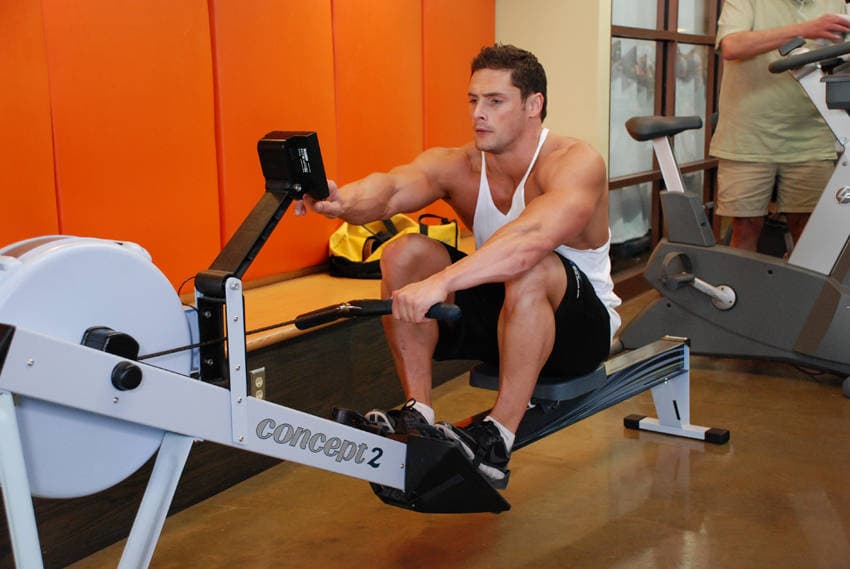
How to Use a Rowing Machine With Proper Form
Set the foot position: secure the straps across the feet so you can push the footplates firmly without the heels or shoes feeling trapped.
Build the catch: sit tall with arms straight, shoulders relaxed, torso leaning slightly forward from the hips, and shins vertical or as close to vertical as is comfortable.
Start with the legs: press the footplates away while keeping the arms long and the trunk braced. The seat and handle should begin moving together rather than the hips shooting back alone.
Open the torso after the leg drive is underway: as the legs approach extension, swing the torso through vertical into a small comfortable layback.
Finish with the arms: pull the handle smoothly toward the lower ribs with elbows moving behind the torso and wrists staying relaxed.
Recover in reverse order: extend the arms first, hinge the torso forward from the hips, then bend the knees and slide toward the catch.
Keep the handle path smooth: let the hands travel in a relatively straight line to and from the flywheel instead of lifting over the knees.
Use the recovery to reset: spend more time returning to the catch than driving away from it so each stroke begins controlled rather than rushed.
Form Check & Technique
DO THIS (Technique Tips)
- Legs first on the drive.
- Body opens after the leg drive begins.
- Arms finish last.
- Recover arms, body, then legs.
- Keep wrists and grip relaxed.
- Do not over-compress at the catch.
- Treat damper setting as feel, not a weight stack.
- Use a slower recovery than drive.
AVOID THIS (Common Mistakes)
- Pulling With the Arms First — Fix: initiate the drive by pressing the footplates with the legs.
- Hips Shooting Back Before the Handle — Fix: let the seat and handle begin moving together.
- Swinging the Back Too Early — Fix: delay the torso opening until the leg drive is underway.
- Bending the Knees Too Early on Recovery — Fix: hands away, body forward, then knees bend.
- Over-Compressing at the Catch — Fix: stop around vertical shins or your comfortable controlled limit.
- Extreme Layback at the Finish — Fix: use a small, supported lean rather than reclining far backward.
- Setting the Damper to 10 Because It Seems Harder — Fix: learn technique at a moderate setting and use drag factor when you need repeatable machine feel.
- Rushing the Recovery — Fix: slow the slide and allow the drive to be the faster phase.
About Rowing Machine
The rowing machine, or indoor rower/ergometer, is a full-body cardiovascular exercise that combines a powerful lower-body drive with a controlled hip swing and horizontal arm pull. The quadriceps and glutes contribute strongly to the drive while the hamstrings, calves, back, biceps, shoulders, and trunk work across different phases of the stroke. Efficient rowing machine form follows a clear sequence: at the catch, brace with the arms long; on the drive, push with the legs before opening the torso and finishing with the arms; on recovery, send the hands away, hinge forward, then bend the knees and slide smoothly back to the catch.
Rowing Machine Muscles Worked
Indoor rowing is a coordinated whole-body movement rather than an arm-only pull.
- The quadriceps and other leg muscles initiate the drive, the glutes and trunk contribute as the hips open, and the lats, upper back, and biceps finish the handle pull.
- EMG studies of rowing ergometry show activity across both lower- and upper-body muscle groups, and recruitment changes with rowing intensity and phase of the stroke.
Sets & Reps Guidance
Technique / Learning
Beginner technique: 2–3 blocks of 5–10 minutes at easy effort, emphasizing catch position, legs-body-arms drive sequence, and arms-body-legs recovery.
Strength Focus
Power / interval work: 4–8 rounds of 30 seconds to 2 minutes at a hard sustainable pace with enough easy rowing or rest to preserve stroke sequence.
Muscle Growth (Hypertrophy)
Aerobic conditioning: 15–40 minutes of steady rowing at a conversational-to-moderate effort and a stroke rate that allows deliberate leg drive and recovery rhythm.
General training baseline. Need.fit automatically adjusts exact sets, reps, and working weight based on your individual fitness level, recovery, and progress over time.
Exercise Variations & Alternatives
Running
A weight-bearing locomotion exercise with repeated ground contact and no upper-body pulling phase.
Jump Rope
A portable plyometric cardio exercise emphasizing coordination and repeated low hops.
Kettlebell Swing
A ballistic hip-hinge exercise that develops lower-body power and conditioning.
Burpee
A full-body bodyweight conditioning exercise involving floor transitions and jumping.
Barbell Back Squat
Learn barbell back squat form, muscles worked, rack setup, stance, bracing, squat depth, common mistakes, variations, and practical sets and reps.
Goblet Squat
Learn proper goblet squat form, muscles worked, dumbbell or kettlebell setup, stance and depth cues, common mistakes, variations, and sets and reps.
Rowing Stroke Order: Legs, Body, Arms
The drive starts with the legs.
- Once the legs have generated force and are nearing extension, the torso opens slightly and the arms finish the stroke.
- Pulling with the arms first or swinging the back before the legs reduces efficiency.
Recovery Order: Arms, Body, Legs
The recovery reverses the drive.
- Send the hands away first, hinge the torso forward, then bend the knees and slide toward the catch.
- Early knee bend forces the hands to travel around the knees and disrupts rhythm.
How Far Forward Should You Slide at the Catch?
Aim for vertical shins or as close to vertical as is comfortable without over-compressing. Sliding so far forward that the shins pass substantially beyond vertical can weaken the starting position and make the drive less effective.
Damper Setting vs Drag Factor
The damper lever changes airflow and the feel of the flywheel; it is not a simple weight or resistance setting.
- Concept2 recommends many beginners start around damper 3–5 while learning technique.
- Drag factor is the better measure for comparing how different machines actually feel because dust, altitude, temperature, and machine condition can change the relationship between the lever number and flywheel drag.
Does a Higher Stroke Rate Mean More Intensity?
Not necessarily.
- You can produce more power at the same stroke rate by driving harder with the legs and accelerating the handle.
- Stroke rate and intensity are related but separate variables, so avoid simply rushing the slide to make the number higher.
Drive-to-Recovery Rhythm
A useful general rhythm is to make the recovery longer than the drive. Concept2 commonly teaches about a 1:2 drive-to-recovery ratio for efficient rowing: accelerate during the work phase, then relax and control the return.
Rowing Machine vs Running
Rowing is seated and does not use the repeated running landing phase, so it is often considered a lower-impact cardio option.
- It is not literally 'zero joint load': the knees, hips, spine, and shoulders still move and produce force.
- Running is weight-bearing locomotion, while rowing distributes work across the legs, trunk, and upper body.
Beginner Rowing Workouts
Beginners should first practice sequencing at an easy stroke rate. Short technique rows of 5–10 minutes, easy continuous rows, or brief intervals with generous recovery are better starting points than immediately attempting all-out 500-meter repeats.
Sources & References
- [1]
- [2]
- [3]
- [4]
- [5]
- [6]Cardio-respiratory and Electromyographic Responses to Ergometer and On-water Rowing in Elite Rowers — PubMed (PMID: 23179206)View Source
- [7]Differences in Muscle Activation Between Submaximal and Maximal 6-Minute Rowing Tests — PubMed (PMID: 21747297)View Source