Goblet Squat
How to Do a Goblet Squat
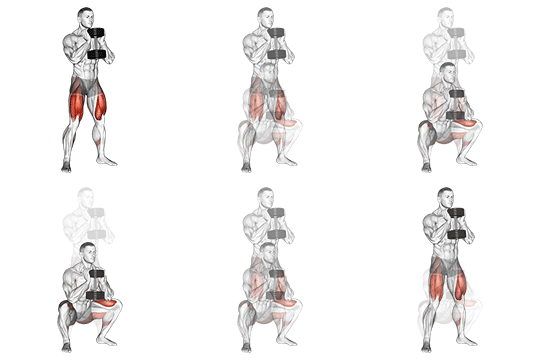
Choose and hold the weight: hold a dumbbell vertically against the chest with both hands around one end, or hold a kettlebell by the horns. Keep the load close instead of letting it drift forward.
Set your stance: begin around shoulder width or slightly wider with a comfortable toe angle. Stance width and toe angle should match your hip structure, ankle mobility, and comfort rather than one fixed rule.
Brace and establish balance: keep the rib cage and pelvis controlled, create trunk tension, and maintain pressure through the heel, big-toe side, and little-toe side of each foot.
Descend by bending the hips and knees together: sit down between the legs while keeping the weight close to the chest. Let the knees track in the same general direction as the toes.
Use a controlled depth: lower until you reach the deepest range you can maintain without the heels lifting, the knees collapsing inward, or the torso losing control. Parallel is a useful checkpoint, but deeper can be appropriate when mobility and control allow it.
Drive through the whole foot: extend the knees and hips together to stand while keeping the dumbbell or kettlebell close to the torso.
Finish tall and repeat: return to a stable standing position without leaning backward, then reset your breath and brace before the next repetition.
Form Check & Technique
DO THIS (Technique Tips)
- Keep the dumbbell or kettlebell close to your chest.
- Brace before each repetition.
- Maintain heel, big-toe, and little-toe contact.
- Use a toe angle that feels natural.
- Let the knees track with the toes.
- Squat between your feet instead of only pushing the hips backward.
- Use controlled depth rather than forcing range of motion.
- Progress load only while the same technique remains repeatable.
AVOID THIS (Common Mistakes)
- Holding the Weight Away From the Chest — Fix: keep the load close so the arms and upper back do not fatigue before the legs.
- Heels Lifting — Fix: adjust stance, footwear, ankle range, load, or depth until the whole foot stays connected to the floor.
- Knees Collapsing Inward — Fix: reduce the load and let the knees track in a stable direction with the toes.
- Forcing an Extremely Wide Stance — Fix: use a stance that matches your anatomy rather than chasing one universal position.
- Dropping Too Fast Into the Bottom — Fix: control the descent and maintain tension through the turnaround.
- Rounding to Reach More Depth — Fix: stop at the deepest position you can control without losing trunk position.
- Letting the Weight Pull the Torso Forward — Fix: keep the load close and maintain whole-foot pressure.
About Goblet Squat
The goblet squat is a compound lower-body squat performed while holding a dumbbell or kettlebell close to the chest. It primarily trains the quadriceps and glutes while the adductors, hamstrings, core, calves, and upper back help control the movement. Because the load is held in front of the body, the goblet squat is often easier to learn than a barbell back squat and can help lifters practice an upright, balanced squat pattern before progressing to heavier variations.
Goblet Squat Muscles Worked
The goblet squat trains the quadriceps through knee extension and the gluteus maximus through hip extension.
- The adductors and hamstrings assist with lower-body control, while the abdominals, obliques, calves, and upper-back musculature help stabilize the torso and front-held load.
- Muscle demand changes with depth, stance, load, and individual anatomy.
Sets & Reps Guidance
Technique / Learning
Technique: 2–3 sets of 8–12 reps with a light dumbbell, kettlebell, or bodyweight while practicing stance, depth, and knee tracking.
Strength Focus
Strength-focused work: 3–5 sets of 5–8 reps using the heaviest load you can hold securely while maintaining squat depth and whole-foot pressure.
Muscle Growth (Hypertrophy)
Muscle growth: 3–4 sets of 8–15 reps using a controlled tempo and a load that keeps the legs as the main limiting factor.
General training baseline. Need.fit automatically adjusts exact sets, reps, and working weight based on your individual fitness level, recovery, and progress over time.
Exercise Variations & Alternatives
Barbell Back Squat
A back-loaded squat that allows heavier progressive loading and greater whole-body strength demands.
Front Squat
A barbell front-loaded squat that keeps the load close to the body's front and challenges the upper back and front rack.
Bulgarian Split Squat
A rear-foot-elevated unilateral squat that trains one leg at a time.
Dumbbell Lunge
A dynamic unilateral lower-body exercise that adds stepping and balance demands.
Leg Press
A machine-based compound leg exercise with lower balance and load-holding demands.
Leg Extension
Learn proper leg extension form, muscles worked, machine setup and knee cues, common mistakes, knee-safety context, variations, and practical sets and reps.
Why Is the Goblet Squat Good for Beginners?
Holding the load in front of the torso acts as a counterbalance and often makes it easier to learn squat depth, whole-foot pressure, and an upright torso compared with a back-loaded barbell squat. It is still a strength exercise, so beginners should start with a load they can control and progress gradually.
How Wide Should Your Goblet Squat Stance Be?
Start near shoulder width and adjust from there.
- Hip structure, femur length, ankle mobility, footwear, and comfort all influence the stance that feels strongest.
- Toe angle is also individual.
- The goal is stable feet, controlled knees, and a repeatable path rather than forcing a universal stance.
Can Your Knees Go Past Your Toes in a Goblet Squat?
Yes.
- Some forward knee travel is normal and can be necessary for an upright squat, especially for people with longer femurs or a narrower stance.
- Focus on keeping the whole foot planted and the knees tracking in a stable direction with the toes rather than trying to keep the knees behind an imaginary line.
How Deep Should You Goblet Squat?
Use the deepest range you can control while maintaining foot pressure, balance, and trunk position.
- Thighs around parallel with the floor are a useful reference, but deeper squats can be appropriate when mobility and technique allow them.
- Do not force depth by letting the heels rise or the pelvis lose control.
Goblet Squat vs Barbell Back Squat
The goblet squat holds the load in front of the torso and is usually limited by how much weight you can comfortably hold.
- The barbell back squat places the load across the upper back and allows much heavier progressive loading.
- Goblet squats are excellent for learning, warm-ups, accessory work, and moderate-load leg training, while back squats are often chosen when maximal loading potential is important.
Dumbbell Goblet Squat vs Kettlebell Goblet Squat
Both versions use the same basic squat pattern.
- A kettlebell can be held by the horns, while a dumbbell is commonly held vertically by one end.
- The better option is whichever implement lets you keep the load close to the chest with comfortable wrists and a stable squat.
How to Progress the Goblet Squat
Begin with bodyweight or a light load, then increase repetitions, range of motion, tempo control, or external weight while preserving technique. When the legs are stronger than the amount of weight you can comfortably hold at the chest, progress to front squats, back squats, split squats, or machine-based leg exercises.
Goblet Squat Benefits
Goblet squats train a foundational squat pattern, build lower-body strength, challenge trunk control, and require minimal equipment. They can be used in beginner programs, warm-ups, full-body sessions, leg workouts, and higher-repetition accessory work.
Sources & References
- [1]
- [2]
- [3]Differences in Muscle Activity and Kinetics Between the Goblet Squat and Landmine Squat in Men and Women — PubMed (PMID: 34341315)View Source
- [4]A Biomechanical Review of the Squat Exercise: Implications for Clinical Practice — PubMed / PMC (PMID: 38576836)View Source