
Rear Delt Fly
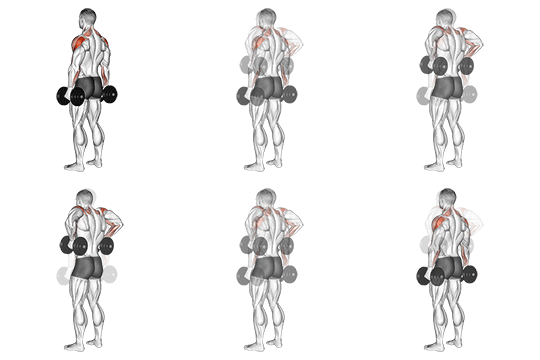
How to Do a Rear Delt Fly
Choose Light-to-Moderate Dumbbells: Select light dumbbells that allow complete control over the outward arm path without using torso momentum.
Hinge Into Position: Stand with feet shoulder-width apart, push your hips back, and incline your torso forward to roughly 45 degrees or lower.
Set the Arms: Let the dumbbells hang beneath your shoulders with a soft, fixed elbow bend and palms facing each other (neutral grip).
Raise the Upper Arms Outward: Initiate the rep by driving your upper arms outward away from your torso through horizontal shoulder abduction.
Keep Scapular Movement Controlled: Allow natural scapular movement without forcing an extreme shoulder-blade squeeze that turns the fly into a row.
Stop at a Controlled End Position: Pause briefly when your upper arms reach parallel with your torso or alignment with your shoulders.
Lower Slowly: Lower the dumbbells back under full muscular control while holding your hinge stable before the next repetition.
Form Check & Technique
DO THIS (Technique Tips)
- Select light to moderate dumbbells.
- Hinge torso forward at hips.
- Maintain fixed, soft elbow bend.
- Drive upper arms outward to sides.
- Keep neck relaxed and traps down.
- Lower under control over 2 seconds.
- Avoid swinging or bobbing torso.
- Balance with pressing and lateral work.
AVOID THIS (Common Mistakes)
- Using too much weight — Fix: Reduce load to keep the focus strictly on rear-shoulder abduction.
- Turning it into a row — Fix: Maintain a fixed, soft elbow bend rather than bending elbows to 90 degrees.
- Shrugging aggressively — Fix: Keep your neck relaxed and upper traps quiet during the raise.
- Over-squeezing shoulder blades — Fix: Focus on moving your upper arms outward rather than pinching your shoulder blades.
- Changing torso angle throughout — Fix: Maintain a steady hip hinge without bobbing up and down.
- Using momentum — Fix: Control both the upward raise and 2-second downward return.
- Raising far beyond controllable range — Fix: Stop when your upper arms align with your torso.
- Forcing one hand rotation — Fix: Use a neutral or pronated grip that feels comfortable for your shoulders.
About Rear Delt Fly
The rear delt fly is a foundational shoulder horizontal-abduction exercise that primarily trains the posterior deltoid while upper-back and rotator-cuff muscles assist in joint stabilization. In the bent-over dumbbell version, the objective is to move the upper arms outward under strict control without turning the exercise into a heavy row or forcing an exaggerated shoulder-blade squeeze. Performing the rear delt fly with proper technical execution balances front-to-back shoulder development and supports complete upper-body posture across structured training routines.
Muscles Worked by the Rear Delt Fly
The rear delt fly isolates horizontal shoulder abduction to target the posterior (rear) head of the deltoid.
- The infraspinatus and teres minor assist with upper-arm stabilization and external rotation support during the raise.
- The middle trapezius and rhomboids assist with scapular control across the upper back, while the erector spinae hold the static hip-hinge posture throughout every set.
Sets & Reps Guidance
Technique / Learning
General accessory: 2–4 sets of 10–20 reps with light controlled dumbbells.
Strength Focus
Higher-rep volume: 2–4 sets of 12–25 reps focusing on deep rear-delt burn and pump.
Muscle Growth (Hypertrophy)
Strict isolation: 3–4 sets of 12–15 reps taken near technical failure.
General training baseline. Need.fit automatically adjusts exact sets, reps, and working weight based on your individual fitness level, recovery, and progress over time.
Exercise Variations & Alternatives
Lateral Raise
Shoulder abduction for side delts.
Barbell Bent-Over Row
Compound horizontal pulling exercise.
Overhead Press
Learn proper overhead press form, muscles worked, grip and bar-path cues, bracing, lockout, common mistakes, and practical sets and reps.
Dumbbell Shoulder Press
Learn dumbbell shoulder press form, muscles worked, seated setup, grip, elbow path and range-of-motion cues, mistakes, and practical sets and reps.
Arnold Press
Learn Arnold press form, muscles worked, dumbbell rotation and elbow-path cues, seated vs standing setup, common mistakes, and practical sets and reps.
Front Raise
Learn proper dumbbell front raise form, muscles worked, grip and arm-path cues, how high to raise, common mistakes, variations, and sets and reps.
How Far Should You Hinge?
Hinge forward at the hips until your torso is positioned between 45 degrees and parallel to the floor. A deeper hinge aligns the arm path directly perpendicular to gravity, maximizing mechanical tension on the posterior deltoid throughout the movement.
Where Should Your Arms Travel?
Raise your upper arms outward in line with your shoulders or slightly lower toward your middle back. Avoid pulling the dumbbells back toward your hips, which shifts tension off the rear delt and onto the broad lats.
Should You Squeeze Your Shoulder Blades Together?
Normal scapular motion is a natural, necessary part of healthy shoulder movement. For a rear-delt-focused fly, keep scapular movement controlled so horizontal movement of the upper arm remains the primary action rather than converting the exercise into a heavy upper-back row.
Neutral vs Pronated Hand Position
A neutral grip (palms facing each other) is comfortable for most lifters and supports clean horizontal abduction. A pronated grip (palms facing backward) slightly changes external rotator recruitment; choose the grip that allows the smoothest arm path without shoulder pinching.
How Much Should You Bend Your Elbows?
Maintain a fixed, soft bend in your elbows (around 15 to 30 degrees) throughout the entire set. Bending your elbows too much turns the movement into a row, while locking them completely straight increases joint lever strain on the elbows and shoulders.
Seated vs Standing Rear Delt Fly
Seated bent-over rear delt flies (sitting on the edge of a flat bench) take leg fatigue out of the exercise and prevent torso swinging. Standing bent-over flies require greater hamstring, glute, and lower-back static stability.
Rear Delt Fly vs Rear Delt Row
Rear delt flies use a fixed elbow bend to isolate horizontal shoulder abduction. Rear delt rows bend and extend the elbows dynamically, allowing heavier weight capacity through combined arm and scapular pulling mechanics.
Dumbbell Rear Delt Fly vs Reverse Pec Deck
Dumbbell rear delt flies require free-weight core and posture stabilization with peak resistance occurring near the top of the raise. Reverse pec deck machines guide the arm path along a fixed track with continuous tension from start to finish.
Sources & References
- [1]Effect of Hand Position on EMG Activity of the Posterior Deltoid and Infraspinatus During Reverse Fly — PubMed (PMID: 23302754)View Source
- [2]
- [3]Surface EMG Analysis of Upper Back and Rear Shoulder Musculature — PubMed (PMID: 28011412)View Source
- [4]Electromyographic Activity in Posterior Shoulder Resistance Exercises — PubMed (PMID: 32107499)View Source
- [5]
- [6]Spine Loading and Erector Spinae Activation in Bent-Over Exercises — PubMed (PMID: 31775556)View Source
- [7]Joint Mechanics and Controlled Eccentric Lowering in Rear Shoulder Work — PubMed (PMID: 34875981)View Source