
Arnold Press
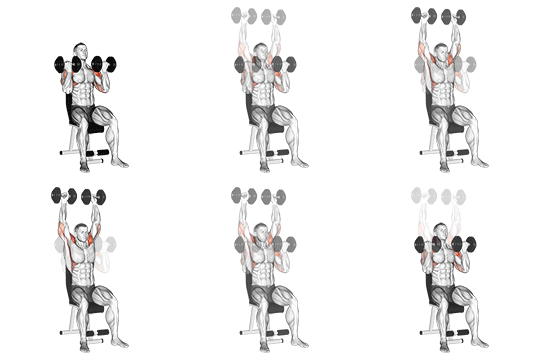
How to Do an Arnold Press
Set the Bench and Dumbbells: Sit on an upright bench with your back supported and bring two dumbbells up to shoulder height.
Start With Palms Facing You: Hold the dumbbells in front of your chest with palms facing your body and elbows positioned forward directly underneath the weights.
Brace the Torso: Keep your abdominal core braced and back supported against the bench without initiating the movement by leaning backward.
Open the Elbows as You Press: Begin pressing the dumbbells upward while smoothly opening your elbows out to the sides.
Rotate Gradually: Turn your forearms continuously as the dumbbells ascend so your palms face forward by the time the weights pass your head.
Finish Overhead: Reach full extended lockout overhead with palms facing forward without slamming the dumbbells together.
Reverse the Path: Lower the dumbbells smoothly while rotating forearms back to the palms-in starting position before starting the next rep.
Form Check & Technique
DO THIS (Technique Tips)
- Start palms-in with elbows forward.
- Brace core against bench backrest.
- Press up while opening elbows outward.
- Rotate forearms smoothly during ascent.
- Finish with palms facing forward overhead.
- Avoid slamming dumbbells together.
- Reverse rotation smoothly on descent.
- Maintain controlled fluid motion.
AVOID THIS (Common Mistakes)
- Treating rotation as a wrist-only twist — Fix: Rotate your forearms continuously as part of the full arm pressing path.
- Starting with dumbbells too low — Fix: Begin with dumbbells held stably at upper chest height.
- Elbows drifting unpredictably — Fix: Keep elbow opening coordinated with the upward press.
- Using excessive load — Fix: Choose a manageable weight that allows smooth, controlled rotation.
- Leaning far backward — Fix: Keep your core braced and torso supported against the bench.
- Snapping into end-range rotation — Fix: Maintain continuous, fluid movement throughout the ascent.
- Clanging dumbbells overhead — Fix: Finish lockout with dumbbells parallel without impact.
- Assuming more rotation is always better — Fix: Use only the natural rotational range your shoulder joints control comfortably.
About Arnold Press
The Arnold Press is a dumbbell overhead press that begins with the palms facing toward the body and the elbows positioned forward, then combines upward pressing with gradual arm rotation. It primarily trains the anterior deltoid, with substantial lateral-delt and triceps contribution, while the rotating path changes shoulder and elbow position throughout the repetition.
Muscles Worked by the Arnold Press
The Arnold Press engages the shoulder complex through an extended rotational arc.
- The anterior deltoid is the main driver during initial shoulder flexion and overhead pressing, while the lateral deltoid is heavily recruited as the elbows abduct outward.
- The triceps brachii extend the elbows at lockout, and the supraspinatus and rotator cuff muscles stabilize the humeral head throughout the rotating trajectory.
Sets & Reps Guidance
Technique / Learning
General shoulder work: 2–4 sets of 6–12 reps with controlled moderate weight.
Strength Focus
Higher-rep accessory: 2–4 sets of 10–15 reps focusing on rotational control and time under tension.
Muscle Growth (Hypertrophy)
Technique focus: 2–3 light sets mastering the fluid rotation path.
General training baseline. Need.fit automatically adjusts exact sets, reps, and working weight based on your individual fitness level, recovery, and progress over time.
Exercise Variations & Alternatives
Dumbbell Shoulder Press
Standard non-rotating dumbbell shoulder press.
Overhead Press
Strict barbell overhead press.
Lateral Raise
Learn lateral raise form, muscles worked, arm path, elbow and hand-position cues, common mistakes, dumbbell variations, and practical sets and reps.
Front Raise
Learn proper dumbbell front raise form, muscles worked, grip and arm-path cues, how high to raise, common mistakes, variations, and sets and reps.
Rear Delt Fly
Learn rear delt fly form, muscles worked, hip-hinge and arm-path cues, scapular movement, seated vs standing options, mistakes, and sets and reps.
Barbell Bench Press
Learn proper barbell bench press form, muscles worked, grip and bar-path cues, common mistakes, and practical sets and reps for strength or muscle.
How Should the Dumbbells Rotate?
The dumbbell rotation should be a gradual, continuous motion synchronized smoothly with the upward press. Avoid snapping or twisting your wrists abruptly at the bottom or top of the repetition, ensuring that the forearm rotation originates naturally from upper-arm rotation in the shoulder joint.
Where Should Your Elbows Start?
Your elbows should start tucked forward in front of your chest directly underneath the dumbbells in a deep flexed rack position. This initial placement creates a longer movement arc and places high initial tension on the anterior deltoid before opening out into shoulder abduction.
When Should Your Palms Turn Forward?
Your palms should gradually turn from facing inward at your chest to facing fully forward by the time the dumbbells reach eye or forehead level. Synchronizing forearm rotation with the midpoint of the ascent maintains continuous muscular loading across the anterior and lateral deltoids.
Does the Arnold Press Work All Three Delts?
The anterior deltoid is the primary target and the lateral deltoid contributes substantially during shoulder abduction. The rotational path does not establish equal training of all three deltoid heads, and the Arnold Press does not serve as a primary rear-delt movement.
Seated vs Standing Arnold Press
Seated Arnold presses allow firm backrest support, isolating the rotational pressing pattern with heavier dumbbells without spinal instability. Standing Arnold presses increase core anti-rotation, glute engagement, and spinal stabilization demands across the entire body.
Arnold Press vs Dumbbell Shoulder Press
Standard dumbbell shoulder presses start with palms facing forward or semi-neutral and press in a fixed vertical path. Arnold presses start palms-in with elbows tucked forward, adding a smooth 180-degree rotation that extends the active range of motion and alters shoulder joint mechanics.
How Much Range of Motion Should You Use?
Lower the dumbbells fully until your forearms touch near your upper chest in the palms-in position. Only shorten range of motion if you experience joint pinching, wrist strain, or shoulder discomfort at the deep starting stretch position.
Does the Arnold Press Train the Rear Delts?
While the posterior deltoid provides minor stabilizing support during upper-arm rotation, its overall contribution is minimal compared to dedicated horizontal pulling, face pulls, or rear-delt fly exercises.
Sources & References
- [1]Electromyographic Comparison of Arnold Press vs. Standard Dumbbell Shoulder Press — PubMed (PMID: 33312291)View Source
- [2]
- [3]Surface EMG Analysis of Upper Body Musculature in Rotational Pressing — PubMed (PMID: 28011412)View Source
- [4]
- [5]
- [6]
- [7]