
Front Raise
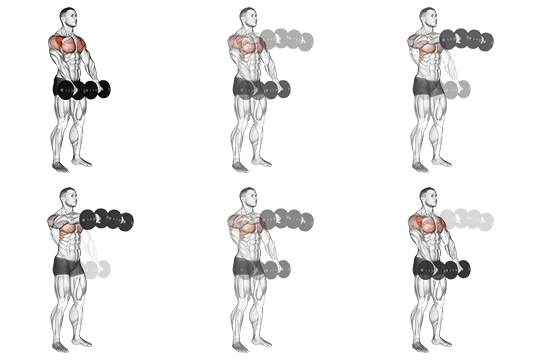
How to Do a Front Raise
Choose a Manageable Load: Select light to moderate dumbbells that allow you to raise and lower the weights with complete muscular control without swinging your body.
Set the Starting Position: Stand tall with feet shoulder-width apart, holding dumbbells in front of or beside your thighs using a pronated (palms down) or neutral grip.
Brace the Torso: Engage your abdominal core and glutes to maintain a stable, vertical spine, avoiding leaning backward as you initiate the movement.
Raise the Dumbbells Forward: Lift the dumbbells forward through shoulder flexion, maintaining a soft, fixed bend in your elbows throughout the ascent.
Keep the Arm Path Controlled: Guide the dumbbells straight forward or slightly converging toward shoulder width, avoiding excessive outward flare.
Stop at a Repeatable Height: Pause briefly around shoulder height (90 degrees of shoulder flexion) where tension on the anterior deltoid is highest.
Lower Under Control: Lower the dumbbells smoothly back to the starting position over a 2-second eccentric descent before repeating.
Form Check & Technique
DO THIS (Technique Tips)
- Select light to moderate dumbbells.
- Maintain soft, fixed elbow bend.
- Raise dumbbells forward to shoulder height.
- Brace core to prevent back arching.
- Lower weights under control over 2 seconds.
- Choose comfortable pronated or neutral grip.
- Avoid body swinging or leg drive.
- Balance volume with existing pressing work.
AVOID THIS (Common Mistakes)
- Swinging the torso — Fix: Reduce weight and brace your abdominals tightly.
- Using momentum from knees/hips — Fix: Keep your lower body completely still during the raise.
- Raising much higher by shrugging — Fix: Stop at shoulder height and keep upper traps relaxed.
- Changing elbow angle throughout the rep — Fix: Maintain a small, fixed elbow bend from start to finish.
- Using excessive weight — Fix: Choose light to moderate dumbbells to prioritize strict shoulder flexion.
- Letting the dumbbells fall — Fix: Lower the weights under full control over 2 seconds.
- Assuming palms-down is mandatory — Fix: Use a neutral or semi-neutral grip if shoulder comfort requires it.
- Adding front raises despite excessive overlapping press volume — Fix: Program total front-delt volume intentionally alongside pressing.
About Front Raise
The front raise is a targeted shoulder-flexion exercise performed by lifting a dumbbell forward from the thighs to shoulder level, primarily challenging the anterior deltoid. Maintaining a controlled vertical torso, manageable load, and repeatable arm path matters more than swinging heavy dumbbells or forcing an unnatural wrist angle. When performed with deliberate control, the front raise strengthens the front head of the shoulder complex and reinforces shoulder flexion stability across training programs.
Muscles Worked by the Front Raise
The front raise isolates shoulder flexion to target the anterior (front) head of the deltoid.
- The clavicular head of the pectoralis major assists during the early portion of the forward raise, while the supraspinatus helps initiate arm elevation in the scapular plane.
- The upper trapezius and serratus anterior stabilize the shoulder girdle, and the forearm flexors maintain grip security throughout the lift.
Sets & Reps Guidance
Technique / Learning
General accessory: 2–4 sets of 8–15 reps with controlled light-to-moderate dumbbells.
Strength Focus
Higher-rep volume: 2–4 sets of 12–20 reps focusing on strict front-delt pump and tension.
Muscle Growth (Hypertrophy)
Technique focus: 2–3 light sets mastering smooth forward shoulder flexion.
General training baseline. Need.fit automatically adjusts exact sets, reps, and working weight based on your individual fitness level, recovery, and progress over time.
Exercise Variations & Alternatives
Overhead Press
Compound barbell vertical press.
Lateral Raise
Shoulder abduction for side delts.
Dumbbell Shoulder Press
Learn dumbbell shoulder press form, muscles worked, seated setup, grip, elbow path and range-of-motion cues, mistakes, and practical sets and reps.
Arnold Press
Learn Arnold press form, muscles worked, dumbbell rotation and elbow-path cues, seated vs standing setup, common mistakes, and practical sets and reps.
Rear Delt Fly
Learn rear delt fly form, muscles worked, hip-hinge and arm-path cues, scapular movement, seated vs standing options, mistakes, and sets and reps.
Barbell Bench Press
Learn proper barbell bench press form, muscles worked, grip and bar-path cues, common mistakes, and practical sets and reps for strength or muscle.
What Muscles Does the Front Raise Work?
The front raise primarily targets the anterior deltoid, which drives forward shoulder flexion.
- Secondary contributors include the upper chest (clavicular pectoralis major), lateral deltoid, supraspinatus, upper trapezius, and serratus anterior.
- While front raises isolate the front shoulder, they do not work the anterior deltoid in total isolation, as upper-body stabilizers co-contract to balance the shoulder joint during execution.
How High Should You Raise the Dumbbells?
Raising the dumbbells to shoulder height (around 90 degrees of arm elevation) is the standard endpoint for deltoid isolation. Raising above shoulder height increases upper-trapezius involvement and reduces mechanical leverage on the anterior deltoid while increasing subacromial compression.
Pronated vs Neutral Grip Front Raise
A pronated (palms facing down) grip is the traditional execution for front raises. A neutral grip (palms facing each other) positions the humerus in a slightly more comfortable rotation for lifters with sensitive shoulder joints, subacromial tightness, or wrist discomfort.
Should Your Elbows Be Bent?
Maintain a soft, stable bend in your elbows (around 10 to 20 degrees) throughout the entire movement. Keeping your elbows fixed prevents joint hyperextension while keeping the moment arm consistent across every repetition without shifting work to the biceps.
Alternating vs Both Arms Together
Alternating front raises allow you to focus on one arm at a time, reducing core fatigue and allowing subtle postural stabilization adjustments. Raising both dumbbells simultaneously increases core stabilization demands and speeds up set duration for efficient conditioning.
Do You Need Front Raises If You Already Shoulder Press?
Heavy overhead pressing and incline bench pressing already place high training demands on the anterior deltoid. Front raises provide direct isolation volume, but they are not mandatory for every lifter who already performs heavy compound pressing routines.
Front Raise vs Lateral Raise
Front raises lift the arms forward in the sagittal plane to target the anterior deltoid. Lateral raises lift the arms outward in the frontal/scapular plane to target the lateral deltoid, shaping the outer shoulder width.
Dumbbell vs Cable Front Raise
Dumbbell front raises provide peak tension near the top horizontal position due to gravity's moment arm. Cable front raises maintain continuous loading from the bottom stretch position all the way up to shoulder height.
Sources & References
- [1]Electromyographic Analysis of Deltoid Activation Across Shoulder Elevation Exercises — PubMed (PMID: 33312291)View Source
- [2]Shoulder Muscle Activation Patterns During Loaded Sagittal Elevation — PubMed (PMID: 21647962)View Source
- [3]Surface EMG Analysis of Upper Body Musculature in Resistance Training — PubMed (PMID: 28011412)View Source
- [4]
- [5]Grip Kinematics and Subacromial Clearance in Shoulder Elevation — PubMed (PMID: 41335596)View Source
- [6]
- [7]Joint Mechanics and Controlled Eccentric Execution in Shoulder Exercises — PubMed (PMID: 34875981)View Source