
Overhead Press
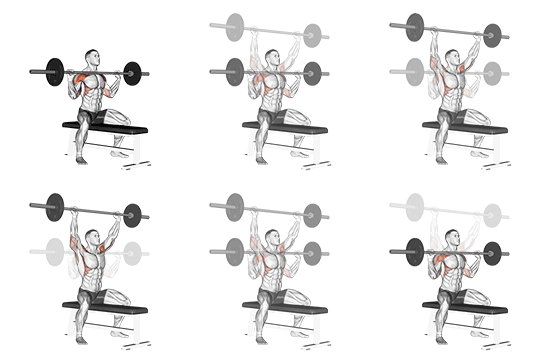
How to Do an Overhead Press
Set the Rack Height and Grip: Set the J-cups inside a power rack at upper-chest height and grip the barbell slightly wider than shoulder width with a full overhand grip.
Build the Starting Position: Unrack the bar onto your upper chest and front shoulders, keeping your wrists stacked vertically above your forearms and feet firmly planted.
Brace Before the Press: Create intra-abdominal pressure and squeeze your glutes and core muscles to stabilize your spine and prevent lower-back arching.
Clear the Face: Move your head slightly back as you initiate the press so the barbell can travel in a near-vertical path past your face.
Press Up and Reorganize Under the Bar: Extend your elbows forcefully, pushing the bar upward while bringing your head and torso back into neutral alignment once the bar clears your forehead.
Finish Overhead: Lock out your arms over your midfoot with elbows extended and allow natural scapular upward rotation without forcing your shoulders down.
Lower With Control: Lower the barbell smoothly under control back to upper-chest height and reset your brace before initiating the next rep.
Form Check & Technique
DO THIS (Technique Tips)
- Grip shoulder-width to moderately wider.
- Keep forearms vertical under bar.
- Brace core and squeeze glutes.
- Tilt head back slightly to clear bar.
- Push head forward under bar at top.
- Lock out with bar over midfoot.
- Allow natural upward scapular rotation.
- Control lowering return smoothly.
AVOID THIS (Common Mistakes)
- Using leg drive unintentionally — Fix: Keep knees locked and hips stationary to preserve strict pressing mechanics.
- Grip too wide or too narrow — Fix: Set hand position shoulder-width to moderately wider so forearms remain vertical.
- Pressing the bar far forward — Fix: Clear your face minimally and push your head under the bar once it passes your forehead.
- Excessive backward lean — Fix: Reduce load and brace your abdominals and glutes tightly to keep your spine neutral.
- Letting wrists collapse backward — Fix: Keep the barbell supported directly over your wrist joint and forearms.
- Forcing elbows directly sideways — Fix: Tuck elbows slightly forward (30–45 degrees) in the scapular plane.
- Keeping shoulders pinned down at lockout — Fix: Allow controlled scapular upward rotation as you reach tall overhead.
- Dropping the bar quickly — Fix: Control the 2-second eccentric return back to your front shoulder rack position.
About Overhead Press
The overhead press is a foundational compound vertical pressing exercise that drives a barbell overhead from shoulder level to build upper-body pressing strength and shoulder mass. It primarily targets the anterior and lateral deltoids and triceps brachii, while the upper trapezius, serratus anterior, rotator cuff, and core stabilizers support shoulder girdle mechanics.
Muscles Worked by the Overhead Press
The overhead press is an essential multi-joint compound movement for upper-body pushing strength.
- The anterior deltoid performs the primary work of shoulder flexion and abduction, while the triceps brachii extend the elbow joints during lockout.
- The lateral deltoid contributes to overhead stabilization, and the upper trapezius and serratus anterior control scapular upward rotation.
Sets & Reps Guidance
Technique / Learning
Strength: 3–5 sets of 3–6 reps with heavy controlled load.
Strength Focus
Moderate-volume strength/muscle: 2–4 sets of 6–10 reps near technical failure.
Muscle Growth (Hypertrophy)
Technique / Volume: 2–3 sets of lighter controlled reps focusing on bar path.
General training baseline. Need.fit automatically adjusts exact sets, reps, and working weight based on your individual fitness level, recovery, and progress over time.
Exercise Variations & Alternatives
Dumbbell Shoulder Press
Unilateral or bilateral dumbbell overhead press variation.
Arnold Press
Rotating dumbbell overhead press.
Lateral Raise
Learn lateral raise form, muscles worked, arm path, elbow and hand-position cues, common mistakes, dumbbell variations, and practical sets and reps.
Front Raise
Learn proper dumbbell front raise form, muscles worked, grip and arm-path cues, how high to raise, common mistakes, variations, and sets and reps.
Rear Delt Fly
Learn rear delt fly form, muscles worked, hip-hinge and arm-path cues, scapular movement, seated vs standing options, mistakes, and sets and reps.
Barbell Bench Press
Learn proper barbell bench press form, muscles worked, grip and bar-path cues, common mistakes, and practical sets and reps for strength or muscle.
How Wide Should Your Overhead Press Grip Be?
A grip set shoulder-width to moderately wider provides the best leverage and joint stacking for most lifters. Placing hands too narrow can strain the wrists and elbows, while a grip that is excessively wide shortens the pressing range of motion and increases shoulder joint shear.
Where Should the Bar Start?
The barbell should rest on the front deltoids and clavicles in a rack position, with your forearms positioned nearly vertical underneath the bar. Starting every repetition from this full stretch position ensures a consistent range of motion and optimal shoulder muscle recruitment.
What Should the Overhead Press Bar Path Look Like?
The ideal bar path is close to a vertical line directly over your center of gravity. To achieve this, tilt your head slightly back as the bar passes your nose, then guide your head forward under the bar at full lockout so the weight sits balanced directly over your ankles and midfoot.
Where Should Your Elbows Be?
Position your elbows slightly in front of the bar (roughly 30–45 degrees forward in the scapular plane) at the bottom starting position. Flaring your elbows directly out to the sides places unnecessary stress on the rotator cuff and reduces pushing efficiency.
How Should You Brace During the Press?
Inhale deeply into your abdomen, squeeze your abdominal core wall, and contract your glutes before initiating the press. Proper bracing prevents excessive hyperextension of the lumbar spine when driving heavy loads overhead.
Should Your Head Move Around the Bar?
Yes, moving your head slightly backward during the initial press allows the bar to clear your face safely. Once the bar passes your head, push your head forward into a neutral position under the bar at full extension.
How Much Back Lean Is Too Much?
A small degree of upper-back leaning is natural to permit bar clearance. However, excessive arching that turns the movement into a standing incline bench press indicates the weight is too heavy and places high strain on the lumbar spine.
What Should Lockout Look Like?
At full lockout, your elbows should be extended with the barbell centered directly over your ears, shoulders, and midfoot. Allow natural upward scapular rotation and reach tall overhead rather than forcefully depressing your shoulder blades.
Overhead Press vs Military Press
Standard overhead presses allow a comfortable shoulder-width foot stance for maximum stability. Military presses require heels to be held together, dramatically increasing balance demands and restricting the base of support.
Overhead Press vs Push Press
The overhead press is a strict upper-body push executed without leg assistance. The push press uses a quick knee dip and hip drive to propel heavier loads upward before finishing with arm extension.
Sources & References
- [1]Biomechanical Analysis of Grip Width and Forearm Alignment in the Overhead Press — PubMed (PMID: 41335596)View Source
- [2]Effects of Body Position and Loading Modality on Muscle Activation in Overhead Pressing — PubMed (PMID: 23096062)View Source
- [3]Electromyographic Analysis of Deltoid Muscle Activation Across Overhead Press Variations — PubMed (PMID: 33312291)View Source
- [4]Surface EMG Analysis of Upper Body Musculature in Pressing Movements — PubMed (PMID: 28011412)View Source
- [5]Electromyographic Activity in Shoulder Resistance Exercises: Systematic Review — PubMed (PMID: 32107499)View Source
- [6]
- [7]Scapulae Motion and Joint Safety in Overhead Pressing Exercises — PubMed (PMID: 34875981)View Source