
Lateral Raise
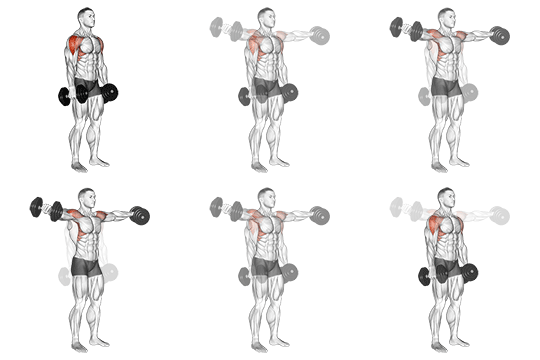
How to Do a Lateral Raise
Choose a Manageable Load: Select dumbbells light enough to lift and lower with strict muscular control without relying on lower-body momentum.
Establish the Start: Stand or sit tall with feet planted, holding dumbbells beside your thighs with a slight, fixed bend in your elbows.
Set a Comfortable Arm Plane: Position your arm path slightly forward of your torso (around 15–30 degrees in the scapular plane) rather than directly out to the sides.
Keep Hands Neutral: Maintain a neutral or slightly thumbs-up hand orientation throughout the raise, avoiding aggressive thumbs-down or pinky-up rotation.
Raise With Control: Lead with your upper arms and elbows, raising the dumbbells outward and upward until your hands reach shoulder height.
Stop at a Repeatable Height: Pause briefly at shoulder height without shrugging your shoulders or arching your back to force extra height.
Lower Slowly: Lower the dumbbells back to your sides under complete control over a 2-second eccentric descent before repeating.
Form Check & Technique
DO THIS (Technique Tips)
- Select light to moderate dumbbells.
- Maintain soft, fixed elbow bend.
- Raise in the scapular plane (15–30° forward).
- Keep hands neutral or slightly thumbs-up.
- Lead movement with upper arms.
- Stop at shoulder height.
- Avoid shrugging upper traps.
- Lower under control over 2 seconds.
AVOID THIS (Common Mistakes)
- Using momentum to swing the dumbbells — Fix: Reduce weight and raise with strict muscular control.
- Aggressively turning thumbs down — Fix: Use a neutral or slightly thumbs-up hand orientation to protect the shoulder joint.
- Shrugging to gain height — Fix: Keep your upper traps relaxed and stop when hands reach shoulder level.
- Changing elbow angle throughout the rep — Fix: Lock a soft 10–20 degree elbow bend from start to finish.
- Raising too far forward — Fix: Keep your arm path out to the sides, angled only 15–30 degrees forward.
- Using weight too heavy for the lever — Fix: Use light to moderate dumbbells to maintain target deltoid tension.
- Dropping the eccentric — Fix: Lower dumbbells slowly over 2 seconds to maximize mechanical tension.
- Assuming shoulder height is mandatory for every body — Fix: Use a repeatable, comfortable endpoint within your shoulder mobility limits.
About Lateral Raise
The lateral raise is a shoulder-abduction exercise performed by lifting the arms away from the body, usually with dumbbells, to emphasize the lateral deltoid. A controlled arm path, neutral-to-comfortable hand position and repeatable range are more important than forcing a specific pinky-up cue or using heavy momentum.
Muscles Worked by the Lateral Raise
The lateral raise isolates shoulder abduction to target the lateral (middle) head of the deltoid.
- The supraspinatus initiates the first 15 degrees of abduction, while the lateral deltoid generates primary force to raise the upper arm to 90 degrees.
- The upper trapezius and serratus anterior stabilize the shoulder girdle, and the forearm flexors maintain grip on the dumbbells.
Sets & Reps Guidance
Technique / Learning
General accessory: 2–4 sets of 10–20 reps with light controlled load.
Strength Focus
Higher-rep controlled work: 2–4 sets of 12–25 reps focusing on deep pump and burn.
Muscle Growth (Hypertrophy)
Strict isolation: 3–4 sets of 12–15 reps taken near muscular failure.
General training baseline. Need.fit automatically adjusts exact sets, reps, and working weight based on your individual fitness level, recovery, and progress over time.
Exercise Variations & Alternatives
Dumbbell Shoulder Press
Compound dumbbell vertical press.
Arnold Press
Rotating dumbbell shoulder press.
Overhead Press
Learn proper overhead press form, muscles worked, grip and bar-path cues, bracing, lockout, common mistakes, and practical sets and reps.
Front Raise
Learn proper dumbbell front raise form, muscles worked, grip and arm-path cues, how high to raise, common mistakes, variations, and sets and reps.
Rear Delt Fly
Learn rear delt fly form, muscles worked, hip-hinge and arm-path cues, scapular movement, seated vs standing options, mistakes, and sets and reps.
Barbell Bench Press
Learn proper barbell bench press form, muscles worked, grip and bar-path cues, common mistakes, and practical sets and reps for strength or muscle.
Where Should Your Arms Travel?
Raise your arms outward in a path positioned slightly in front of your torso (15 to 30 degrees forward in the scapular plane). Moving slightly forward aligns the raise naturally with the angle of the scapula, reducing subacromial joint pinching and tendon friction compared to raising arms directly out to a flat 90-degree side position.
Should You Raise Slightly Forward?
Yes, raising slightly forward in the scapular plane is anatomically sound and strongly recommended for long-term shoulder health. It allows full, deep lateral deltoid recruitment while preserving smooth joint space clearance throughout the entire range of motion.
Should Your Elbows Be Bent?
Maintain a soft, fixed bend in your elbows (around 10 to 20 degrees) throughout every repetition. Locking your elbows completely straight creates unnecessary stress on the elbow joint, whereas bending elbows excessively to 90 degrees dramatically shortens lever length and reduces effective deltoid loading.
Should Your Thumbs or Pinkies Point Up?
Maintain a neutral hand orientation or a slight thumbs-up tilt. The outdated 'pour the pitcher' or aggressive pinkies-up cue forces extreme internal rotation, which pinches the supraspinatus and rotator cuff tendons under load without offering any documented increase in lateral deltoid activation.
How High Should You Raise the Dumbbells?
Raising the dumbbells to shoulder height (90 degrees of shoulder abduction) serves as the standard optimal endpoint for deltoid isolation. Raising significantly above shoulder height shifts primary tension onto the upper trapezius rotators and reduces lateral deltoid leverage.
Why Light Weights Often Work Better
The lateral raise positions dumbbells at the far end of a long lever arm (your extended arms), generating high joint torque even with modest resistance. Using heavy dumbbells inevitably causes torso swinging, leg drive, and excessive trap shrugging that robs the side delts of tension.
Lateral Raise vs Shoulder Press
Shoulder presses are heavy compound movements where the triceps and anterior delts assist overhead pressing. Lateral raises are dedicated isolation movements that target shoulder abduction to specifically widen the lateral deltoids.
Dumbbell vs Cable Lateral Raise
Dumbbell lateral raises provide peak resistance at the top horizontal portion of the movement. Cable lateral raises use a continuous line of pull to maintain constant tension on the side delts from the bottom stretch position all the way to peak lockout.
Seated vs Standing Lateral Raise
Seated lateral raises restrict lower-body cheating and leg drive, enforcing strict deltoid isolation. Standing lateral raises permit subtle body posture adjustments but require greater active core and spinal stabilization.
Sources & References
- [1]Effect of Humeral Rotation and Arm Elevation Angle on Deltoid Muscle Activation — PubMed (PMID: 32824894)View Source
- [2]Electromyographic Analysis of Shoulder Abduction in the Scapular Plane vs Frontal Plane — PubMed (PMID: 25920341)View Source
- [3]Electromyographic Analysis of Deltoid Activation in Lateral Raises — PubMed (PMID: 33312291)View Source
- [4]Surface EMG Analysis of Upper Body Musculature in Isolation Exercises — PubMed (PMID: 28011412)View Source
- [5]
- [6]
- [7]Scapular Kinematics and Rotator Cuff Impingement Risk in Lateral Elevation — PubMed (PMID: 34875981)View Source