
Dumbbell Shoulder Press
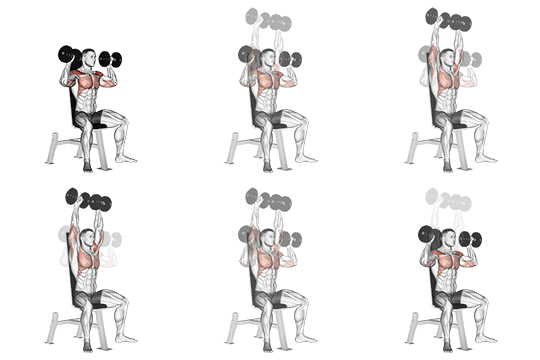
How to Do a Dumbbell Shoulder Press
Set the Bench: Adjust an incline bench to a near-upright backrest angle (around 80–85 degrees), keeping your feet planted flat and stable on the floor.
Bring the Dumbbells Into Position: Rest dumbbells vertically on your thighs while seated, then use a controlled knee kick to propel each dumbbell up to shoulder height.
Choose Your Grip: Position your hands with palms facing forward (pronated) or turned slightly inward (semi-neutral) to suit shoulder joint comfort.
Set Elbows and Torso: Keep your back supported against the bench, brace your core, and position your elbows slightly forward in the scapular plane.
Press Overhead: Drive both dumbbells upward simultaneously along a smooth vertical path until your arms are extended overhead.
Finish Without Clanging the Dumbbells: Reach a controlled overhead extension with dumbbells centered above your shoulders without knocking them together.
Lower to a Controlled Depth: Lower the dumbbells under full muscular control until they reach shoulder height before initiating the next repetition.
Form Check & Technique
DO THIS (Technique Tips)
- Set bench backrest to 80–85 degrees.
- Kick dumbbells up using knees.
- Choose comfortable grip orientation.
- Keep elbows slightly forward.
- Press overhead along subtle converging arc.
- Avoid clanging dumbbells together.
- Lower under control to shoulder level.
- Maintain core bracing against bench.
AVOID THIS (Common Mistakes)
- Bench too reclined — Fix: Adjust backrest closer to upright (80–85°) to keep focus on deltoids.
- Unstable dumbbell setup — Fix: Use controlled knee kicks to bring dumbbells up safely to shoulders.
- Forcing elbows directly sideways — Fix: Tuck elbows slightly forward (30–45°) in the scapular plane.
- Dumbbells drifting far forward — Fix: Press directly overhead in line with your ears and shoulders.
- Clanging dumbbells together — Fix: Finish lockout with dumbbells parallel overhead without impact.
- Cutting depth progressively — Fix: Lower dumbbells smoothly to shoulder level on every single rep.
- Excessive rib flare/back extension — Fix: Keep your back pressed against the bench and core braced.
- Assuming each arm must look perfectly identical — Fix: Use symmetrical intent while allowing natural anatomical wrist differences.
About Dumbbell Shoulder Press
The dumbbell shoulder press is a foundational compound overhead press performed with one dumbbell in each hand. In the seated version, the adjustable bench supports the upper and lower back, stabilizing the spine while each arm independently controls its dumbbell through the press. This unilateral freedom allows grip orientation and elbow position to adapt naturally to individual joint mechanics.
Muscles Worked by the Dumbbell Shoulder Press
The dumbbell shoulder press provides independent overhead loading for each arm, preventing a stronger dominant side from compensating.
- The anterior deltoid is the primary driver of shoulder flexion and abduction, assisted by the lateral deltoid.
- The triceps brachii extend the elbows at lockout, while the upper trapezius and serratus anterior control scapular upward rotation as the arms press overhead.
Sets & Reps Guidance
Technique / Learning
Heavier pressing: 3–4 sets of 5–10 reps with heavy controlled dumbbells.
Strength Focus
Moderate-volume muscle building: 2–4 sets of 8–15 reps focusing on deep stretch and lockout.
Muscle Growth (Hypertrophy)
Higher-rep accessory: 2–3 sets of 12–20 reps for high volume and pump.
General training baseline. Need.fit automatically adjusts exact sets, reps, and working weight based on your individual fitness level, recovery, and progress over time.
Exercise Variations & Alternatives
Overhead Press
Bilateral strict barbell overhead press.
Arnold Press
Rotating dumbbell overhead press.
Lateral Raise
Learn lateral raise form, muscles worked, arm path, elbow and hand-position cues, common mistakes, dumbbell variations, and practical sets and reps.
Front Raise
Learn proper dumbbell front raise form, muscles worked, grip and arm-path cues, how high to raise, common mistakes, variations, and sets and reps.
Rear Delt Fly
Learn rear delt fly form, muscles worked, hip-hinge and arm-path cues, scapular movement, seated vs standing options, mistakes, and sets and reps.
Barbell Bench Press
Learn proper barbell bench press form, muscles worked, grip and bar-path cues, common mistakes, and practical sets and reps for strength or muscle.
How to Set Up Heavy Dumbbells
Sit near the front edge of the bench with heavy dumbbells resting vertically on your thighs near your knees. One at a time, kick your knees upward dynamically to propel each dumbbell up toward shoulder height while leaning back smoothly onto the backrest, establishing a secure starting rack position.
What Bench Angle Should You Use?
A near-upright bench angle of 80 to 85 degrees is a practical default for most lifters. Setting the bench to a completely flat 90-degree angle often forces excessive lower-back arching, whereas reclining below 75 degrees turns the exercise into a steep incline chest press.
Palms Forward vs Neutral Grip
Palms-forward (pronated) grips maximize lateral deltoid involvement during overhead abduction. Neutral (palms-facing) or semi-neutral grips align the elbows 30 to 45 degrees forward in the scapular plane, reducing subacromial joint compression and easing wrist strain.
Where Should Your Elbows Be?
Position your elbows slightly forward in the scapular plane rather than flaring them directly out 90 degrees sideways. Tucking your elbows slightly forward protects your rotator cuff tendons while preserving optimal joint leverage throughout the press.
How Low Should You Lower the Dumbbells?
Lower the dumbbells under control until the handles reach shoulder height or upper chest level. Adjust your lowering depth based on active shoulder joint mobility, avoiding forced deep stretches that cause joint pinching.
Should the Dumbbells Touch at the Top?
No, dumbbells do not need to touch or clang together at the peak of the movement. Drive the weights overhead in a smooth arc, finishing with arms extended and dumbbells positioned directly above your shoulders while maintaining constant deltoid tension.
Seated vs Standing Dumbbell Shoulder Press
Seated dumbbell shoulder presses provide solid back support, allowing greater focus on shoulder muscle isolation and heavier loading. Standing dumbbell shoulder presses increase core stabilizer demands and require active balance across the entire body.
Dumbbell Shoulder Press vs Barbell Overhead Press
Dumbbell shoulder presses allow independent arm motion, flexible wrist orientations, and a wider pressing path that adapts to individual shoulder mechanics. Barbell overhead presses permit heavier absolute loading because both hands grip a single rigid bar.
Sources & References
- [1]Effects of Body Position and Loading Modality on Muscle Activation in Overhead Pressing — PubMed (PMID: 23096062)View Source
- [2]Electromyographic Analysis of Deltoid Muscle Activation Across Dumbbell and Barbell Pressing — PubMed (PMID: 33312291)View Source
- [3]
- [4]Surface EMG Analysis of Upper Body Musculature in Resistance Training — PubMed (PMID: 28011412)View Source
- [5]
- [6]
- [7]Joint Kinematics and Motion Control in Dumbbell Shoulder Pressing — PubMed (PMID: 34875981)View Source