
Barbell Bent-Over Row
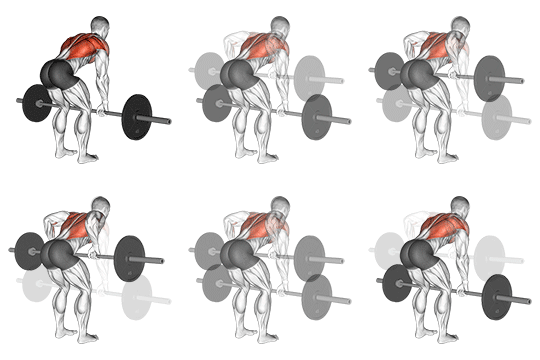
How to Do a Barbell Bent-Over Row
Set Your Stance and Grip: Stand with feet hip-to-shoulder width apart and grip the barbell slightly wider than your legs with an overhand grip.
Hinge Into Position: Push your hips back and incline your torso forward while keeping the load balanced over the midfoot.
Brace the Trunk: Create a repeatable torso position with active core tension before initiating the pull.
Let the Arms Lengthen: Begin with straight arms hanging vertically and controlled shoulder blades.
Row the Bar Toward the Lower Ribs / Upper Abdomen: Drive your elbows back behind your body, guiding the bar toward your lower ribcage.
Finish Without Heaving: Squeeze your shoulder blades together at the top without using excessive hip extension or momentum.
Lower Under Control: Extend your arms smoothly back to full reach while holding the stable hip-hinge torso angle.
Form Check & Technique
DO THIS (Technique Tips)
- Hinge at hips with knees slightly bent.
- Keep bar balanced over midfoot.
- Brace core before initiating pull.
- Drive elbows back behind torso.
- Touch lower ribs or upper waist.
- Retract shoulder blades fully at top.
- Control lowering phase completely.
- Keep spine stable and neutral.
AVOID THIS (Common Mistakes)
- Standing up too tall — Fix: Maintain your hip hinge rather than turning the row into an upright pull.
- Using excessive torso heaving — Fix: Reduce weight to keep torso movement minimal and controlled.
- Rounding the lower back — Fix: Hinge at the hips with a braced, neutral spine before pulling.
- Pulling the bar to the collarbones — Fix: Guide the bar toward your lower ribs or belly button level.
- Jerking the head and neck — Fix: Keep neck aligned naturally with your spine.
- Shrugging shoulders at top — Fix: Pull elbows back and down rather than shrugging traps upward.
- Half reps without full stretch — Fix: Lower bar to full arm extension on every repetition.
- Bouncing weights off knees — Fix: Maintain clear bar path in front of knees during the hinge.
About Barbell Bent-Over Row
The barbell bent-over row is a compound bilateral horizontal pulling exercise performed from a hip-hinge position. It trains the latissimus dorsi, rhomboids, middle and lower trapezius, rear deltoids, and erector spinae. A proper bent-over row hinges at the hips, maintains a braced torso angle, and pulls the barbell toward the lower ribs or upper abdomen under control.
Muscles Worked by the Barbell Bent-Over Row
The bent-over row is a premier upper-body pulling and posterior-chain exercise.
- The lats, rhomboids, and trapezius drive shoulder extension and scapular retraction.
- The erector spinae, glutes, and hamstrings work isometric effort to hold the hip hinge position against gravity throughout every repetition.
Sets & Reps Guidance
Technique / Learning
Technique: 2–3 sets of 8–10 reps with lighter load focusing on hinge stability.
Strength Focus
Strength: 3–5 sets of 4–8 reps with heavy controlled weight.
Muscle Growth (Hypertrophy)
Muscle-focused: 3–4 sets of 6–12 reps taken near technical proximity to failure.
General training baseline. Need.fit automatically adjusts exact sets, reps, and working weight based on your individual fitness level, recovery, and progress over time.
Exercise Variations & Alternatives
Single-Arm Dumbbell Row
Unilateral chest/hand-supported row variation.
Deadlift
Bilateral floor pull and posterior chain builder.
Pull-Up
Learn proper pull-up form, muscles worked, grip and range-of-motion cues, common mistakes, progressions, and practical sets and reps.
Chin-Up
Learn proper chin-up form, muscles worked, underhand-grip setup, range-of-motion cues, common mistakes, progressions, and practical sets and reps.
Lat Pulldown
Learn proper lat pulldown form, muscles worked, grip-width and torso-position cues, common mistakes, pull-up differences, and practical sets and reps.
Seated Cable Row
Learn seated cable row form, muscles worked, handle and grip options, scapular-motion and torso cues, common mistakes, and practical sets and reps.
What Muscles Does the Barbell Bent-Over Row Work?
The bent-over row targets the lats, rhomboids, trapezius, and rear deltoids for complete upper back thickness. Simultaneously, the erector spinae, glutes, hamstrings, and abdominal core wall exert continuous static isometric effort to maintain your braced torso angle against gravity.
How Far Should You Bend Over?
Torso inclination generally ranges from 30 to 70 degrees relative to horizontal, depending on your individual training goals, hip mobility, and lower-back tolerance. Being completely parallel (Pendlay style) maximizes back isolation, while a slightly higher angle (45–60°) allows heavier loading with lower spine strain.
Where Should the Bar Touch?
Pull the bar toward your lower ribcage or upper waist area. Pulling too high toward the upper chest forces unwanted shoulder elevation and shifts work away from the lats onto the upper traps.
Should Your Shoulder Blades Move?
Yes, permit natural scapular movement. Allow the shoulder blades to protract naturally at the bottom stretch and retract fully together at the top lockout of every repetition.
What Grip Width Should You Use?
Use a grip slightly wider than your knees or legs (roughly shoulder width). This hand placement keeps your forearms near vertical at the top of the pull for clean mechanical leverage.
Overhand vs Underhand Barbell Row
Overhand (pronated) grips emphasize rhomboids, mid-traps, and rear delts with elbows flared 30–45 degrees. Underhand (supinated) grips bring elbows closer to the torso, increasing lower lat and biceps recruitment.
How Much Momentum Is Acceptable?
Strict form with minimal torso motion is ideal for muscle hypertrophy and joint safety. Controlled torso movement of 5–10 degrees on heavy sets is acceptable, but heavy body heaving compromises back engagement.
Does the Barbell Row Work the Lower Back?
Yes, the erector spinae work statically to support your torso against gravity during the entire set. Proper intra-abdominal bracing protects the spine while building lumbar endurance over time.
Bent-Over Row vs Pendlay Row
Standard bent-over rows maintain a constant torso angle in mid-air between repetitions. Pendlay rows rest the barbell on the floor after every rep from a strictly parallel torso position.
Barbell Row vs Dumbbell Row
Barbell rows load both arms simultaneously and place high static demand on the lower back. Dumbbell rows allow unilateral movement and external bench support, reducing lumbar stress significantly.
Sources & References
- [1]Comparison of Different Row Exercises: Trunk Muscle Activation and Lumbar Spine Load, Kinematics — PubMed (PMID: 19197209)View Source
- [2]Electromyographic Analysis of Muscle Activation During Horizontal Rowing Exercises — PubMed (PMID: 24077382)View Source
- [3]
- [4]
- [5]
- [6]
- [7]