
Hanging Leg Raise
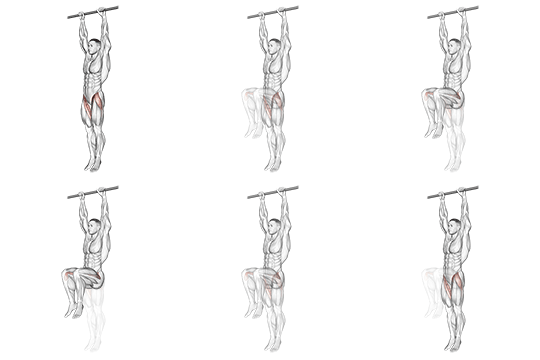
How to Do a Hanging Leg Raise
Take a secure hang: grip a stable pull-up bar around shoulder width and hang with the arms long, feet clear of the floor, and shoulders controlled.
Stop the swing before starting: bring the body to a quiet position and brace the abdominals, glutes, and upper body before the legs move.
Set the legs: keep the knees straight or softly extended. If this is too difficult, begin with hanging knee raises.
Raise the legs under control: flex at the hips and lift the legs in front of you while keeping the torso as still as possible.
Add pelvic control near the top: think about bringing the pelvis toward the rib cage rather than only lifting from the hips.
Use your controllable height: raise to around hip height or higher only if you can avoid swinging or excessive back arching.
Lower slowly: reverse the motion under control and return to a quiet hang before the next repetition.
Form Check & Technique
DO THIS (Technique Tips)
- Quiet hang first.
- Brace before lifting.
- Use knee raises if needed.
- Raise only as high as you can control.
- Keep the torso still.
- Control the lowering phase.
- Build grip separately if needed.
- Progress range before external load.
AVOID THIS (Common Mistakes)
- Swinging Like a Pendulum — Fix: return to a quiet hang before each rep.
- Kicking the Legs Up — Fix: slow the lift and shorten the lever with bent knees.
- Lowering Too Fast — Fix: control the eccentric.
- Arching the Lower Back — Fix: shorten the range and brace harder.
- Chasing Toes-to-Bar Too Early — Fix: own strict hip-height reps first.
- Grip Failing Immediately — Fix: reduce set length or train hanging strength.
- Losing Shoulder Control — Fix: maintain a stable active hang.
About Hanging Leg Raise
The hanging leg raise is an advanced bodyweight core exercise performed while hanging from a pull-up bar and raising the legs in front of the body. The hip flexors create much of the leg-lifting motion, while the rectus abdominis, obliques, and deeper trunk muscles work hard to control the pelvis and resist swinging. Grip, forearms, lats, and shoulder-girdle muscles stabilize the hanging position. Strong hanging leg raise form starts from a quiet hang, uses deliberate abdominal bracing, raises only through a controllable range, and lowers without turning the body into a pendulum.
Hanging Leg Raise Muscles Worked
A hanging leg raise combines hip flexion with demanding trunk and pelvic control.
- The hip flexors raise the thighs, while the abdominal wall resists extension and helps control pelvic position.
- Laboratory testing has shown a very high abdominal-wall challenge during hanging straight-leg raises, while the hanging position adds grip and shoulder-stability demands that floor raises do not.
Sets & Reps Guidance
Technique / Learning
Technique: 2–4 sets of 5–8 hanging knee raises or partial leg raises.
Strength Focus
Strength: 3–5 sets of 5–10 controlled reps using straight legs or a harder progression.
Muscle Growth (Hypertrophy)
Muscle / core work: 3–4 sets of 8–15 controlled reps using a variation that keeps the abdominals working.
General training baseline. Need.fit automatically adjusts exact sets, reps, and working weight based on your individual fitness level, recovery, and progress over time.
Exercise Variations & Alternatives
Lying Leg Raise
A floor-supported leg raise that reduces grip and shoulder demands.
Plank
An isometric anti-extension core exercise.
Ab Wheel Rollout
An advanced anti-extension exercise with strong shoulder and lat involvement.
Bicycle Crunch
A floor-based core exercise combining trunk flexion and rotation.
Crunch
Master abdominal crunch form, upper ab isolation, crunch vs sit-up differences, proper neck position, common mistakes, and sets and reps.
Sit-Up
Master full-range sit-up form, abdominal & hip flexor muscles worked, sit-up vs crunch differences, common mistakes, and sets and reps.
Hanging Leg Raise vs Lying Leg Raise
The hanging version removes floor support and adds grip, shoulder, and anti-swing demands. Lying leg raises support the trunk and are easier to scale, making them a useful progression toward strict hanging reps.
Hanging Knee Raise vs Hanging Leg Raise
Bending the knees shortens the lever and reduces difficulty. Start with knee raises, then gradually straighten the legs as you can keep the torso quiet and control the lowering phase.
Do Hanging Leg Raises Work the Lower Abs?
The rectus abdominis is one continuous muscle rather than separate upper and lower abs. Hanging leg raises create a strong abdominal challenge, especially when pelvic motion is controlled, while the hip flexors also contribute substantially.
How High Should You Raise Your Legs?
Hip height is a useful first target. Higher ranges can increase the pelvic-control demand, but only use them if the body stays controlled rather than swinging.
How to Stop Swinging on Hanging Leg Raises
Start every rep from a quiet hang, brace before lifting, slow the eccentric, and use fewer reps or a bent-knee variation if momentum starts to build.
What if Grip Fails Before Your Abs?
Build hanging strength separately, use shorter sets, or consider straps when appropriate. Captain's-chair variations can remove grip as the main limiter.
Hanging Leg Raise Progression
Progress from lying leg raises to supported knee raises, hanging knee raises, partially straightened leg raises, and finally strict straight-leg raises. Add range before external load.
Hanging Leg Raise Benefits
The exercise develops abdominal and hip-flexor strength, grip endurance, shoulder-girdle stability, and whole-body control with minimal equipment.
Sources & References
- [1]
- [2]
- [3]
- [4]Muscle Activity and Spine Load During Anterior Chain Whole Body Linkage Exercises — PubMed (PMID: 25111163)View Source