Leg Press
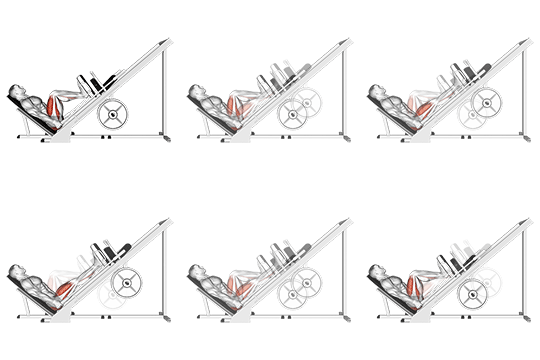
How to Do a Leg Press
Adjust the machine: set the seat, backrest, safety stops, and starting position so you can reach the handles and move the sled without your hips being forced into an uncomfortable position.
Place the feet: start around shoulder width with the whole foot flat on the platform. Adjust stance width, toe angle, and height slightly based on hip and ankle comfort.
Brace against the pad: keep the head, upper back, and pelvis supported and hold the machine handles for stability.
Unlock the sled: extend the legs enough to release the safeties without forcefully snapping the knees straight.
Lower under control: bend the hips and knees as the platform approaches, keeping the knees tracking with the feet and the pelvis from rolling off the pad.
Use your controlled depth: stop when you reach the deepest position you can maintain without the lower back or pelvis losing contact and without the heels lifting.
Press through the whole foot: extend the knees and hips to move the platform away while keeping the knees stable and the feet planted.
Finish smoothly: return near the starting position without aggressively locking the knees, then repeat.
Form Check & Technique
DO THIS (Technique Tips)
- Set the safeties before the set.
- Start with feet around shoulder width.
- Keep the pelvis supported.
- Track knees with the feet.
- Lower only as deep as you can control.
- Keep the heels planted.
- Press through the whole foot.
- Do not snap the knees into lockout.
AVOID THIS (Common Mistakes)
- Pelvis Rolling Off the Pad — Fix: shorten the range or adjust stance until the hips and lower back stay supported.
- Forcefully Locking the Knees — Fix: finish smoothly without snapping into end range.
- Heels Lifting — Fix: move the feet or reduce depth so the whole foot remains planted.
- Knees Collapsing Inward — Fix: reduce load and maintain stable tracking with the feet.
- Lowering the Sled Too Fast — Fix: control the eccentric phase and use the safeties correctly.
- Using a Load That Limits Depth — Fix: choose resistance that lets you reach your intended controlled range.
- Pushing Only Through the Toes or Only the Heels — Fix: maintain pressure through the whole foot rather than chasing an exaggerated cue.
About Leg Press
The leg press is a compound machine exercise that trains the quadriceps and glutes while the hamstrings and adductors assist. On a 45-degree sled or similar leg-press machine, sit with the pelvis and back supported, place the feet securely on the platform, lower the sled through a controlled range without the pelvis rolling away from the pad, and press the platform away without snapping the knees into lockout. The machine reduces balance and bar-support demands, but good pelvic, knee, and foot control still matter.
Leg Press Muscles Worked
The leg press trains several lower-body muscles through combined knee and hip extension.
- The quadriceps contribute strongly to extending the knees, while the gluteus maximus and adductors contribute at the hip.
- Hamstrings and calves assist depending on the machine, stance, depth, and individual technique.
- Because the torso is supported, the balance and bar-support demands differ substantially from free-weight squats.
Sets & Reps Guidance
Technique / Learning
Technique: 2–3 sets of 8–12 reps with a moderate load while learning machine setup, safety handles, depth, and foot position.
Strength Focus
Strength-focused machine work: 3–5 sets of 4–8 reps using a load that preserves pelvic position and controlled depth.
Muscle Growth (Hypertrophy)
Muscle growth: 3–5 sets of 8–15 reps with consistent range of motion and a controlled eccentric phase.
General training baseline. Need.fit automatically adjusts exact sets, reps, and working weight based on your individual fitness level, recovery, and progress over time.
Exercise Variations & Alternatives
Barbell Back Squat
A free-weight squat that requires more balance, trunk control, and bar support.
Front Squat
A front-loaded barbell squat with strong quadriceps and upper-back demands.
Hack Squat
A guided squat machine variation that keeps the torso supported while the knees and hips flex.
Leg Extension
A single-joint machine exercise that targets knee extension and the quadriceps.
Bulgarian Split Squat
A unilateral lower-body exercise that trains one leg at a time with additional balance demands.
Goblet Squat
Learn proper goblet squat form, muscles worked, dumbbell or kettlebell setup, stance and depth cues, common mistakes, variations, and sets and reps.
Where Should Your Feet Go on the Leg Press?
A shoulder-width stance near the middle of the platform is a useful starting point.
- Higher, lower, wider, and narrower placements change joint positions and may shift muscle demands, but the exact effect varies with machine geometry and anatomy.
- Prioritize a position that keeps the heels down, knees stable, and pelvis supported.
How Deep Should You Leg Press?
Lower as far as you can without the pelvis rolling under or the lower back lifting away from the pad.
- A 90-degree knee angle is only a rough checkpoint, not a universal stopping rule.
- Machine design, hip mobility, femur length, and stance all influence usable depth.
Should You Lock Your Knees on the Leg Press?
Finish the press with the knees extended or near extension under muscular control, but avoid forcefully snapping into lockout. Keeping a small amount of knee flexion can help some lifters maintain tension, but the key is a smooth, controlled finish.
Leg Press vs Squat
Both exercises train the legs, but they are not interchangeable.
- The leg press supports the torso and guides the load on a machine, reducing balance and bar-support requirements.
- A squat requires more whole-body coordination and trunk control.
- Use either or both based on your goals, equipment, and tolerance.
Does Foot Placement Change the Muscles Worked?
Foot placement changes hip, knee, and ankle angles, but claims that one position completely isolates the quads, glutes, or hamstrings are too strong. Research on squat and leg-press technique has found some stance effects while also showing that simple foot-angle changes do not necessarily produce large muscle-activation differences.
Why Does My Lower Back Lift on the Leg Press?
The pelvis often rolls away from the pad when the sled is lowered beyond the lifter's available hip range, the stance is unsuitable, or the load is too heavy. Reduce depth or load and adjust foot position until the pelvis remains supported.
Leg Press Benefits
The leg press makes it possible to train the lower body with high external loads while the torso is supported and balance demands are low. That can make it useful for beginners, hypertrophy work, accessory training after squats, or situations where a free-weight squat is not the preferred exercise.
Sources & References
- [1]
- [2]
- [3]Effects of Technique Variations on Knee Biomechanics During the Squat and Leg Press — PubMed (PMID: 11528346)View Source
- [4]Leg Press vs. Smith Machine: Quadriceps Activation and Overall Perceived Effort Profiles — PubMed (PMID: 30405437)View Source