
Bulgarian Split Squat
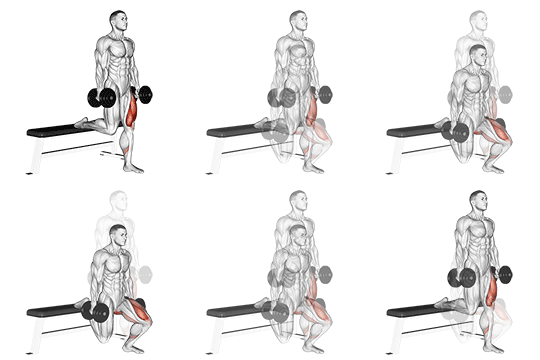
How to Do a Bulgarian Split Squat
Choose a stable rear-foot support: use a bench or platform around knee height or slightly lower as a starting point. A lower support can be easier to balance on.
Find your front-foot position: stand roughly one long step in front of the bench, then place the top of the rear foot on the support. Adjust until the front foot can stay fully planted through the repetition.
Set the torso and pelvis: brace the trunk and keep the pelvis controlled. A mostly upright torso emphasizes the quads more, while a modest forward torso lean can increase posterior-chain demand.
Lower through the front leg: bend the front knee and hip while the rear knee travels toward the floor. Keep the front knee tracking in a stable direction with the toes.
Use a controlled depth: descend until the front thigh approaches parallel or until you reach the deepest position you can control without losing foot pressure, balance, or pelvic position.
Drive through the front leg: press the front foot into the floor and extend the knee and hip to return toward standing. The rear leg should provide support, not the main drive.
Complete one side: finish the planned reps on one leg before switching sides, using the same bench height and front-foot distance for repeatable training.
Form Check & Technique
DO THIS (Technique Tips)
- Find and repeat your front-foot distance.
- Keep the front foot fully planted.
- Let the rear foot support, not drive.
- Brace the trunk and control the pelvis.
- Track the front knee with the toes.
- Use torso angle intentionally, not accidentally.
- Master bodyweight before heavy loading.
- Train both sides with the same setup.
AVOID THIS (Common Mistakes)
- Front Foot Too Close — Fix: move the foot forward until the heel stays planted and the descent feels balanced.
- Front Foot Too Far Away — Fix: shorten the stance if you cannot reach useful depth without excessive reaching or instability.
- Rear Leg Doing the Work — Fix: keep most of the effort on the front leg and use the rear foot mainly for support.
- Front Knee Collapsing Inward — Fix: reduce load and keep the knee tracking in a stable direction with the toes.
- Losing Balance Every Rep — Fix: master bodyweight and use a consistent setup before adding heavy dumbbells or a barbell.
- Bench Too High — Fix: use a lower support if the rear hip or balance position feels forced.
- Forcing One Torso Angle — Fix: choose a torso position that matches the training emphasis and allows stable control.
- Rushing the Bottom — Fix: lower under control and avoid bouncing off the rear-leg position.
About Bulgarian Split Squat
The Bulgarian split squat is a rear-foot-elevated unilateral squat that trains one leg at a time. The front leg performs most of the work while the rear foot rests on a bench or other stable support. It strongly trains the quadriceps and gluteus maximus, with the hamstrings, adductors, hip stabilizers, and core contributing to balance and control. Proper form starts with finding a repeatable front-foot distance, keeping the front foot planted, lowering under control, and driving through the front leg to stand.
Bulgarian Split Squat Muscles Worked
The Bulgarian split squat combines knee and hip extension on the front leg.
- The quadriceps extend the knee, while the gluteus maximus and adductors contribute at the hip.
- The hamstrings assist, and the gluteus medius, trunk muscles, and other stabilizers help control the pelvis and balance.
- Research also shows that changing trunk position can meaningfully change muscle activation patterns.
Sets & Reps Guidance
Technique / Learning
Technique: 2–3 sets of 6–10 bodyweight reps per leg while learning bench height, foot distance, balance, and depth.
Strength Focus
Strength: 3–4 sets of 5–8 reps per leg using dumbbells or another load that does not compromise balance or depth.
Muscle Growth (Hypertrophy)
Muscle growth: 3–4 sets of 8–12 reps per leg with a controlled eccentric and consistent front-foot pressure.
General training baseline. Need.fit automatically adjusts exact sets, reps, and working weight based on your individual fitness level, recovery, and progress over time.
Exercise Variations & Alternatives
Dumbbell Lunge
A unilateral lower-body exercise with both feet returning to or moving through the floor instead of elevating the rear foot.
Goblet Squat
A bilateral squat using a front-held dumbbell or kettlebell with lower balance demands.
Barbell Back Squat
A bilateral barbell squat that supports heavier total external loads and uses less single-leg balance.
Front Squat
A bilateral front-loaded squat with strong quadriceps and upper-back demands.
Leg Press
A supported machine exercise that trains the legs with much lower balance requirements.
Leg Extension
Learn proper leg extension form, muscles worked, machine setup and knee cues, common mistakes, knee-safety context, variations, and practical sets and reps.
Where Should Your Front Foot Be?
There is no single correct distance from the bench.
- Start about one long step forward, then adjust so the heel stays down, the front knee can track comfortably, and you can lower without falling forward or backward.
- Once you find the position, mark it mentally or on the floor for repeatable sets.
Quad-Dominant vs Glute-Dominant Bulgarian Split Squat
A closer front-foot position and a more upright torso generally increase the knee-dominant character of the exercise, while a longer stance and more forward torso lean can increase hip and posterior-chain demand. These changes shift emphasis; they do not turn the exercise into complete isolation of one muscle.
Should Your Knee Go Over Your Toes?
Some forward knee travel can be normal and useful.
- Instead of forcing the knee behind the toes, keep the heel planted and let the knee track in a stable direction with the foot.
- Front-foot distance, ankle mobility, femur length, and torso angle all affect how far the knee travels.
How High Should the Bench Be?
A bench around knee height or slightly lower is a practical starting point.
- A very high rear-foot support can increase hip and balance demands without automatically improving the exercise.
- Choose a height that lets the rear leg rest comfortably while the front leg does the work.
Bulgarian Split Squat vs Split Squat
A standard split squat keeps both feet on the floor, while the Bulgarian split squat elevates the rear foot.
- Rear-foot elevation changes balance, hip position, and loading demands.
- Both are unilateral lower-body exercises and can be useful for building strength and muscle.
Bulgarian Split Squat vs Back Squat
The Bulgarian split squat trains one leg at a time and places greater balance demands on the lifter, while the back squat loads both legs together and usually supports heavier total external loads. Biomechanical research shows meaningful joint-demand differences between the two exercises, so they can complement rather than replace each other.
How to Progress Bulgarian Split Squats
Start with bodyweight until you can control balance, depth, and front-foot pressure.
- Then add dumbbells or another stable loading method.
- Progress by increasing repetitions, adding load, improving controlled range of motion, or using slower eccentrics rather than immediately choosing the most unstable variation.
Bulgarian Split Squat Benefits
Bulgarian split squats build unilateral leg strength while challenging balance, pelvic control, and coordination. They can expose side-to-side differences, provide substantial leg loading with less total external weight than a bilateral squat, and fit strength, hypertrophy, athletic, and general fitness programs.
Sources & References
- [1]
- [2]
- [3]Biomechanical Differences Between the Bulgarian Split-Squat and Back Squat — PubMed / PMC (PMID: 34055144; PMCID: PMC8136570)View Source
- [4]Targeted Muscle Activation in Bulgarian Split Squat Variations: Effects of Trunk Position and Suspension-Based Execution — PubMed (PMID: 40867012)View Source