
Leg Extension
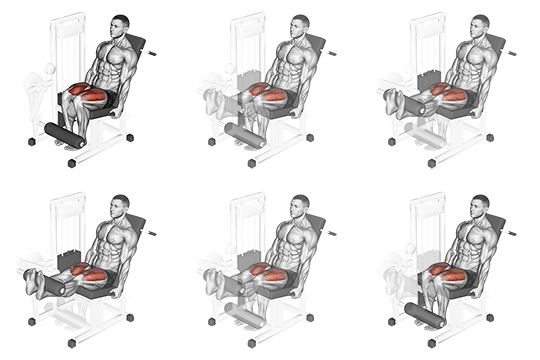
How to Do a Leg Extension
Adjust the seat and backrest: sit so the knee joint lines up closely with the machine's rotation axis and your back can remain supported.
Set the shin pad: position the lower-leg pad comfortably above the ankles rather than directly on the feet.
Secure your body: sit back into the pad, hold the handles if available, and keep the hips from lifting off the seat as the load gets harder.
Extend the knees under control: straighten the legs through the range you can control without kicking or using momentum.
Use a comfortable finish position: full knee extension can be used if it feels comfortable, but a forced pause at lockout is not required for muscle growth.
Lower slowly: bend the knees under control and keep tension on the quadriceps instead of allowing the weight stack to drop.
Repeat with the same setup: keep the hips, torso, and machine position consistent from rep to rep.
Form Check & Technique
DO THIS (Technique Tips)
- Align the knee with the machine pivot.
- Place the pad above the ankles.
- Keep the hips supported.
- Use a controlled extension instead of kicking.
- Choose a comfortable end range.
- Control the return without slamming the stack.
- Use moderate or high reps when appropriate.
- Combine leg extensions with compound leg training for broader lower-body development.
AVOID THIS (Common Mistakes)
- Seat Misaligned With the Knee — Fix: adjust the seat so the knee sits close to the machine's pivot point.
- Shin Pad Positioned on the Feet — Fix: place it comfortably above the ankles on the lower leg.
- Kicking the Weight Up — Fix: reduce load and use controlled knee extension.
- Hips Lifting From the Seat — Fix: hold the handles, sit firmly against the pad, and lower the load if needed.
- Weight Stack Slamming Down — Fix: control the eccentric phase all the way to the starting position.
- Forcing Painful End Range — Fix: use a comfortable range and modify load or machine setup if symptoms occur.
- Assuming a Pause Is Mandatory — Fix: use a pause only if it helps control; it is not required for hypertrophy.
About Leg Extension
The leg extension is a single-joint machine exercise that trains the quadriceps by extending the knee against resistance. It is an open-chain exercise, meaning the lower leg moves freely rather than the foot staying fixed to the floor or a platform. A well-performed leg extension uses a properly adjusted seat and shin pad, keeps the hips and back supported, extends the knees under control, and lowers the weight without letting the stack slam.
Leg Extension Muscles Worked
All four quadriceps muscles contribute to knee extension.
- Because the hip stays relatively fixed while the knee moves, seated leg extensions provide a direct way to train the quadriceps without requiring the hip extension, balance, and trunk demands of squats or leg presses.
- Research suggests knee-extension training can be especially useful for rectus femoris hypertrophy compared with some multi-joint leg exercises.
Sets & Reps Guidance
Technique / Learning
Technique: 2–3 sets of 10–15 light-to-moderate reps while learning seat position, pad alignment, and controlled extension.
Strength Focus
Heavier accessory work: 3–4 sets of 6–10 controlled reps when the machine setup is stable and the knees tolerate the load comfortably.
Muscle Growth (Hypertrophy)
Muscle growth: 2–4 sets of 10–20 reps taken close enough to muscular fatigue while maintaining a smooth tempo.
General training baseline. Need.fit automatically adjusts exact sets, reps, and working weight based on your individual fitness level, recovery, and progress over time.
Exercise Variations & Alternatives
Leg Press
A multi-joint machine exercise that trains the quadriceps along with the glutes and adductors.
Hack Squat
A guided compound squat machine that trains the quadriceps with additional hip involvement.
Barbell Back Squat
A free-weight compound squat with greater trunk and balance demands.
Goblet Squat
A front-loaded squat variation that is easy to learn and trains the quadriceps, glutes, and trunk.
Bulgarian Split Squat
A unilateral compound leg exercise that challenges quadriceps, glutes, and balance.
Front Squat
Learn proper front squat form, muscles worked, front-rack setup, grip options, elbow and foot cues, common mistakes, variations, and sets and reps.
Are Leg Extensions Bad for Your Knees?
Leg extensions are not automatically harmful to healthy knees.
- They create different joint forces from squats and leg presses because they are an open-chain exercise.
- Load, knee angle, training history, symptoms, and injury status matter.
- People with current knee pain, recent surgery, or rehabilitation restrictions should use an appropriate range and load based on professional guidance rather than assuming one rule applies to everyone.
How Should You Set Up the Leg Extension Machine?
Align the knee close to the machine's pivot, place the pad above the ankles, and adjust the backrest so the hips stay supported.
- Exact machine dimensions differ.
- If the hips lift, the pad feels awkward, or the knee cannot move comfortably, readjust the seat or load.
Do You Need to Pause at the Top of Leg Extensions?
No.
- A deliberate pause can be useful for learning control, but it is not required for hypertrophy.
- E3 Rehab notes that research does not show a top-position pause is necessary for muscle growth.
- Prioritize controlled repetitions and sufficient effort over forcing a one-second squeeze.
Should You Fully Lock Out Your Knees?
Use full or near-full knee extension if it is comfortable and controlled, but do not kick or snap aggressively into the end position.
- You can also stop slightly short if that better matches your tolerance or training goal.
- The important point is that the load stays controlled.
Leg Extension vs Squat
A leg extension isolates knee extension and directly trains the quadriceps, while a squat combines knee and hip extension and trains multiple lower-body and trunk muscles.
- They are complementary rather than interchangeable.
- Research shows exercise selection can produce different regional quadriceps hypertrophy.
Leg Extension vs Leg Press
The leg extension is a single-joint open-chain exercise.
- The leg press is a multi-joint machine movement using both the hips and knees.
- Recent research comparing the two found both can grow the quadriceps, while leg extension produced substantially more rectus femoris growth in the studied participants and leg press also grew the gluteus maximus and adductor magnus.
How Many Reps Should You Do on Leg Extensions?
Leg extensions are often programmed for moderate to high repetitions because the machine makes technique easy to standardize. Sets of roughly 8–20 reps are practical for muscle building, but lower or higher rep ranges can also work when effort, load, and control are appropriate.
Leg Extension Benefits
Leg extensions provide direct quadriceps work without grip, balance, or heavy trunk demands. They can add quad volume after compound exercises, help target the rectus femoris, and are also used in many rehabilitation settings when the load and range are selected appropriately.
Sources & References
- [1]
- [2]
- [3]The Role of Exercise Selection in Regional Muscle Hypertrophy: A Randomized Controlled Trial — PubMed (PMID: 34743671)View Source
- [4]The Effects of Hip Flexion Angle on Quadriceps Femoris Muscle Hypertrophy in the Leg Extension Exercise — PubMed (PMID: 39699974)View Source
- [5]Effect of Open vs. Closed Kinetic Chain Exercises in ACL Rehabilitation: A Systematic Review With Meta-Analysis — PubMed (PMID: 38887689)View Source