
Hack Squat
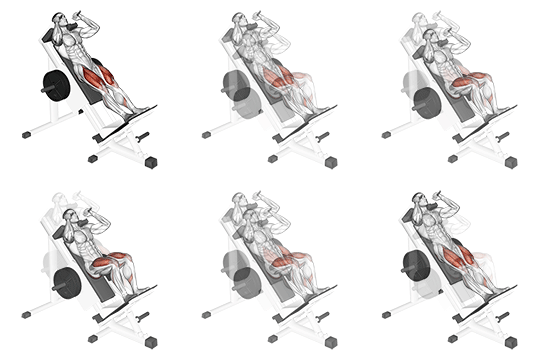
How to Do a Hack Squat
Set the machine: choose a manageable load and check the safety stops or release handles before starting.
Position your body: place your shoulders under the pads and keep your back and pelvis supported against the backrest.
Set your feet: start around shoulder width in the middle area of the platform with a comfortable toe angle. Adjust slightly based on machine design, ankle mobility, and hip comfort.
Unrack with control: extend the legs enough to release the safety handles without snapping the knees into lockout.
Lower the sled: bend the knees and hips while keeping the feet planted and the knees tracking in a stable direction with the toes.
Use your controlled depth: descend until you reach the deepest position you can maintain without the heels lifting or the pelvis and lower back losing contact with the pad.
Drive the platform away: extend the knees and hips smoothly through the whole foot while keeping the torso supported.
Finish without aggressive lockout: return to the top position under control, reset your breath, and repeat.
Form Check & Technique
DO THIS (Technique Tips)
- Learn the safety handles before loading heavily.
- Keep the back and shoulders supported.
- Start with shoulder-width foot placement.
- Maintain whole-foot pressure.
- Let the knees track with the toes.
- Use controlled depth.
- Avoid aggressive knee lockout.
- Progress load without sacrificing range of motion.
AVOID THIS (Common Mistakes)
- Going Too Heavy Too Soon — Fix: use a load that allows your intended controlled depth.
- Feet Positioned Uncomfortably High or Low — Fix: start near the middle of the platform and adjust gradually.
- Heels Lifting — Fix: change foot placement, ankle position, load, or depth until the whole foot stays planted.
- Knees Collapsing Inward — Fix: reduce load and maintain stable knee tracking with the toes.
- Pelvis or Lower Back Leaving the Pad — Fix: reduce depth or load and keep the torso supported.
- Dropping Quickly Into the Bottom — Fix: control the eccentric phase instead of bouncing on the machine.
- Snapping the Knees Into Lockout — Fix: finish the repetition smoothly under muscular control.
About Hack Squat
The machine hack squat is a compound lower-body exercise performed on a guided sled with the back and shoulders supported against pads. It heavily trains the quadriceps while the glutes and adductors assist with hip extension. Compared with a barbell back squat, the machine reduces balance and trunk-stabilization demands, which can make it easier to focus on loading the legs through a controlled squat range.
Hack Squat Muscles Worked
The hack squat strongly trains the quadriceps through repeated knee extension.
- The gluteus maximus and adductor magnus assist as the hips extend, and the calves help stabilize the ankle.
- Because the machine supports the torso and guides the sled, trunk-muscle demands are generally lower than in a free-weight back squat.
Sets & Reps Guidance
Technique / Learning
Technique: 2–3 sets of 8–12 reps with a light-to-moderate load while learning the machine, safety handles, and foot position.
Strength Focus
Strength-focused work: 3–5 sets of 4–8 reps using a load that keeps the back supported and depth consistent.
Muscle Growth (Hypertrophy)
Muscle growth: 3–5 sets of 8–15 reps with a controlled eccentric and stable foot placement.
General training baseline. Need.fit automatically adjusts exact sets, reps, and working weight based on your individual fitness level, recovery, and progress over time.
Exercise Variations & Alternatives
Leg Press
A seated or reclined machine press with lower balance and trunk demands.
Barbell Back Squat
A free-weight squat that requires more trunk stabilization and balance.
Front Squat
A front-loaded barbell squat with strong quadriceps and upper-back demands.
Goblet Squat
A beginner-friendly front-loaded squat using a dumbbell or kettlebell.
Leg Extension
A single-joint quadriceps exercise that removes the hip-extension component of squatting.
Bulgarian Split Squat
Learn Bulgarian split squat form, muscles worked, bench and foot setup, quad vs glute emphasis, common mistakes, variations, progression, sets and reps.
Hack Squat vs Barbell Back Squat
Both exercises train the quadriceps and glutes, but the hack squat supports the trunk and follows a guided path.
- Research comparing the two found back squats produced greater trunk-muscle activation, while hack squats allowed greater tested one-repetition maximum loads in the study.
- Use back squats for more free-weight coordination and trunk demand, and hack squats when you want a stable machine-based leg exercise.
Hack Squat vs Leg Press
Both are machine-based compound leg exercises, but their body positions differ.
- The hack squat keeps the torso more upright against a back pad while the sled moves along a squat-like path.
- The leg press places the torso in a seated or reclined position and pushes a platform away.
- Neither is universally better.
Where Should Your Feet Go on the Hack Squat?
Start around shoulder width near the middle of the platform.
- From there, make small changes to find a position that keeps the heels down, knees stable, and pelvis supported.
- Machine geometry varies, so an exact universal foot location is not appropriate.
How Deep Should You Hack Squat?
Lower through the deepest range you can control while keeping the feet planted and the pelvis and back supported. A knee angle around 90 degrees or thighs near parallel can be a useful checkpoint, but depth should match your mobility, machine design, and technique.
Should Your Knees Go Over Your Toes on a Hack Squat?
Some forward knee travel is expected in a squat pattern and can be substantial on a hack squat. Keep the whole foot planted and allow the knees to track naturally with the toes rather than trying to force them behind the toes.
Does Foot Placement Change Hack Squat Muscles Worked?
Foot position changes hip, knee, and ankle angles and can shift how the exercise feels.
- However, extreme claims that one placement isolates the outer quads, inner quads, or glutes are too strong.
- Choose a placement that produces stable technique and a useful range of motion.
How to Progress the Hack Squat
Learn the machine with a moderate load, then increase repetitions or resistance only when you can repeat the same foot placement and depth. The guided path makes progressive overload straightforward, but adding plates too quickly often shortens range of motion or changes pelvic position.
Hack Squat Benefits
Hack squats let you train the legs hard with less balance and trunk-stabilization demand than a free-weight back squat. They can be useful for beginners learning a guided squat pattern, for hypertrophy-focused training, or as a secondary squat after free-weight work.
Sources & References
- [1]
- [2]Trunk Muscle Activation in the Back and Hack Squat at the Same Relative Loads — PubMed (PMID: 28704312)View Source
- [3]A Biomechanical Review of the Squat Exercise: Implications for Clinical Practice — PubMed / PMC (PMID: 38576836)View Source