
Front Squat
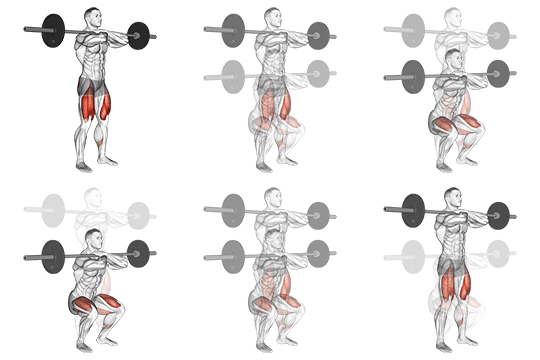
How to Do a Front Squat
Set the rack and safeties: position the bar just below shoulder height and set safety arms or pins when available.
Build the front rack: step under the bar and place it across the front shoulders. Use a clean-style fingertip grip, cross-arm grip, or straps if needed to create a secure position.
Drive the elbows up: keep the upper arms high enough to create a stable shelf for the bar without trying to hold the load in the hands.
Unrack and establish stance: stand the bar up, take a few controlled steps back, and use a stance around shoulder width as a starting point. Adjust toe angle to comfort and anatomy.
Brace and descend: inhale, create trunk tension, keep the elbows high, and squat between the legs by bending the hips and knees together.
Keep the whole foot connected: maintain contact through the heel and both sides of the forefoot while the knees track in a stable direction with the toes.
Reverse under control: descend through the deepest range you can control, then drive the floor away while keeping the elbows from dropping and the torso from collapsing forward.
Finish tall: extend the hips and knees, regain a stable top position, breathe, and repeat.
Form Check & Technique
DO THIS (Technique Tips)
- Bar on the front shoulders, not in the hands.
- Drive the elbows up.
- Brace before descending.
- Keep heel, big-toe side, and little-toe side planted.
- Let knees track with toes.
- Choose a grip your wrists tolerate.
- Keep the upper back active.
- Stand by driving the floor away.
AVOID THIS (Common Mistakes)
- Holding the Bar in the Hands — Fix: support the bar on the front shoulders and use the fingers mainly to guide it.
- Elbows Dropping — Fix: reduce the load and keep the elbows driving forward and up during the ascent.
- Heels Lifting — Fix: adjust stance, mobility demands, footwear, or depth so the whole foot stays connected.
- Knees Collapsing Inward — Fix: maintain stable tracking in the same general direction as the toes.
- Trying to Force a Perfectly Vertical Torso — Fix: stay as upright as your anatomy and bar balance allow without exaggerating posture.
- Front Rack Causing Wrist Pain — Fix: try fewer fingers, a cross-arm grip, or straps instead of forcing painful wrist extension.
- Losing the Brace at the Bottom — Fix: maintain trunk tension through the reversal.
About Front Squat
The front squat is a compound barbell squat performed with the bar supported across the front of the shoulders in a front-rack position. It heavily trains the quadriceps while the glutes, adductors, upper back, core, hamstrings, and calves contribute to the lift. Compared with a back squat, the front-loaded bar position generally encourages a more upright torso and makes front-rack mobility and upper-back control important parts of proper form.
Front Squat Muscles Worked
The quadriceps are heavily involved in the front squat because the movement requires substantial knee extension.
- The glutes and adductors contribute to hip extension, while the upper back and trunk musculature work to keep the front-loaded bar supported and the torso controlled.
- Hamstrings and calves also contribute to lower-body control.
- Muscle recruitment depends on load, depth, stance, and the lifter's anatomy.
Sets & Reps Guidance
Technique / Learning
Technique: 2–4 sets of 3–5 reps with an empty bar or manageable load while practicing the rack, stance, and elbow position.
Strength Focus
Strength: 3–5 sets of 3–6 reps using a load that preserves the front rack and upright torso control.
Muscle Growth (Hypertrophy)
Muscle growth: 3–4 sets of 5–10 reps when high elbows, whole-foot pressure, and depth remain consistent.
General training baseline. Need.fit automatically adjusts exact sets, reps, and working weight based on your individual fitness level, recovery, and progress over time.
Exercise Variations & Alternatives
Barbell Back Squat
Places the bar on the upper back and usually allows heavier absolute loading with different torso mechanics.
Goblet Squat
Uses a front-held dumbbell or kettlebell and can help teach an upright squat pattern with less setup complexity.
Bulgarian Split Squat
Trains one leg at a time with the rear foot elevated, adding balance and unilateral strength demands.
Leg Press
A machine-based compound leg exercise that reduces balance and front-rack requirements.
Dumbbell Lunge
Learn proper dumbbell lunge form, muscles worked, step length and knee cues, common mistakes, forward vs reverse variations, plus practical sets and reps.
Leg Extension
Learn proper leg extension form, muscles worked, machine setup and knee cues, common mistakes, knee-safety context, variations, and practical sets and reps.
How High Should Your Elbows Be in a Front Squat?
Keep the elbows high enough that the upper arms support a secure front-rack shelf and the bar does not roll forward.
- If the elbows drop significantly during the ascent, the torso often follows.
- Think 'elbows forward and up' rather than forcing one exact angle.
Front Squat Grip Options
The clean-style fingertip grip is common, but it is not the only valid option.
- A cross-arm grip or straps can reduce wrist demands while preserving the front-loaded bar position.
- Choose the grip that keeps the bar secure and the elbows high without unnecessary wrist pain.
Do Your Knees Have to Stay Behind Your Toes?
No.
- Some forward knee travel is normal in a front squat and can help maintain the upright torso required by the front-loaded bar.
- Keep the whole foot planted and allow the knees to track with the toes instead of forcing them backward.
How Deep Should You Front Squat?
Squat as deep as you can while maintaining foot pressure, a stable trunk, high elbows, and a secure front rack. Many lifters can reach deep positions in the front squat, but ankle, hip, and upper-body mobility influence the usable range.
Front Squat vs Back Squat
Both exercises train the lower body effectively.
- The front squat places the bar in front of the torso and generally produces a more upright trunk, while the back squat carries the bar on the upper back and usually allows heavier absolute loads.
- Research in trained lifters has found meaningful biomechanical differences without showing that one style is universally better.
Why Does the Bar Roll Forward in a Front Squat?
The bar usually rolls when the elbows drop, the upper back loses position, the load is too heavy, or the front rack was not secure before the descent. Reduce the load and practice keeping the bar balanced on the shoulder shelf rather than trying to hold it up with the hands.
Front Squat Benefits
Front squats train the squat pattern with a strong quadriceps demand and challenge the upper back and trunk to resist forward collapse. They are also closely related to the receiving position used in Olympic weightlifting cleans.
Sources & References
- [1]
- [2]
- [3]A Biomechanical Comparison of Back and Front Squats in Healthy Trained Individuals — PubMed (PMID: 19002072)View Source
- [4]Kinematic and EMG Activities During Front and Back Squat Variations in Maximum Loads — PubMed (PMID: 25630691)View Source