
Dumbbell Lunge
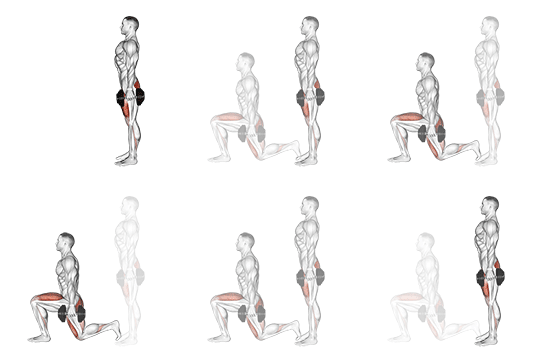
How to Do a Dumbbell Lunge
Set the start position: stand tall with a dumbbell in each hand, arms relaxed at the sides, feet around hip to shoulder width, and the trunk braced.
Step forward under control: take a comfortable step with one leg and place the whole front foot on the floor instead of landing only on the heel or toes.
Lower into the lunge: bend both knees and lower the hips while the rear knee travels toward the floor. A roughly 90-degree knee position can be a useful checkpoint but does not need to be exact.
Keep the front leg stable: let the front knee track in the same general direction as the toes and keep the front foot planted. Some forward knee travel can be normal.
Control the torso: stay balanced over the stance rather than collapsing sideways. A small forward torso lean can occur naturally depending on stride length and training emphasis.
Push back to standing: drive through the front foot to reverse the step and return to the starting position without bouncing off the rear leg.
Alternate or complete one side: repeat on the other leg or complete the planned repetitions on one side according to your program.
Form Check & Technique
DO THIS (Technique Tips)
- Start with bodyweight before heavy dumbbells.
- Land with the whole front foot.
- Use a repeatable stride length.
- Track the front knee with the foot.
- Lower the rear knee under control.
- Keep the pelvis and torso balanced.
- Push through the front leg to return.
- Train both sides with the same setup.
AVOID THIS (Common Mistakes)
- Taking an Unstable Step — Fix: shorten or lengthen the stride until you can land with the entire front foot planted.
- Front Knee Collapsing Inward — Fix: reduce load and keep the knee tracking in a stable direction with the toes.
- Slamming the Rear Knee Into the Floor — Fix: lower under control and stop just above the floor or at your chosen range.
- Using the Rear Leg to Push Back — Fix: drive primarily through the front leg when returning to the start.
- Losing Side-to-Side Balance — Fix: reduce the load and widen the starting stance slightly if needed.
- Rushing the Step — Fix: control both the landing and the return instead of using momentum.
- Choosing Weight Before Mastering Bodyweight Form — Fix: make the movement repeatable first, then add dumbbells progressively.
About Dumbbell Lunge
The dumbbell lunge is a compound unilateral lower-body exercise performed by stepping into a split stance while holding dumbbells at the sides. It trains the quadriceps and glutes while the hamstrings, calves, adductors, hip stabilizers, and core help control the step and return. A strong dumbbell lunge uses a stable front foot, controlled knee tracking, a stride length that matches the lifter's anatomy and training goal, and a smooth push through the front leg.
Dumbbell Lunge Muscles Worked
The quadriceps extend the front knee and the gluteus maximus contributes strongly to hip extension as you rise from the lunge.
- The hamstrings and adductors assist lower-body control, while the gluteus medius, calves, core, and other stabilizers help manage single-leg balance and pelvis position.
- Forward lunges can produce high activity in the quadriceps, gluteus maximus, and gluteus medius.
Sets & Reps Guidance
Technique / Learning
Technique: 2–3 sets of 6–10 bodyweight or light-dumbbell reps per leg while learning balance, step length, and knee tracking.
Strength Focus
Strength: 3–4 sets of 5–8 reps per leg using dumbbells that allow a stable step, controlled depth, and powerful return.
Muscle Growth (Hypertrophy)
Muscle growth: 3–4 sets of 8–12 reps per leg with a repeatable stride and controlled eccentric phase.
General training baseline. Need.fit automatically adjusts exact sets, reps, and working weight based on your individual fitness level, recovery, and progress over time.
Exercise Variations & Alternatives
Bulgarian Split Squat
A rear-foot-elevated fixed-stance unilateral squat that removes the repeated stepping portion.
Goblet Squat
A bilateral front-loaded squat with lower single-leg balance demands.
Barbell Back Squat
A bilateral barbell squat that allows heavier total loading.
Front Squat
A front-loaded barbell squat that emphasizes quadriceps and upper-back control.
Leg Press
A machine-based bilateral leg exercise that minimizes balance demands.
Leg Extension
Learn proper leg extension form, muscles worked, machine setup and knee cues, common mistakes, knee-safety context, variations, and practical sets and reps.
How Long Should Your Lunge Step Be?
There is no single ideal stride length.
- A shorter step usually creates more knee flexion, while a longer step increases hip motion and can change glute, hamstring, adductor, and calf demands.
- Recent research found generally greater lower-extremity muscle activity with longer forward-lunge steps in the tested participants.
- Choose a step length that keeps the front foot planted and the movement balanced.
Forward Lunge vs Reverse Lunge
A forward lunge requires you to step out, decelerate the body, and push back to the start.
- A reverse lunge steps backward and can feel easier to control for some lifters because the front foot remains planted.
- Neither is universally better; choose the direction that matches your goals, balance, and comfort.
Dumbbell Lunge vs Walking Lunge
A standard forward lunge returns to the same starting position after each repetition, while a walking lunge continues moving forward.
- Walking lunges add more continuous balance and locomotion demands.
- Stationary or returning lunges are often easier to standardize for strength training.
Can Your Knee Go Past Your Toes During Lunges?
Some forward knee travel can be normal and depends on stride length, ankle mobility, limb proportions, and torso position. Rather than forcing the knee behind the toes, keep the front foot planted and the knee tracking in a stable direction with the foot.
Are Dumbbell Lunges Better for Quads or Glutes?
Dumbbell lunges train both.
- A shorter, more upright lunge generally increases knee demand, while a longer stride and greater hip flexion can increase hip-extensor involvement.
- These changes shift emphasis rather than isolating one muscle group.
Dumbbell Lunge vs Bulgarian Split Squat
The dumbbell lunge includes a step and return, while the Bulgarian split squat uses a fixed split stance with the rear foot elevated. Lunges add more deceleration and stepping control; Bulgarian split squats make it easier to repeat the same stance and load one leg through multiple reps.
How to Progress Dumbbell Lunges
Start with bodyweight lunges until step length and balance are repeatable.
- Add light dumbbells, then progress repetitions or load while preserving front-foot pressure and knee control.
- Walking lunges, reverse lunges, deficit lunges, or Bulgarian split squats can be added later for different challenges.
Dumbbell Lunge Benefits
Dumbbell lunges train lower-body strength one leg at a time, challenge balance and pelvis control, require little equipment, and can help expose side-to-side differences. They fit leg workouts, full-body sessions, hypertrophy programs, and general strength training.
Sources & References
- [1]
- [2]
- [3]Effects of Step Length and Stride Variation During Forward Lunges on Lower-Extremity Muscle Activity — PubMed (PMID: 39982282)View Source