
T-Bar Row
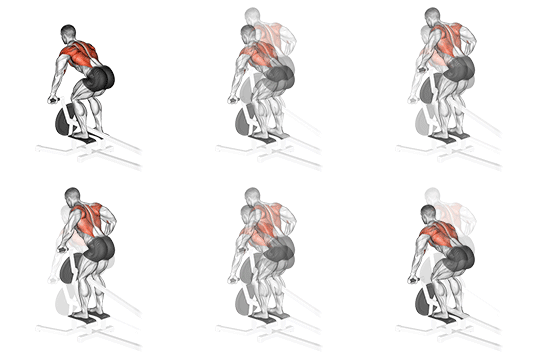
How to Do a T-Bar Row
Anchor and Load the Bar: Secure one end of a barbell in a landmine swivel attachment or stable approved corner anchor, then load weight plates onto the free sleeve end.
Choose and Secure the Handle: Attach a parallel close-grip or wide-grip T-bar handle under the barbell, and stand over the bar with a sturdy, balanced foot stance.
Hinge Into Position: Push your hips backward and assume a braced torso angle that you can hold securely, without forcing a rigid 45-degree posture.
Brace the Trunk: Engage your core abdominals, glutes, and lower back so your unsupported torso remains stable throughout the set.
Row Through the Pivoting Arc: Drive your elbows backward, pulling the handle toward your lower ribs or upper abdomen while managing the bar's natural arc trajectory.
Finish Without Excessive Torso Extension: Retract your shoulder blades cleanly at the top of the pull without standing up increasingly upright to complete reps.
Lower Under Control: Extend your arms smoothly, allowing controlled forward scapular movement as the bar returns along its pivoting arc.
Form Check & Technique
DO THIS (Technique Tips)
- Secure bar in landmine base.
- Straddle bar with wide stance.
- Hinge at hips with neutral spine.
- Brace core abdominals and glutes.
- Pull handle along bar arc.
- Touch lower ribs or upper waist.
- Retract scapulae fully at top.
- Control lowering back to stretch.
AVOID THIS (Common Mistakes)
- Using an unstable landmine setup — Fix: Secure the bar in an approved landmine sleeve or heavy corner anchor.
- Forcing a magic 45-degree torso — Fix: Adopt a natural hip-hinge angle compatible with your body build and plate clearance.
- Standing up during every rep — Fix: Maintain a fixed hip hinge and pull with your back rather than lifting with your hips.
- Loading before mastering the arc — Fix: Master the barbell's pivoting trajectory before adding heavy plates.
- Pulling excessively high — Fix: Guide the handle toward your lower ribs or upper waist level.
- Shrugging aggressively — Fix: Keep neck relaxed and direct elbows back rather than lifting traps upward.
- Using a handle that limits range — Fix: Use smaller plates (25s or 35s) or a handle attachment that prevents premature plate contact.
- Treating chest-supported and unsupported rows as identical — Fix: Adjust your core bracing according to whether external chest support is present.
About T-Bar Row
The T-Bar Row is a horizontal pulling exercise commonly performed by anchoring one end of a barbell and rowing the loaded end through an arc. It trains the lats and mid-to-upper back while the rear delts and elbow flexors assist; unsupported landmine versions also require the trunk and hips to maintain the hinged position.
Muscles Worked by the T-Bar Row
The T-Bar Row provides compound multi-joint resistance along a fixed pivoting arc.
- The latissimus dorsi, middle trapezius, and rhomboids generate force to extend the shoulder joint and retract the scapulae.
- The arm flexors (biceps brachii, brachialis, brachioradialis) assist elbow flexion, and the rear deltoid and teres major stabilize upper arm movement.
- In unsupported landmine setups, the erector spinae, glutes, and core work statically to maintain hip-hinge stability against gravity.
Sets & Reps Guidance
Technique / Learning
Strength-oriented: 3–5 sets of 5–8 reps with heavy controlled weight.
Strength Focus
General muscle work: 3–4 sets of 6–12 reps near technical failure.
Muscle Growth (Hypertrophy)
Higher-rep/chest-supported accessory: 2–4 sets of 10–15 reps for high volume.
General training baseline. Need.fit automatically adjusts exact sets, reps, and working weight based on your individual fitness level, recovery, and progress over time.
Exercise Variations & Alternatives
Barbell Bent-Over Row
Bilateral free-barbell horizontal row.
Seated Cable Row
Seated cable horizontal pull.
Deadlift
Learn proper deadlift form, muscles worked, setup, bracing and bar-path cues, common mistakes, variations, and practical sets and reps.
Pull-Up
Learn proper pull-up form, muscles worked, grip and range-of-motion cues, common mistakes, progressions, and practical sets and reps.
Chin-Up
Learn proper chin-up form, muscles worked, underhand-grip setup, range-of-motion cues, common mistakes, progressions, and practical sets and reps.
Lat Pulldown
Learn proper lat pulldown form, muscles worked, grip-width and torso-position cues, common mistakes, pull-up differences, and practical sets and reps.
Which T-Bar Row Does This Guide Cover?
This guide primarily focuses on the landmine / barbell T-Bar Row, where a free barbell is anchored at one end. We also provide clear comparisons for fixed chest-supported T-bar row machines so you can apply the proper setup for your gym's equipment.
How to Set Up a Landmine T-Bar Row
Place one end of an Olympic barbell into a floor landmine swivel sleeve or secure heavy rubber corner anchor. Slide a double-D handle or specialized landmine attachment underneath the collar, load smaller diameter plates (such as 25s or 35s) to preserve pulling range of motion, and straddle the bar.
What Torso Angle Should You Use?
Do not force a rigid 45-degree rule. Choose a stable hip-hinge angle between 30 and 60 degrees relative to horizontal that you can comfortably maintain while allowing the loaded plates to clear your body and reach your lower ribcage.
What Handle Should You Use?
A close neutral parallel handle (V-bar) is most popular because it keeps elbows tucked in a comfortable mechanical plane. Wide overhand handles allow elbow flare for upper-back thickness, while swiveling stirrup handles reduce wrist strain.
Close-Grip vs Wide-Grip T-Bar Row
Close-grip T-bar rows encourage elbow tuck, emphasizing shoulder extension and lat recruitment. Wide-grip T-bar rows flare elbows out, placing greater work on the rhomboids, middle trapezius, and posterior deltoids.
Where Should You Pull the Handle?
Pull the handle toward your lower ribcage or upper waist. Pulling high toward your chest forces unwanted shoulder shrugging and forces the bar arc into an awkward angle.
Should Your Shoulder Blades Move?
Yes, allow controlled scapular movement. Permit your shoulder blades to protract forward at the bottom stretch position and retract firmly toward your spine at the top of the pull.
Landmine T-Bar Row vs Chest-Supported T-Bar Row
Unsupported landmine rows require active lower back, glute, and core isometric stabilization to hold the hip hinge while rowing through an open arc. Chest-supported T-bar rows eliminate lumbar strain by supporting the torso on a pad, isolating the upper-back pulling muscles.
T-Bar Row vs Barbell Bent-Over Row
Free barbell rows move linearly through unconstrained space. T-Bar rows move along a fixed pivoting arc, altering leverage as the weight approaches your torso.
T-Bar Row vs Seated Cable Row
T-Bar rows require standing hip-hinge control and feature an ascending arc path. Seated cable rows use a flat seated posture and linear cable tension line.
Sources & References
- [1]Comparison of Different Row Exercises: Trunk Muscle Activation and Lumbar Spine Load — PubMed (PMID: 19197209)View Source
- [2]Electromyographic Analysis of Muscle Activation During Horizontal Rowing Exercises — PubMed (PMID: 24077382)View Source
- [3]
- [4]Surface EMG Analysis of Upper Body Musculature in Rowing Variations — PubMed (PMID: 28011412)View Source
- [5]
- [6]
- [7]Biomechanical Loading and Scapular Motion in Free Weight Exercises — PubMed (PMID: 34875981)View Source