
Deadlift
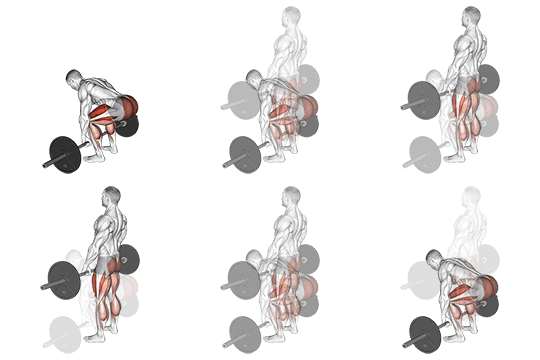
How to Do a Deadlift
Position the bar: stand roughly hip-width with a comfortable toe angle and place the bar approximately over the middle of the foot, close enough that your final setup does not require rolling it forward.
Grip the bar: hinge down and take a grip just outside your legs with straight arms, starting with a double-overhand grip when practical.
Set the legs and hips: bend the knees until the shins approach the bar without rolling it forward, letting your body proportions determine hip height while the bar stays balanced over the foot.
Brace and build tension: take a breath, create trunk tension around the torso, set the upper body, and pull the slack out by making the arms and lats tight before the plates leave the floor.
Push the floor away: begin by extending the knees and hips together, keeping balance over the foot and avoiding hips shooting upward while the bar stays on the floor.
Keep the bar close and stand tall: guide the bar close to the legs, continue hip and knee extension, and finish standing tall with hips and knees extended without leaning backward aggressively.
Return and reset: move the hips backward first, keep the bar close, bend the knees more after the bar clears them, return the plates to the floor under control, and reset the start position before the next technique rep.
Form Check & Technique
DO THIS (Technique Tips)
- Bar over midfoot.
- Build tension, then push.
- Keep the bar close.
- Push the floor away.
- Do not force the hips low.
- Stand tall; do not lean back.
- Hinge first on the way down.
- Reset your start position.
AVOID THIS (Common Mistakes)
- Bar Starts Too Far Forward — Fix: Set it near midfoot before finalizing the setup.
- Hips Forced Too Low — Fix: Let hip height come from your usable setup geometry rather than trying to squat the bar.
- Jerking the Bar From Slack — Fix: Brace and build tension before the plates leave the floor.
- Bar Drifts Away — Fix: Keep the bar close throughout the pull.
- Hips Shoot Up Before the Bar Moves — Fix: Coordinate knee and hip extension rather than letting the knees straighten while the bar stays on the floor.
- Trunk Position Changes Suddenly — Fix: Use a load and setup you can maintain repeatably.
- Leaning Back at Lockout — Fix: Finish standing tall instead.
- Squatting the Bar Down — Fix: Hinge the hips first, then bend the knees after the bar clears them.
About Deadlift
The deadlift is a compound barbell exercise that starts with the weight on the floor and uses coordinated hip and knee extension to stand with it. A strong conventional deadlift starts with the bar near the midfoot, uses a braced trunk, keeps the bar close, and finishes standing tall without leaning backward.
Muscles Worked by the Deadlift
The deadlift trains several major muscle groups at once rather than isolating the lower back.
- Gluteus maximus drives hip extension, quadriceps help extend the knees from the floor, hamstrings and adductor magnus support posterior-chain demands, erector spinae maintain trunk position, lats and traps control the bar, the core adds trunk stiffness, and forearms and finger flexors hold the bar.
Sets & Reps Guidance
Technique / Learning
General Strength: 3–5 sets of 3–6 reps using small load increases only when setup consistency and repetition quality stay intact.
Strength Focus
Technique: 2–4 sets of 3–5 reps with a manageable load and a reset between reps.
Muscle Growth (Hypertrophy)
Moderate-Rep Strength / Muscle Work: 2–4 sets of 5–8 reps when bar path, bracing, and return mechanics remain controlled.
General training baseline. Need.fit automatically adjusts exact sets, reps, and working weight based on your individual fitness level, recovery, and progress over time.
Exercise Variations & Alternatives
Romanian Deadlift
A standing hip-hinge variation with less knee-angle change and no floor reset.
Stiff-Leg Deadlift
A straighter-leg hinge variation that shifts the movement intent toward posterior-chain control.
Sumo Deadlift
A wide-stance deadlift variation with different joint positions and demands.
Trap-Bar Deadlift
A deadlift pattern performed with the lifter inside a hex or trap bar.
Rack Pull
A reduced-range pull that starts with the bar elevated.
Pull-Up
Learn proper pull-up form, muscles worked, grip and range-of-motion cues, common mistakes, progressions, and practical sets and reps.
Where Should the Bar Start for a Deadlift?
Start with the bar roughly over the midfoot.
- This keeps the load close to the body's base of support and helps you bend the knees without pushing the bar forward.
- Avoid rigid inch or centimeter rules; stance, shoe shape, and body proportions change how the setup looks.
How High Should Your Hips Be in a Deadlift?
There is no single ideal hip height for everyone.
- Femur length, torso length, arm length, stance, mobility, and bar position all influence the start.
- Set the hips where you can keep the bar over the midfoot, arms straight, a stable trunk, and enough knee flexion to push without moving the bar forward.
- Do not force the hips lower than your setup requires; the start is not simply a deep squat.
How to Brace for a Deadlift
Take a breath and create circumferential trunk tension before initiating the pull.
- Brace to resist unwanted torso movement rather than sucking the stomach inward.
- Pulling the slack out means building tension through the arms, lats, and bar before the plates leave the floor: build tension, then push.
Should Your Back Be Completely Straight When Deadlifting?
For general deadlift instruction, aim for a stable and repeatable trunk position that does not unexpectedly change as the bar leaves the floor.
- Some spinal flexion occurs in real lifting, and visible flexion is not automatically equivalent to injury.
- Load, fatigue, training history, movement control, individual tolerance, and exposure also matter.
Why the Bar Should Stay Close
Keeping the bar close helps maintain an efficient deadlift bar path and reduces unnecessary forward displacement.
- When the bar drifts forward, the horizontal distance between the load and the hips and trunk generally increases, changing external moment arms and making the lift harder.
- The bar does not have to scrape your legs.
How Should You Lock Out a Deadlift?
Finish standing tall with hips and knees extended and the bar controlled.
- Do not lean backward aggressively, hyperextend the lower back, or force the hips past normal standing.
- Stand tall; do not lean back.
Deadlift vs Romanian Deadlift
The conventional deadlift starts from the floor, uses more knee flexion, has greater knee-extension involvement, and can reset before each full floor-to-lockout pull.
- The Romanian deadlift normally begins from standing, uses a smaller knee-angle change, emphasizes a hip hinge, and usually does not reset on the floor.
- Neither is universally better.
Conventional vs Sumo Deadlift
A036 is the conventional barbell deadlift.
- Conventional deadlifts use a narrower stance and often more hip flexion, while sumo deadlifts use a wider stance, a more upright trunk in many lifters, and different joint demands.
- Neither style is universally better, and sumo is not cheating.
Sources & References
- [1]Electromyographic Activity in Deadlift Exercise and Its Variants: A Systematic Review — PubMed (PMID: 32107499)View Source
- [2]Biomechanical Analysis of the Deadlift During the 1999 Special Olympics World Games — PubMed (PMID: 11474337)View Source
- [3]To Flex or Not to Flex? Lumbar Spine Flexion During Lifting and Low Back Pain — PubMed (PMID: 31775556)View Source
- [4]Beyond the Neutral Spine: A Narrative Review and Modern Framework for Deadlift Injury Prevention — PubMed (PMID: 42043083)View Source
- [5]
- [6]An Electromyographic and Kinetic Comparison of Conventional and Romanian Deadlifts — PubMed (PMID: 30662500)View Source
- [7]A Three-Dimensional Biomechanical Analysis of Sumo and Conventional Style Deadlifts — PubMed (PMID: 10912892)View Source
- [8]