
Lat Pulldown
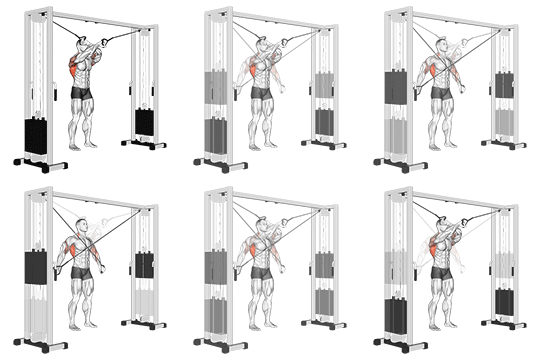
How to Do a Lat Pulldown
Adjust the Seat and Thigh Pad: Secure your thighs firmly under the pad so your feet remain flat on the floor and your lower body stays anchored.
Set Your Grip: Take an overhand (pronated) grip slightly wider than shoulder width on the pulldown bar.
Establish the Torso: Sit tall with a comfortable, small backward torso angle (10–15°) while keeping your chest lifted.
Start From a Controlled Overhead Position: Allow your arms to extend overhead under cable tension without letting your shoulders shrug passively.
Pull the Elbows Down: Guide the bar downward toward your upper chest by driving your elbows down toward your ribcage.
Finish Without Turning It Into a Row: Touch or bring the bar close to your upper chest without swinging your torso backward excessively.
Return Under Control: Extend your arms upward slowly, allowing controlled scapular elevation before starting the next rep.
Form Check & Technique
DO THIS (Technique Tips)
- Lock thighs under pad.
- Grip 1.25–1.5x shoulder width.
- Slight 10–15° backward lean.
- Initiate by depressing shoulders.
- Drive elbows down to ribs.
- Touch bar to upper chest.
- Control the ascent stretch.
- Avoid pulling behind neck.
AVOID THIS (Common Mistakes)
- Pulling behind the neck — Fix: Pull the bar to the upper chest in front of your body.
- Leaning back excessively — Fix: Maintain a stable 10–15° torso angle throughout the pull.
- Using momentum to jerk the cable — Fix: Choose a manageable weight and pull with controlled movement.
- Grip excessively wide — Fix: Set hand position 1.25–1.5x shoulder width for optimal range of motion.
- Pulling down to belly button — Fix: Stop the bar at upper chest height near the collarbones.
- Shrugging shoulders at top — Fix: Depress shoulder blades as you initiate the pull.
- Releasing the weight rapidly — Fix: Control the 2–3 second ascent overhead.
- Thighs loose under pad — Fix: Adjust pad tightly against thighs to prevent lower body lifting.
About Lat Pulldown
The lat pulldown is a cable-based vertical pulling exercise performed from a seated position. It targets the latissimus dorsi, upper back, and elbow flexors while allowing precise, incremental load adjustments. A proper lat pulldown secures the thighs under an adjustable thigh pad, uses a stable torso position with a subtle backward lean, and drives the elbows down to pull the bar toward the upper chest.
Muscles Worked by the Lat Pulldown
The lat pulldown effectively isolates vertical shoulder adduction and shoulder extension.
- The latissimus dorsi performs the primary work by pulling the upper arm downward toward the torso.
- The elbow flexors (biceps brachii, brachialis, and brachioradialis) assist throughout elbow flexion, while the rhomboids, middle and lower trapezius, and rear deltoids depress, retract, and stabilize the shoulder girdle throughout the movement.
Sets & Reps Guidance
Technique / Learning
Technique: 2–3 sets of 8–12 reps with light weight focusing on lat engagement.
Strength Focus
Muscle-focused: 3–4 sets of 8–15 reps with progressive resistance.
Muscle Growth (Hypertrophy)
Higher-rep accessory work: 2–4 sets of 12–20 reps for high volume and pump.
General training baseline. Need.fit automatically adjusts exact sets, reps, and working weight based on your individual fitness level, recovery, and progress over time.
Exercise Variations & Alternatives
Pull-Up
Bodyweight vertical pull using overhand grip.
Chin-Up
Underhand bodyweight vertical pull.
Deadlift
Learn proper deadlift form, muscles worked, setup, bracing and bar-path cues, common mistakes, variations, and practical sets and reps.
Barbell Bent-Over Row
Learn barbell bent-over row form, muscles worked, torso-angle and bar-path cues, common mistakes, grip options, and practical sets and reps.
Single-Arm Dumbbell Row
Learn single-arm dumbbell row form, muscles worked, bench setup, dumbbell and elbow path, torso-rotation cues, mistakes, and practical sets and reps.
Seated Cable Row
Learn seated cable row form, muscles worked, handle and grip options, scapular-motion and torso cues, common mistakes, and practical sets and reps.
How Wide Should Your Lat Pulldown Grip Be?
A grip width approximately 1.25 to 1.5 times shoulder width is ideal for most lifters. This hand placement permits a full stretch overhead and clean elbow tracking without straining the shoulder joint or shortening the effective pulling range of motion unnecessarily.
Wide vs Close-Grip Lat Pulldown
Wide overhand pulldowns emphasize frontal-plane shoulder adduction and upper lat development, whereas close neutral or underhand pulldowns increase sagittal-plane shoulder extension range and arm flexor contribution. Both variations train the latissimus dorsi effectively when performed with consistent technique and full range of motion.
Overhand vs Underhand vs Neutral Grip
Overhand grips emphasize lat adduction and upper back control.
- Underhand (supinated) grips recruit more biceps involvement and elbow flexion assistance.
- Neutral grips (palms facing each other) offer excellent wrist and shoulder comfort for lifters with joint sensitivity or mobility limitations.
Where Should the Lat Pulldown Bar Travel?
The bar should travel in a smooth vertical path directly toward the upper chest near the collarbones. Avoid pulling the bar down to stomach level, which requires excessive backward leaning and transforms the vertical pull into an inefficient horizontal row movement.
How Far Should You Lean Back?
A slight torso lean of 10–15 degrees is normal and allows the cable bar to clear your face safely during the descent. However, leaning backward beyond 30 degrees relies on body momentum and shifts tension away from the lats onto the mid-back horizontal rowing musculature.
Should You Pull the Bar Behind Your Neck?
Behind-the-neck pulldowns place the shoulder joint in extreme external rotation and horizontal abduction, increasing risk of shoulder impingement and cervical spine strain. Front pulldowns are far safer and equally or more effective for lat muscle growth.
Lat Pulldown Range of Motion
Achieve a full overhead stretch at the top of every rep by allowing your scapulae to elevate naturally under control, then pull smoothly until the bar reaches upper chest height before reversing the movement under full muscular control.
Lat Pulldown vs Pull-Up
Lat pulldowns allow precise incremental weight adjustments and isolate vertical pulling mechanics without bodyweight constraints, making them ideal for beginners, volume work, and targeted hypertrophy. Pull-ups require full bodyweight control and total-body core stabilization.
Sources & References
- [1]Effects of Grip Width on Muscle Strength and Activation in the Lat Pull-Down — PubMed (PMID: 24662157)View Source
- [2]
- [3]
- [4]
- [5]
- [6]
- [7]