
Seated Cable Row
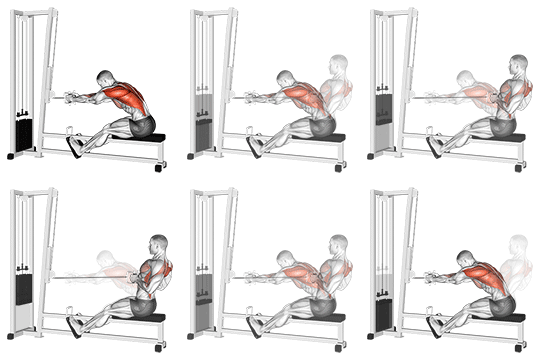
How to Do a Seated Cable Row
Set the Seat, Foot Position and Handle: Place your feet securely on the foot plates with knees softly bent, and select a handle attachment that permits a comfortable grip.
Establish the Starting Position: Sit upright with tall spinal alignment, grip the handle firmly, and establish a controlled initial torso angle.
Reach Forward Under Control: Extend your arms forward smoothly, allowing controlled scapular protraction and a minor, natural forward torso inclination if appropriate for your setup.
Brace Before Pulling: Create sufficient trunk tension so your torso remains stable and does not rock uncontrollably when load is applied.
Row the Handle Toward the Body: Drive your elbows backward according to your chosen handle and guide the attachment toward your lower ribs or upper abdomen.
Finish With Controlled Scapular Retraction: Bring your shoulder blades together naturally at the finish without forcing excessive squeezing or leaning far backward.
Return Smoothly: Extend your elbows under control, allow smooth forward scapular movement, and maintain control of the weight stack before starting the next rep.
Form Check & Technique
DO THIS (Technique Tips)
- Plant feet firmly on foot plates.
- Keep knees softly flexed.
- Maintain upright braced spine.
- Reach forward into full stretch.
- Drive elbows back toward lower ribs.
- Retract shoulder blades cleanly at top.
- Control 2-second eccentric return.
- Avoid swinging cable stack.
AVOID THIS (Common Mistakes)
- Rocking the torso excessively — Fix: Reduce load and maintain controlled, stable torso position throughout.
- Keeping the scapula permanently pinned — Fix: Allow controlled scapular protraction forward during the eccentric reach.
- Letting the weight stack slam — Fix: Control the eccentric return over 2 seconds before reaching bottom.
- Using an awkward attachment — Fix: Choose a handle attachment compatible with wrist, forearm, and shoulder comfort.
- Pulling far too high — Fix: Match handle endpoint to your lower ribs or upper belly button level.
- Collapsing forward for extra ROM — Fix: Reach forward through your shoulder blades without losing lumbar spine alignment.
- Shrugging throughout the row — Fix: Keep your neck relaxed and direct your elbows back and down.
- Using load that shortens repetition range — Fix: Reduce cable stack weight and execute complete range of motion.
About Seated Cable Row
The seated cable row is a compound horizontal pulling exercise that trains the lats and mid-to-upper back while the rear delts, elbow flexors, forearms and trunk contribute. Its seated cable setup makes resistance easy to adjust and lets you change handle width, elbow path and line of pull without maintaining a standing hip hinge.
Muscles Worked by the Seated Cable Row
The seated cable row provides continuous horizontal resistance throughout the horizontal pulling pattern.
- The latissimus dorsi, middle trapezius, and rhomboids work in coordination to extend the shoulder joint and retract the scapulae.
- The elbow flexors (biceps brachii, brachialis, and brachioradialis) assist during pulling, while the rear deltoid and upper back musculature control upper-arm trajectory.
- Erector spinae and abdominal core muscles provide static trunk stability.
Sets & Reps Guidance
Technique / Learning
Strength-oriented: 3–4 sets of 6–10 reps with controlled heavy resistance.
Strength Focus
General muscle work: 3–4 sets of 8–15 reps focusing on smooth reps.
Muscle Growth (Hypertrophy)
Higher-rep accessory: 2–4 sets of 12–20 reps for high volume and tension.
General training baseline. Need.fit automatically adjusts exact sets, reps, and working weight based on your individual fitness level, recovery, and progress over time.
Exercise Variations & Alternatives
Single-Arm Dumbbell Row
Unilateral supported dumbbell row variation.
T-Bar Row
Pivoting landmine horizontal row.
Deadlift
Learn proper deadlift form, muscles worked, setup, bracing and bar-path cues, common mistakes, variations, and practical sets and reps.
Pull-Up
Learn proper pull-up form, muscles worked, grip and range-of-motion cues, common mistakes, progressions, and practical sets and reps.
Chin-Up
Learn proper chin-up form, muscles worked, underhand-grip setup, range-of-motion cues, common mistakes, progressions, and practical sets and reps.
Lat Pulldown
Learn proper lat pulldown form, muscles worked, grip-width and torso-position cues, common mistakes, pull-up differences, and practical sets and reps.
Which Handle Should You Use for Seated Cable Rows?
A close neutral V-bar handle encourages a tucked elbow path that emphasizes lat shoulder extension.
- Medium wide-grip handles allow moderate elbow flare for balanced upper-back and lat development.
- Independent handles or swiveling stirrup handles permit natural wrist rotation for lifters with elbow or forearm sensitivity.
Close-Grip vs Wide-Grip Seated Cable Row
Close-grip rows keep elbows closer to the body, emphasizing lower lat involvement and sagittal shoulder extension. Wide-grip overhand rows flare the elbows out to 45–60 degrees, placing greater emphasis on the rhomboids, middle trapezius, and posterior deltoids.
Should Your Shoulder Blades Move During Cable Rows?
Controlled scapular movement is a legitimate rowing strategy.
- Research comparing fixed and free scapular strategies during seated rows found broadly similar overall muscle-excitation patterns, with selected phase-specific differences.
- Keeping shoulder blades permanently pinned in retraction is not the only correct technique.
How Far Should You Reach Forward?
Reach forward until your arms are fully extended and your shoulder blades move into controlled protraction. Avoid rounding your lower spine or collapsing your chest forward excessively at the bottom stretch.
How Much Should You Lean Back?
A minor torso movement of 5–10 degrees is completely compatible with clean cable rowing. However, leaning backward beyond 20–30 degrees uses bodyweight momentum to swing the stack, converting the horizontal row into an inefficient upright pull.
Where Should the Handle Touch?
Guide the cable handle toward your lower ribcage or upper abdomen. Pulling high toward your upper chest or neck forces shoulder elevation and shifts load away from the lats toward the upper traps.
How Does Elbow Path Change the Row?
Tucking elbows close to your sides maximizes latissimus dorsi mechanical leverage. Flaring elbows out to 45–70 degrees shifts muscle recruitment toward the rear delts, rhomboids, and middle trapezius.
Seated Cable Row vs Barbell Row
Seated cable rows provide constant cable tension, adjustable handle options, and low spinal fatigue because you sit upright. Barbell bent-over rows require maintaining an unsupported hip hinge and tax the lower back static endurance.
Seated Cable Row vs T-Bar Row
Seated cable rows feature a linear cable resistance line and seated position. Landmine T-Bar rows involve a fixed pivoting arc path and an unsupported standing hip hinge.
Sources & References
- [1]Muscle Excitation and Kinematics During Seated Cable Rows: Fixed vs. Free Scapular Strategies — PubMed (PMID: 41562724)View Source
- [2]Electromyographic Analysis of Back Exercises Including Seated Cable Rows — PubMed (PMID: 15228624)View Source
- [3]Electromyographic Analysis of Muscle Activation During Cable and Free-Weight Rowing — PubMed (PMID: 24077382)View Source
- [4]Trunk Muscle Activation and Lumbar Spine Load in Seated vs Standing Rows — PubMed (PMID: 19197209)View Source
- [5]
- [6]
- [7]