
Stiff-Leg Deadlift
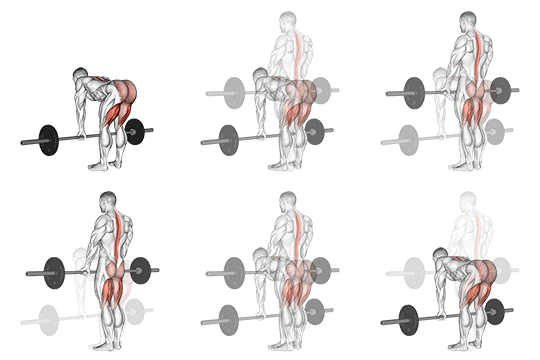
How to Do a Stiff-Leg Deadlift
Stance and grip: stand over a barbell with feet hip-width apart. Hinge down and take an overhand grip slightly wider than shoulder-width.
Set your knee angle: bend your knees slightly (soft knees) and lock this exact knee angle in place. Do not let your knees bend further as you lower the bar.
Raise hips high: set your hips higher than in a conventional deadlift so your torso is almost parallel to the floor.
Brace core and pack lats: flatten your back, pull your shoulders down into your lats, and take a deep breath into your abdomen.
Lift by extending hips: drive through your heels and midfoot, extending your hips to pull the barbell up along your legs to standing.
Hinge backward under control: lower the barbell by pushing your hips straight back while keeping the bar close to your thighs and shins.
Reverse at deep hamstring stretch: descend until the plates touch the floor or until your available hamstrings range ends without rounding your back, then drive hips forward to return to standing.
Form Check & Technique
DO THIS (Technique Tips)
- Set hips high and knees soft.
- Lock knee bend angle permanently.
- Push hips far back as bar descends.
- Keep barbell close to shins.
- Feel deep hamstring stretch before reversing.
- Brace core tightly throughout.
AVOID THIS (Common Mistakes)
- Rounding Lower Back — Fix: keep chest up, core braced, and stop descent if spine starts to curve.
- Bending Knees More as Bar Lowers — Fix: lock a slight knee bend at the top and keep it fixed.
- Bar Drifting Away From Legs — Fix: engage lats to keep bar scraping close to thighs and shins.
- Hyperextending Back at Top — Fix: finish standing tall by squeezing glutes, not leaning back.
- Jerking Off Floor — Fix: pull slack out of bar before driving hips forward.
About Stiff-Leg Deadlift
The stiff-leg deadlift (SLDL) is a compound hip-hinge exercise that heavily targets the hamstrings, gluteus maximus, and spinal erectors. Performed with nearly straight knees (a soft bend that remains locked in place), high hip positioning, and a floor or near-floor bar path, the stiff-leg deadlift creates a intense loaded stretch on the hamstrings. Proper form requires maintaining a flat neutral spine, hinging strictly at the hips, and keeping the bar close to the body.
Stiff-Leg Deadlift Muscles Worked
Because knee bend is kept minimal and fixed throughout the movement, the hamstrings are stretched to a greater degree at the hip joint compared to conventional deadlifts.
- The gluteus maximus and adductor magnus assist hip extension, while the erector spinae and upper back muscles work isometrically to maintain a rigid, flat torso.
Sets & Reps Guidance
Technique / Learning
Technique: 2–3 sets of 8–12 reps with light weight to master hinge.
Strength Focus
Strength: 3–4 sets of 5–6 reps with heavy control and flat spine.
Muscle Growth (Hypertrophy)
Hypertrophy: 3–4 sets of 8–10 reps focusing on loaded hamstring stretch.
General training baseline. Need.fit automatically adjusts exact sets, reps, and working weight based on your individual fitness level, recovery, and progress over time.
Exercise Variations & Alternatives
Romanian Deadlift
Top-down hip hinge with slightly more knee bend and controlled range.
Conventional Deadlift
Floor-start compound pulling exercise with greater quad participation.
Lying Leg Curl
Isolation knee flexion exercise for hamstrings.
Seated Leg Curl
Seated knee flexion exercise providing long muscle length hamstring work.
Good Morning
Barbell hip hinge with weight supported on upper back.
Hip Thrust
Learn proper hip thrust form, muscles worked, bench and foot setup, top-position cues, common mistakes, progressions, variations, and practical sets and reps.
Stiff-Leg Deadlift vs Romanian Deadlift (RDL)
While both are posterior chain hip hinges, the stiff-leg deadlift typically starts from the floor (or closer to it), uses higher hip placement with minimal fixed knee bend, and features a greater range of motion. The RDL usually starts from standing, allows slightly more soft knee bend, and stops around mid-shin level.
Stiff-Leg Deadlift vs Conventional Deadlift
Conventional deadlifts involve significant knee bend and quad contribution to lift off the floor. Stiff-leg deadlifts minimize quad involvement by keeping the knees fixed, placing almost all of the pulling load directly onto the hamstrings and lower back.
Preventing Lower Back Rounding
Only lower the bar as far as your hamstring flexibility allows with a flat spine.
- If your spinal erectors start to round, stop the descent.
- Flexible lifters may reach the floor, while others stop at mid-shin.
Bar Path & Lat Engagement
Keep the barbell close to your shins throughout the descent. Letting the bar drift forward creates a long moment arm on the lower back, increasing shear stress on the spine.
Stiff-Leg Deadlift Benefits
Builds massive hamstring and glute strength, reinforces heavy hip-hinge mechanics, improves hamstring flexibility under load, and strengthens the posterior chain for conventional deadlifting.