
Seated Leg Curl
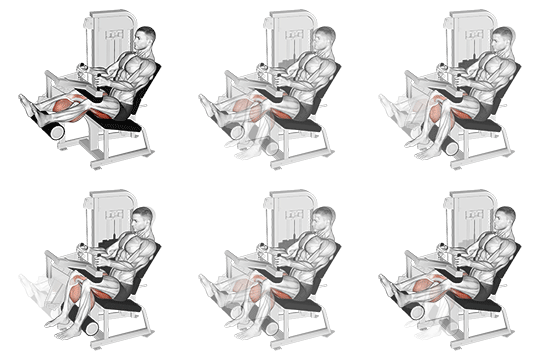
How to Do a Seated Leg Curl
Adjust the backrest: set the back pad so your lower back rests firmly against it and your knees align directly with the machine's red pivot point.
Position the ankle pad: adjust the lower roller pad so it rests against your lower calves, just above the ankles/Achilles tendon.
Lock the thigh pad down: lower the upper thigh constraint pad tightly onto your lap. This prevents your hips and thighs from lifting during heavy curls.
Grasp the side handles: hold the machine handles firmly to anchor your upper body and keep your spine flat against the backrest.
Flex the knees: exhale as you pull the lower pad down and back toward the underside of the seat in a smooth arc.
Squeeze at bottom contraction: pause briefly at full knee flexion, squeezing your hamstrings hard without letting your back arch.
Extend under control: inhale as you slowly return the weight stack over 2–3 seconds, allowing a full stretch at top without locking the knees.
Form Check & Technique
DO THIS (Technique Tips)
- Lock thigh pad tightly over lap.
- Align knee joint with machine pivot pin.
- Press back flat into seat rest.
- Curl pad smoothly under seat.
- Pause for 1 second at full contraction.
- Return under a controlled 2–3s negative.
- Keep feet dorsiflexed for calf help or plantarflexed for pure hamstring focus.
AVOID THIS (Common Mistakes)
- Loose Lap/Thigh Pad — Fix: lock the upper pad down tight against your thighs before starting.
- Knee Axis Misalignment — Fix: adjust the backrest so your knees line up with the machine pivot pin.
- Slouching or Arching Back — Fix: keep your lower back pressed into the back pad and chest up.
- Allowing Weight Stack to Slam — Fix: control the eccentric return for 2 to 3 seconds.
- Incomplete Range of Motion — Fix: flex knees fully under seat and extend back to a full comfortable stretch.
- Using Heavy Momentum — Fix: reduce load and focus on a clean 1-second contraction squeeze.
About Seated Leg Curl
The seated leg curl is an isolation machine exercise that targets the hamstring muscles through knee flexion while sitting with the hips flexed at ~90 degrees. Because hip flexion places the hamstrings in a lengthened position, the seated leg curl provides higher muscle stretch and activation across the long head of the biceps femoris and semitendinosus compared to prone variations. Proper form requires securing the thigh pad firmly, aligning the knee joint with the machine pivot, and controlling both the curl and extension phases.
Seated Leg Curl Muscles Worked
Because the hips are flexed at 90 degrees in a seated position, the hamstrings are pre-stretched at their origin on the ischial tuberosity.
- This loaded stretch under knee flexion stimulates high muscle recruitment across all hamstring heads.
- The gastrocnemius assists in flexing the knee joint, while the thigh pad keeps the hip flexors and quads immobilized.
Sets & Reps Guidance
Technique / Learning
Endurance & Finishers: 2–3 sets of 15–20 reps with light load to pump the hamstrings.
Strength Focus
Strength & Resistance: 3–4 sets of 6–8 reps with strict control and slow negatives.
Muscle Growth (Hypertrophy)
Hypertrophy (Muscle Growth): 3–4 sets of 8–12 reps focusing on deep stretch and peak contraction.
General training baseline. Need.fit automatically adjusts exact sets, reps, and working weight based on your individual fitness level, recovery, and progress over time.
Exercise Variations & Alternatives
Lying Leg Curl
Prone leg curl variation targeting hamstrings at neutral hip extension.
Stiff-Leg Deadlift
Barbell hip-hinge exercise for posterior chain stretch and strength.
Romanian Deadlift
Compound hip hinge focusing on glute and hamstring stretch.
Standing Calf Raise
Calf isolation exercise complementing leg curl training.
Glute Bridge
Hip extension movement targeting glutes and hamstrings.
Barbell Bench Press
Learn proper barbell bench press form, muscles worked, grip and bar-path cues, common mistakes, and practical sets and reps for strength or muscle.
Seated Leg Curl vs Lying Leg Curl
Research consistently shows that seated leg curls induce greater hamstring muscle activation and muscle growth (hypertrophy) than lying leg curls. The ~90-degree hip flexion angle in the seated position places the hamstrings at longer muscle lengths, which is superior for hypertrophy.
Why Tightening the Thigh Pad is Critical
If the lap/thigh pad is loose, your pelvis will tilt forward and your thighs will lift off the seat during the curl. This turns an isolation knee-flexion exercise into a sloppy hip movement and reduces tension on the hamstrings.
Foot Position: Dorsiflexion vs Plantarflexion
Flexing your ankles (toes pointed up toward shins) engages the upper calf (gastrocnemius) to help pull the weight. Pointing your toes away (plantarflexion) disengages the calf, placing almost 100% of the knee-flexion workload directly onto the hamstring complex.
Controlling the Eccentric Stretch
Do not let the weight stack slam back up. Taking 2 to 3 seconds on the return phase takes full advantage of the lengthened hamstring position and builds strong tendon resilience against hamstring strains.
Seated Leg Curl Benefits
Provides maximal loaded hamstring stretch, isolates knee flexors without spinal compression, allows easy incremental loading, and is suitable for beginners to advanced lifters.
Programming the Seated Leg Curl
Use seated leg curls as a primary hamstring builder on leg days or as a accessory exercise following heavy compound lifts like squats and Romanian deadlifts.