
Lying Leg Curl
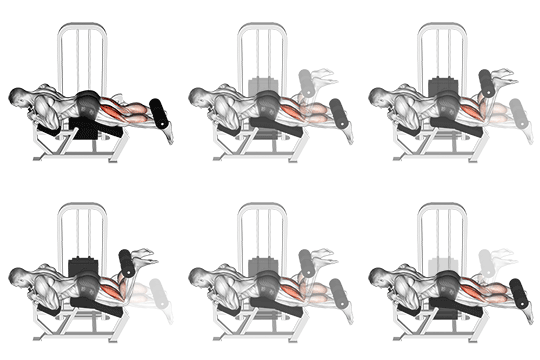
How to Do a Lying Leg Curl
Adjust the machine settings: position the lower leg pad so it rests comfortably against your lower calves, just above the Achilles tendon/ankles. Ensure the machine axis aligns with your knee joints.
Lie prone on the bench: lie face-down with your knees just off the edge of the pad so your knee joints can pivot freely without friction.
Grasp the support handles: hold the machine handles securely to anchor your upper body, pull your chest lightly down, and brace your core.
Press your pelvis into the pad: engage your glutes slightly and maintain firm hip contact with the bench to avoid arching your lower back as load increases.
Initiate the knee curl: exhale as you flex your knees and smoothly bring the lever pad up toward your glutes in a sweeping arc.
Pause at peak contraction: squeeze your hamstrings hard at the top of the movement without letting your hips lift off the bench.
Lower under control: inhale as you extend your knees slowly back toward full stretch over a 2 to 3 second eccentric phase, stopping just before locking out the knees.
Form Check & Technique
DO THIS (Technique Tips)
- Align knees with the machine pivot point.
- Adjust pad to sit just above the ankles.
- Press hips firmly into the bench pad.
- Squeeze hamstrings hard at top contraction.
- Lower weight over a slow 2–3 second eccentric.
- Keep core braced and neck neutral.
- Keep toes flexed to involve calves or pointed for pure hamstring isolation.
- Use a weight that allows full range without hip compensation.
AVOID THIS (Common Mistakes)
- Lifting Hips Off the Bench — Fix: drive your pelvis down and reduce weight if your hips pop up.
- Swinging the Weight with Momentum — Fix: initiate the curl strictly with your hamstrings, not momentum.
- Rushing the Lowering Phase — Fix: take 2–3 seconds to lower the pad under complete control.
- Incorrect Pad Setup — Fix: adjust pad distance so it rests just above the Achilles tendon.
- Hyperextending the Neck — Fix: keep your head neutral, looking slightly down at the pad.
- Knee Axis Misalignment — Fix: align your knee joint directly with the machine's pivot point.
- Shortening Range of Motion — Fix: curl all the way up without lifting hips, and extend fully without locking.
- Using Excessively Heavy Load — Fix: prioritize continuous tension and peak squeeze over maximum weight.
About Lying Leg Curl
The lying leg curl (also known as the prone hamstring curl) is an isolation machine exercise that targets the hamstrings through knee flexion. By isolating the hamstring muscles across the knee joint while the torso remains supported on the bench, it allows targeted loading without heavy lower-back or grip fatigue. Proper lying leg curl form requires pressing the hips firmly into the bench pad, setting the lower pad just above the ankles, and moving the load through a smooth, controlled range of motion.
Lying Leg Curl Muscles Worked
The lying leg curl is a direct knee-flexion exercise.
- Because the hamstrings cross both the hip joint and knee joint (except the short head of biceps femoris), flexing the knee while keeping the hip in relative extension strongly recruits all heads of the hamstring complex.
- The gastrocnemius (upper calf) assists in knee flexion, while the glutes and core work isometrically to stabilize the pelvis on the pad.
Sets & Reps Guidance
Technique / Learning
Muscular Endurance & Warm-Up: 2–3 sets of 15–20 light, controlled reps.
Strength Focus
Strength & Resilience: 3–4 sets of 6–8 reps with strict tempo and complete hip stability.
Muscle Growth (Hypertrophy)
Hypertrophy (Muscle Growth): 3–4 sets of 8–12 reps with a 2-second eccentric and 1-second squeeze.
General training baseline. Need.fit automatically adjusts exact sets, reps, and working weight based on your individual fitness level, recovery, and progress over time.
Exercise Variations & Alternatives
Seated Leg Curl
Performs knee flexion with hips flexed at 90 degrees for increased hamstring stretch.
Stiff-Leg Deadlift
Hip-hinge posterior-chain exercise emphasizing hamstring stretch at the hip.
Romanian Deadlift
Loaded hip hinge starting from standing to build glute and hamstring strength.
Standing Calf Raise
Calf isolation exercise that complements lower leg and knee flexion strength.
Glute Bridge
Bodyweight or weighted hip extension targeting glutes and hamstrings.
Barbell Bench Press
Learn proper barbell bench press form, muscles worked, grip and bar-path cues, common mistakes, and practical sets and reps for strength or muscle.
Lying Leg Curl vs Seated Leg Curl
The primary difference lies in hip position.
- Seated leg curls place the hips in ~90 degrees of flexion, stretching the hamstrings at the hip joint and yielding high muscle stretch.
- Lying leg curls place the hips closer to neutral extension, emphasizing peak contraction at shortened lengths and providing a different stimulus for complete hamstring development.
Why Do Your Hips Lift During Lying Leg Curls?
When the weight is too heavy or hamstrings fatigue, your body compensates by flexing the hips to shorten the lever arm.
- This causes the glutes and hips to pop up off the bench, transferring load to the lower back.
- Keep the weight manageable and press your hips flat into the pad on every rep.
Proper Pad Placement Above the Ankles
The padded roller should sit on the lower calf/achilles area, not mid-calf or low on the feet. Setting the pad too high decreases lever length and reduces hamstring activation, while setting it on the heels can cause slipping or heel strain.
Importance of the Slow Eccentric (Negative)
Hamstrings respond exceptionally well to controlled eccentric loading. Lowering the weight over 2–3 seconds under full tension triggers greater hypertrophy and builds tendon resilience, helping protect against hamstring strains.
Foot Position: Dorsiflexion vs Plantarflexion
Keeping your feet in a neutral or slightly flexed position (dorsiflexion — toes toward shins) recruits the calf (gastrocnemius) to assist the hamstrings. Pointing your toes (plantarflexion) decreases calf involvement and isolates the hamstrings further.
How Lying Leg Curls Complement Hip-Hinge Lifts
Compound hinge movements like deadlifts and Romanian deadlifts train the hamstrings as hip extenders. The lying leg curl trains them as knee flexors, ensuring balanced development across both joint functions.
Lying Leg Curl Benefits
Isolates hamstrings with zero spinal loading, allows safe hypertrophy training close to failure, improves knee flexion strength, and supports knee joint stability for sprinters, lifters, and athletes.
Dumbbell Lying Leg Curl Alternative
If you don't have a lying leg curl machine, you can perform lying leg curls on a flat bench holding a dumbbell between your feet. Ensure a training partner assists with placing the dumbbell or use a secure ankle attachment.
Sources & References
- [1]
- [2]Regional Hypertrophy in Hamstrings Following Knee Flexion vs. Hip Extension Training — PubMed (PMID: 33497853)View Source