
Romanian Deadlift
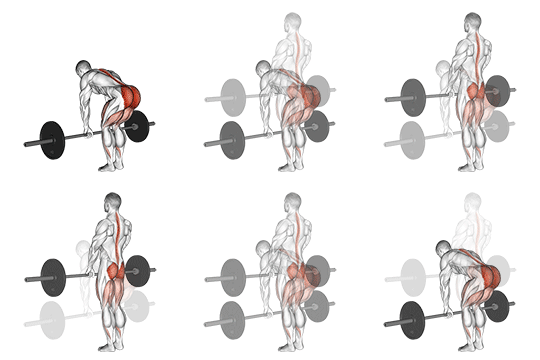
How to Do a Romanian Deadlift
Start from standing: hold the bar at thigh level with a double-overhand grip just outside the legs and use a stance around hip width.
Set the knees and trunk: soften the knees slightly, brace the torso, and keep the shoulders and lats controlled so the bar stays close.
Push the hips backward: initiate the repetition by moving the hips behind you rather than squatting straight down.
Keep the bar close: let the bar travel down the thighs toward the shins while the arms stay long and the weight remains close to the body.
Stop at your available hinge depth: descend until you feel strong hamstring tension or until further lowering would require more knee bend, loss of balance, or a change in trunk position. The bar does not need to reach the floor or a fixed mid-shin point.
Drive through the whole foot: reverse the movement by extending the hips and pushing the floor away while maintaining the same bar path.
Finish standing tall: return to normal standing with the hips and knees extended without leaning backward or overextending the lower back.
Form Check & Technique
DO THIS (Technique Tips)
- Start around hip width.
- Use a double-overhand grip first.
- Keep the knees soft, not deeply bent.
- Push the hips backward.
- Keep the bar close.
- Stop when the hinge ends.
- Drive through the whole foot.
- Stand tall without leaning back.
AVOID THIS (Common Mistakes)
- Squatting the Weight Down — Fix: move the hips backward while keeping only a small, controlled knee bend.
- Bar Drifting Away From the Legs — Fix: keep the lats active and guide the bar close to the thighs and shins.
- Reaching for the Floor — Fix: stop when your hip hinge ends instead of forcing extra depth.
- Knees Locking Completely — Fix: maintain a comfortable soft knee position throughout the repetition.
- Hips Failing to Move Back — Fix: think about sending the hips behind you rather than only lowering the shoulders.
- Leaning Back at the Top — Fix: finish standing tall without hyperextending the lower back.
- Grip Limiting the Target Muscles — Fix: reduce load or use straps when appropriate for heavy posterior-chain work.
- Using Excessive Range From a Deficit — Fix: only use added range if you can maintain the same hinge and control.
About Romanian Deadlift
The Romanian deadlift, or RDL, is a compound hip-hinge exercise that primarily trains the hamstrings and glutes while the spinal erectors, lats, upper back, core, and grip help stabilize the load. Unlike a conventional deadlift, the RDL normally begins from standing and does not reset on the floor between repetitions. Proper Romanian deadlift form uses a small, comfortable knee bend, pushes the hips backward, keeps the bar close to the legs, and stops the descent when additional depth would require losing the hinge or trunk position.
Romanian Deadlift Muscles Worked
The RDL is a posterior-chain hip hinge.
- The hamstrings contribute strongly as the hips move through flexion and extension, while the gluteus maximus and adductor magnus assist hip extension.
- The erector spinae and core help maintain trunk position, the lats and upper back keep the bar close, and the forearms hold the load.
- Research on deadlift variations consistently identifies substantial hamstring involvement in Romanian deadlifts.
Sets & Reps Guidance
Technique / Learning
Technique: 2–4 sets of 5–8 reps with a manageable load while learning knee position, hip travel, and bar proximity.
Strength Focus
Strength: 3–5 sets of 4–8 reps using a load that preserves bar path, trunk control, and a repeatable hinge.
Muscle Growth (Hypertrophy)
Muscle growth: 3–4 sets of 6–12 controlled reps with a deliberate eccentric and a range that maintains hamstring tension.
General training baseline. Need.fit automatically adjusts exact sets, reps, and working weight based on your individual fitness level, recovery, and progress over time.
Exercise Variations & Alternatives
Deadlift
A conventional floor-start deadlift using greater knee flexion and a reset from the ground.
Stiff-Leg Deadlift
A straighter-knee hip-hinge variation with different posterior-chain demands.
Good Morning
A hip hinge performed with the bar supported across the upper back instead of held in the hands.
Hip Thrust
A hip-extension exercise with different hamstring-length and trunk-position demands.
leg-curl
Barbell Back Squat
Learn barbell back squat form, muscles worked, rack setup, stance, bracing, squat depth, common mistakes, variations, and practical sets and reps.
Romanian Deadlift vs Conventional Deadlift
A conventional deadlift begins from the floor and uses more knee flexion before the bar leaves the ground.
- The Romanian deadlift usually begins from standing, keeps a smaller and more consistent knee bend, and emphasizes a controlled hip hinge.
- The bar normally does not reset on the floor between RDL repetitions.
Romanian Deadlift vs Stiff-Leg Deadlift
Both are hip-hinge exercises, but the Romanian deadlift typically uses a small knee bend and stops according to the lifter's available hip hinge.
- A stiff-leg deadlift uses straighter knees and can create different posterior-chain demands.
- Research comparing variations has found differences in glute and hamstring excitation, so the names should not be treated as identical movements.
How Far Down Should You Go on an RDL?
Do not chase a fixed target such as the floor or exactly mid-shin.
- Range of motion depends on hamstring length, hip mobility, limb proportions, stance, and your ability to maintain the hinge.
- Stop when the hips can no longer travel backward without the movement changing.
How Much Should Your Knees Bend During an RDL?
Use a small, comfortable knee bend that stays fairly consistent as the hips move backward.
- There is no need to force an exact 15- or 20-degree angle.
- Too much knee bend turns the exercise toward a squat or conventional deadlift pattern, while completely locked knees may not be comfortable for every lifter.
Why Should the Bar Stay Close?
Keeping the bar close reduces unnecessary forward displacement and helps the lats and upper back maintain an efficient hinge. If the bar drifts away, the exercise usually becomes harder on the trunk and grip without adding useful hamstring range.
Should You Use Straps for Romanian Deadlifts?
Straps can be useful when grip fatigue limits your hamstring and glute training before the target muscles are challenged.
- They are optional, not required.
- Beginners should first learn the bar path and hinge with a grip they can control.
Dumbbell vs Barbell Romanian Deadlift
Barbells make progressive loading straightforward and keep both hands connected to one implement.
- Dumbbells allow more hand freedom and can be easier to use in small spaces.
- The hip-hinge principles are the same: controlled knees, hips back, load close, and depth determined by the hinge.
Romanian Deadlift Benefits
RDLs train the hamstrings and glutes through a loaded hip hinge, build posterior-chain strength, reinforce the hinge pattern used in many lifts and athletic movements, and can be programmed on leg, full-body, or posterior-chain training days.
Sources & References
- [1]
- [2]
- [3]Electromyographic Activity in Deadlift Exercise and Its Variants: A Systematic Review — PubMed (PMID: 32107499)View Source
- [4]An Electromyographic Analysis of Romanian, Step-Romanian, and Stiff-Leg Deadlift — PubMed (PMID: 35162922)View Source
- [5]