
Standing Calf Raise
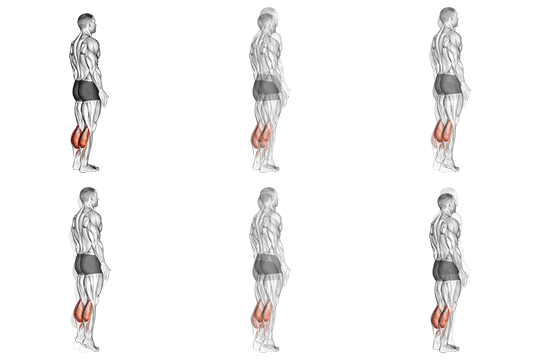
How to Do a Standing Calf Raise
Step setup: place the balls of your feet on the edge of a calf step or machine block, letting your heels hang off the back.
Knee position: stand tall with your knees completely extended but not hyperextended. Keep your knees locked straight throughout.
Lower into deep stretch: inhale as you slowly lower your heels as far as comfortably possible below step level until you feel a strong stretch in your calves.
Hold bottom stretch: pause for 1–2 seconds at the bottom to eliminate elastic achilles Achilles tendon bounce.
Drive up onto toes: exhale as you push forcefully through the balls of your feet, raising your heels as high as possible.
Peak squeeze at top: squeeze your calves hard at full height for 1–2 seconds before lowering under control.
Form Check & Technique
DO THIS (Technique Tips)
- Balls of feet on step edge, heels hanging free.
- Knees must remain locked straight.
- Pause 2 seconds at bottom stretch.
- Rise as high as possible on big toe joint.
- Hold top contraction for 1–2 seconds.
- Control the lowering phase for 2–3 seconds.
AVOID THIS (Common Mistakes)
- Bouncing at Bottom — Fix: pause 2 seconds at bottom stretch to eliminate tendon recoil.
- Bending Knees During Raise — Fix: keep knees locked straight to keep gastrocnemius engaged.
- Partial Range of Motion — Fix: drop heels fully below block and rise fully onto tiptoes.
- Pushing Off Pinky Toes — Fix: push evenly through the big toe and ball of foot.
About Standing Calf Raise
The standing calf raise is the definitive isolation exercise for targeting the gastrocnemius—the large, two-headed muscle that gives calves their diamond shape. Because the gastrocnemius crosses both the knee and ankle joints, performing calf raises with straight knees keeps the muscle elongated and primary. Proper form requires lowering the heels below step level for a deep ankle stretch, driving high onto the balls of your feet, and pausing at peak contraction.
Standing Calf Raise Muscles Worked
The gastrocnemius crosses both the knee joint and ankle joint.
- Standing with straight knees stretches the gastrocnemius, allowing it to generate maximum force.
- The underlying soleus muscle also assists, but standing calf raises disproportionately target the visible gastrocnemius.
Sets & Reps Guidance
Strength Focus
Strength & Achilles Resilience: 3–4 sets of 8–10 heavy reps with strict 2s pauses.
Muscle Growth (Hypertrophy)
Hypertrophy (Calf Growth): 4 sets of 10–15 reps with deep stretch and top squeeze.
General training baseline. Need.fit automatically adjusts exact sets, reps, and working weight based on your individual fitness level, recovery, and progress over time.
Exercise Variations & Alternatives
Seated Calf Raise
Bent-knee calf raise isolating the soleus muscle.
Lying Leg Curl
Hamstring isolation exercise also engaging upper calf.
Hip Thrust
Glute building exercise.
Plank
Core stability hold.
Crunch
Abdominal exercise.
Barbell Bench Press
Learn proper barbell bench press form, muscles worked, grip and bar-path cues, common mistakes, and practical sets and reps for strength or muscle.
Standing vs Seated Calf Raise
Standing calf raises keep the knees straight, heavily loading the gastrocnemius.
- Seated calf raises flex the knees at 90 degrees, which slackens the gastrocnemius and shifts almost all load to the underlying soleus muscle.
- Both are necessary for complete calf development.
Eliminating Achilles Tendon Bounce
The Achilles tendon is an extremely bouncy elastic spring.
- If you bounce out of the bottom of a calf raise, the tendon does the work instead of your calf muscles.
- Pause for 2 full seconds at the bottom stretch on every rep to build real muscle size.
Foot Angle Myths (Toes In vs Toes Out)
Pointing toes slightly inward places minor emphasis on the outer (lateral) head, while pointing toes slightly outward emphasizes the inner (medial) head. However, pointing straight ahead with full range of motion builds the entire muscle complex most effectively.
Standing Calf Raise Benefits
Builds calf size and leg aesthetics, improves ankle stability, increases vertical jump power, and strengthens the Achilles tendon against tears.