
Seated Calf Raise
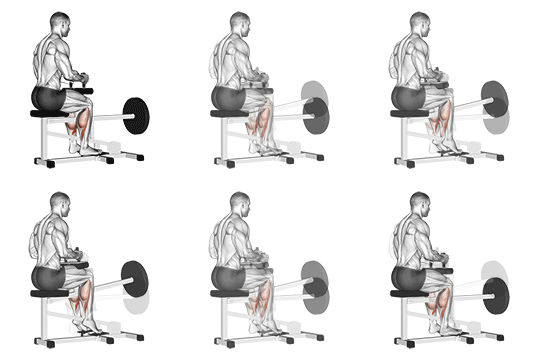
How to Do a Seated Calf Raise
Machine setup: sit on the machine pad and place the balls of your feet on the lower footrest, letting your heels hang off the back.
Adjust thigh pad: lower the thigh pad so it rests comfortably over your lower thighs, just above your knees. Lock it tightly in place.
Disengage safety lever: push up slightly onto your toes to disengage the safety catch mechanism.
Lower heels into deep stretch: inhale as you slowly lower your heels below the step level until you feel a deep stretch in your lower calves.
Pause at bottom: hold the bottom stretch position for 1–2 seconds to eliminate Achilles tendon elasticity.
Raise heels high: exhale as you press down through the balls of your feet, pushing your heels up as high as possible.
Squeeze soleus at top: hold top contraction for 1–2 seconds before lowering under control.
Form Check & Technique
DO THIS (Technique Tips)
- Lock thigh pad securely over lower quads.
- Keep knees bent at 90 degrees.
- Lower heels into full deep stretch.
- Pause 2 seconds at bottom stretch.
- Press through big toe joint at peak lockout.
- Use higher rep ranges (12–20+ reps) for soleus hypertrophy.
AVOID THIS (Common Mistakes)
- Bouncing Weight — Fix: hold a strict 2-second pause at the bottom stretch of every repetition.
- Loose Thigh Pad — Fix: lock pad down snugly so your legs don't slide around.
- Short Range of Motion — Fix: lower heels fully below footrest and rise up onto big toe joints.
- Rushing Reps — Fix: perform 2-second negatives to maximize soleus fiber recruitment.
About Seated Calf Raise
The seated calf raise is an isolation machine exercise specifically engineered to target the soleus muscle—the wide, flat muscle that lies directly beneath the gastrocnemius. Sitting with knees bent at ~90 degrees slackens the gastrocnemius (due to active insufficiency), isolating the soleus to drive lower calf width, ankle stability, and overall lower leg thickness.
Seated Calf Raise Muscles Worked
Bending the knees to 90 degrees shortens the two-headed gastrocnemius muscle across the knee joint, rendering it incapable of producing significant force (active insufficiency).
- This forces the single-joint soleus muscle to carry virtually the entire load of ankle plantarflexion.
Sets & Reps Guidance
Strength Focus
Strength & Tendon Conditioning: 3 sets of 10–12 reps with heavy weight and 2s pause.
Muscle Growth (Hypertrophy)
Hypertrophy (Soleus Growth): 4 sets of 12–15 reps with slow negatives.
General training baseline. Need.fit automatically adjusts exact sets, reps, and working weight based on your individual fitness level, recovery, and progress over time.
Exercise Variations & Alternatives
Standing Calf Raise
Straight-knee calf raise isolating the gastrocnemius.
Lying Leg Curl
Knee flexion hamstring exercise.
Seated Leg Curl
Seated hamstring isolation exercise.
Hip Thrust
Glute building exercise.
Glute Bridge
Floor hip extension exercise.
Barbell Bench Press
Learn proper barbell bench press form, muscles worked, grip and bar-path cues, common mistakes, and practical sets and reps for strength or muscle.
Why the Soleus Requires Seated Calf Raises
The soleus lies underneath the gastrocnemius and adds width and thickness to the lower calf near the Achilles. Because it consists predominantly of slow-twitch Type I muscle fibers, it responds exceptionally well to high-rep ranges (15–25 reps) and long time-under-tension.
Seated vs Standing Calf Raise Comparison
Standing calf raises work the upper calf (gastrocnemius) with straight knees.
- Seated calf raises work the lower/underlying calf (soleus) with bent knees.
- You need both to maximize calf aesthetics and ankle strength.
Dumbbell Seated Calf Raise Alternative
If you don't have a seated calf machine, sit on a bench, place a foot block under your feet, and balance a heavy dumbbell across your lower thighs with a towel for padding.
Seated Calf Raise Benefits
Isolates the soleus muscle, widens lower leg appearance, improves running endurance, supports Achilles tendon health, and adds calf volume.