
Single-Arm Dumbbell Row
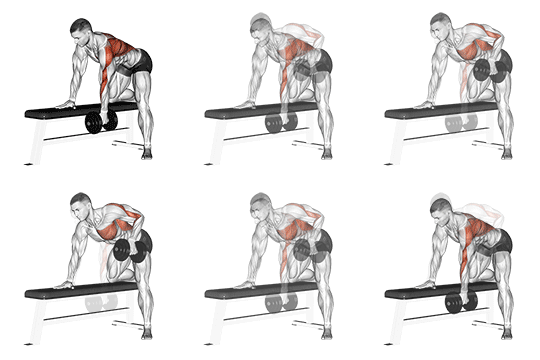
How to Do a Single-Arm Dumbbell Row
Build a Stable Supported Position: Use either knee-and-hand support on a flat bench or a staggered stance with one hand supported on a sturdy rack or bench.
Hold the Dumbbell Under the Shoulder: Grip a dumbbell securely in your working hand and let the arm hang naturally straight down without starting far in front.
Brace the Torso: Maintain control of your pelvis and rib cage to keep your torso sufficiently stable so the row remains the primary movement.
Allow a Controlled Bottom Reach: Let the working shoulder blade move forward naturally without letting your entire torso collapse toward the floor.
Row the Dumbbell: Drive the elbow backward toward your hip or lower ribs for a tucked row path, adapting slightly depending on your target emphasis.
Finish Without Excessive Rotation: Stop when your working shoulder and elbow reach a controlled end position without twisting aggressively at the torso.
Lower Under Control: Return the dumbbell along the same path under full control, allowing scapular protraction before resetting for the next rep.
Form Check & Technique
DO THIS (Technique Tips)
- Establish a solid tripod base of support.
- Keep back flat and braced.
- Start hanging under the shoulder.
- Arc dumbbell toward your hip.
- Drive elbow back behind torso.
- Retract shoulder blade at top.
- Control lowering phase to full stretch.
- Avoid excessive body rotation.
AVOID THIS (Common Mistakes)
- Unstable bench/support setup — Fix: Build a stable tripod base with knee and hand or staggered stance before rowing.
- Twisting aggressively at the top — Fix: Keep torso rotation controlled and finish with shoulder blade retraction.
- Jerking the dumbbell — Fix: Use a load that allows smooth acceleration and controlled muscular pull.
- Shrugging the shoulder — Fix: Keep neck relaxed and direct the elbow through the intended hip-ward path.
- Pulling unnecessarily high — Fix: Stop when shoulder motion and torso control remain clean near torso level.
- Collapsing at the bottom — Fix: Allow scapular reach without dropping your entire torso toward the floor.
- Using a path inconsistent with the goal — Fix: Use hip/lower-rib path for a tucked lat row; higher path for upper-back.
- Using different body positions on each side — Fix: Standardize stance, bench position, and range of motion for both arms.
About Single-Arm Dumbbell Row
The single-arm dumbbell row is a unilateral horizontal pulling exercise that trains the lats and mid-to-upper back while the biceps, rear delts, grip and trunk assist. A stable supported setup lets you row one side at a time while controlling shoulder-blade movement and avoiding excessive torso rotation.
Muscles Worked by the Single-Arm Dumbbell Row
The single-arm dumbbell row allows each side of the upper back to work independently through an extended range of motion.
- The latissimus dorsi drives shoulder extension and adduction, while the rhomboids and middle trapezius pull the shoulder blade inward toward the spine.
- The arm flexors (biceps brachii, brachialis, and brachioradialis) assist elbow flexion, and core musculature stabilizes the torso against rotational forces throughout the complete movement cycle.
Sets & Reps Guidance
Technique / Learning
Strength / controlled loading: 3–4 sets of 6–10 reps per side with heavy controlled weight.
Strength Focus
General muscle work: 3–4 sets of 8–12 reps per side focusing on full stretch and contraction.
Muscle Growth (Hypertrophy)
Higher-rep accessory: 2–4 sets of 10–15+ reps per side with moderate load.
General training baseline. Need.fit automatically adjusts exact sets, reps, and working weight based on your individual fitness level, recovery, and progress over time.
Exercise Variations & Alternatives
Barbell Bent-Over Row
Bilateral unsupported horizontal row.
Seated Cable Row
Seated cable horizontal pull with adjustable handle attachments.
Deadlift
Learn proper deadlift form, muscles worked, setup, bracing and bar-path cues, common mistakes, variations, and practical sets and reps.
Pull-Up
Learn proper pull-up form, muscles worked, grip and range-of-motion cues, common mistakes, progressions, and practical sets and reps.
Chin-Up
Learn proper chin-up form, muscles worked, underhand-grip setup, range-of-motion cues, common mistakes, progressions, and practical sets and reps.
Lat Pulldown
Learn proper lat pulldown form, muscles worked, grip-width and torso-position cues, common mistakes, pull-up differences, and practical sets and reps.
Knee-on-Bench vs Hand-Supported Dumbbell Row
The knee-and-hand bench setup provides maximum external stability for heavy progressive loading.
- A standing hand-supported staggered stance offers greater hip freedom and comfortable positioning for taller lifters or those who experience hip tightness on a flat weight bench.
- Both variations are valid choices.
Where Should the Dumbbell Travel?
Guide the dumbbell in a smooth, subtle J-curve arc from below the shoulder back toward your hip or lower rib area, keeping your forearm perpendicular to the pulling direction throughout the entire ascent and eccentric descent.
Should You Pull Toward the Hip or the Chest?
Pulling toward the hip increases latissimus dorsi leverage by lengthening the moment arm for shoulder extension. Pulling higher toward the chest or upper ribs flares the elbow slightly and shifts muscle emphasis toward the mid-back, rhomboids, and rear delts.
Should Your Shoulder Blade Move During Dumbbell Rows?
Yes, allow full natural scapular movement. Reach downward into full shoulder blade protraction at the bottom stretch position and retract your shoulder blade firmly toward your spine at the peak concentric finish of every single repetition.
How Much Torso Rotation Is Okay?
A small amount of natural torso rotation (5–10 degrees) at the bottom stretch is completely acceptable, but excessive twisting to heave the weight upward reduces targeted back muscle tension and increases spinal shearing forces.
How Low Should You Lower the Dumbbell?
Lower the dumbbell smoothly until your arm is fully extended and your lat is completely stretched, without letting the shoulder joint drop out of socket or collapsing your braced torso posture uncomfortably.
Should Your Elbow Stay Close to Your Body?
Keeping the elbow tucked at a 30–45 degree angle relative to your torso focuses work on the lower lat and keeps the shoulder in a comfortable neutral alignment. Flaring the elbow out to 90 degrees shifts load to the rear deltoid and mid-back.
Single-Arm Dumbbell Row vs Barbell Row
Single-arm dumbbell rows offer unilateral focus, greater range of motion at the bottom stretch, and reduced lumbar stress due to external bench support. Barbell rows allow heavier total system loading and build bilateral torso endurance.
Sources & References
- [1]Trunk Muscle Activation and Kinematics During Unilateral and Bilateral Rowing Exercises — PubMed (PMID: 26134664)View Source
- [2]Comparison of Different Row Exercises: Trunk Muscle Activation and Lumbar Spine Load, Kinematics — PubMed (PMID: 19197209)View Source
- [3]Electromyographic Analysis of Muscle Activation During Unilateral and Bilateral Rowing — PubMed (PMID: 24077382)View Source
- [4]Surface EMG Analysis of Upper Body Musculature in Unilateral Rowing — PubMed (PMID: 28011412)View Source
- [5]
- [6]
- [7]