
Lying Leg Raise
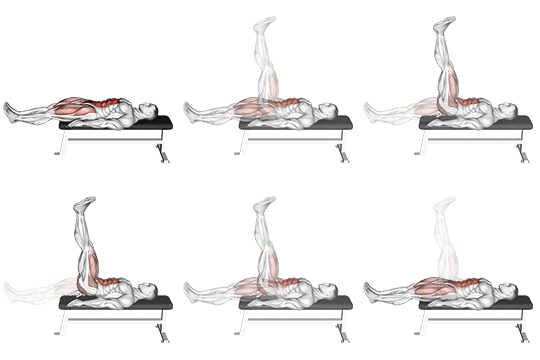
How to Do a Lying Leg Raise
Lie on your back on the floor or a bench with the legs extended.
Place the arms by the sides or lightly under the pelvis if that helps control the lower back.
Brace the abdominals and control the pelvis before moving.
Raise the legs toward vertical with straight or softly bent knees.
Use around 90 degrees of hip flexion as a practical top reference.
Lower the legs slowly toward the floor.
Stop the descent before the lower back arches excessively; shorten the range or bend the knees if needed.
Form Check & Technique
DO THIS (Technique Tips)
- Brace before lifting.
- Use bent knees if needed.
- Lift without momentum.
- Control the pelvis.
- Lower only as far as you can control.
- Keep the head relaxed.
- Use a slow eccentric.
- Progress to hanging raises only after floor control is strong.
AVOID THIS (Common Mistakes)
- Lower Back Arching Excessively — Fix: shorten the lowering range or bend the knees.
- Kicking the Legs Up — Fix: lift under control.
- Dropping the Legs — Fix: slow the eccentric.
- Head and Neck Straining — Fix: keep them relaxed.
- Chasing Heels-to-Floor Range — Fix: stop where pelvic control ends.
- Knees Bending Differently Each Rep — Fix: choose a consistent lever length.
- Using Momentum From the Arms — Fix: keep hand support stable.
About Lying Leg Raise
The lying leg raise is a bodyweight core exercise performed on the floor or a bench by raising and lowering the legs while the trunk remains supported. The hip flexors create much of the leg-lifting motion, while the rectus abdominis, obliques, and deeper core stabilize the pelvis and resist excessive lower-back arching. The most important form cue is to lower the legs only as far as you can maintain abdominal and pelvic control rather than forcing the heels close to the floor.
Lying Leg Raise Muscles Worked
The hip flexors move the legs while the abdominal wall helps control the pelvis and trunk.
- This is why lying leg raises should not be described as isolating a separate lower-ab muscle.
- The exercise becomes more abdominally demanding when pelvic control is maintained through the lowering phase.
Sets & Reps Guidance
Technique / Learning
Technique: 2–3 sets of 6–10 bent-knee or partial-range reps.
Strength Focus
Harder core work: 3–4 sets of 6–12 straight-leg, bench, or lightly weighted reps.
Muscle Growth (Hypertrophy)
Muscle / endurance work: 3–4 sets of 10–20 controlled reps.
General training baseline. Need.fit automatically adjusts exact sets, reps, and working weight based on your individual fitness level, recovery, and progress over time.
Exercise Variations & Alternatives
Hanging Leg Raise
A more advanced suspended leg raise with grip demands.
Bicycle Crunch
A floor-based core exercise combining flexion and rotation.
Plank
A static anti-extension core exercise.
Ab Wheel Rollout
An advanced anti-extension progression.
Crunch
Master abdominal crunch form, upper ab isolation, crunch vs sit-up differences, proper neck position, common mistakes, and sets and reps.
Sit-Up
Master full-range sit-up form, abdominal & hip flexor muscles worked, sit-up vs crunch differences, common mistakes, and sets and reps.
Lying Leg Raise vs Hanging Leg Raise
Lying raises support the trunk and remove grip and shoulder demands, making them easier to learn. Hanging raises add suspension, grip, anti-swing control, and a more advanced progression.
Do Lying Leg Raises Work the Lower Abs?
They challenge the abdominal wall, but there is no separate lower rectus abdominis muscle. Hip flexors move the legs while the abs stabilize and control the pelvis.
How Low Should You Lower Your Legs?
Lower only until you can still control the pelvis and lower back. If the back begins to arch substantially, stop higher or bend the knees.
Should Your Lower Back Stay Flat?
Use abdominal and pelvic control to avoid a large uncontrolled arch. Small individual spinal movement is normal; the practical goal is a repeatable position.
Bent-Knee vs Straight-Leg Raises
Bent knees shorten the lever and reduce difficulty.
- Straight legs increase torque demand.
- Progress by lengthening the lever gradually.
Floor vs Bench Leg Raises
A bench can alter arm support and usable range, while the floor is simpler and more stable. Use the setup where you can best control the pelvis.
Lying Leg Raise Progressions
Start with bent-knee raises or single-leg lowers, progress to straight-leg raises, then use a bench, ankle weights, or hanging variations when appropriate.
Lying Leg Raise Benefits
The exercise needs minimal equipment, builds hip-flexion and trunk-control capacity, and provides an accessible progression toward hanging core work.
Sources & References
- [1]
- [2]
- [3]