
Concentration Curl
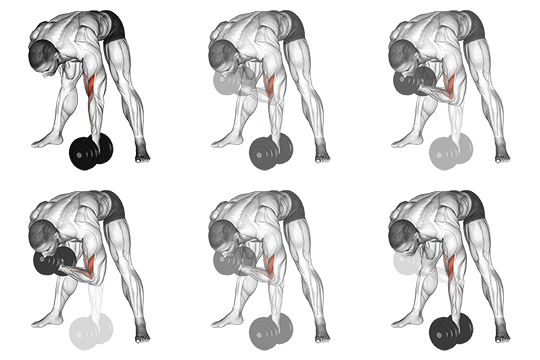
How to Do a Concentration Curl
Set the bench position: sit near the edge of a flat bench with your feet planted and your knees spread far enough to create room for the working arm.
Hold the dumbbell with an underhand grip: take the dumbbell in one hand with the palm facing upward or naturally turning upward as you settle into position.
Support the upper arm: lean forward slightly from the hips and place the back or lower portion of your working upper arm against the inside of the same-side thigh near the knee.
Set the start position: allow the forearm to extend downward while keeping the shoulder quiet and the upper arm supported. Use a comfortable elbow position rather than forcing the joint into a hard lockout.
Curl toward the shoulder: bend the elbow and bring the dumbbell upward while keeping the torso still and the upper arm in contact with the thigh.
Finish without lifting the elbow: pause briefly near the top if desired, but do not slide the elbow upward or turn the repetition into a shoulder raise.
Lower under control: extend the elbow slowly until you return to the same controlled starting position, then repeat before switching arms.
Form Check & Technique
DO THIS (Technique Tips)
- Plant both feet firmly.
- Support the upper arm against the inner thigh.
- Keep the torso still.
- Use a comfortable underhand grip.
- Curl by bending the elbow.
- Do not lift the elbow at the top.
- Lower the dumbbell slowly.
- Match reps and technique between arms.
AVOID THIS (Common Mistakes)
- Elbow Sliding Up the Thigh — Fix: keep the working upper arm supported in the same position throughout the repetition.
- Rocking the Torso Back — Fix: reduce the load and keep your chest and pelvis stable.
- Using Momentum From the Shoulder — Fix: move mainly at the elbow instead of swinging the entire arm.
- Resting the Elbow Point on the Knee — Fix: support the upper arm against the inner thigh instead.
- Dropping the Dumbbell Quickly — Fix: control the lowering phase back to the starting position.
- Forcing Extreme Wrist Supination — Fix: use a comfortable palm-up position with the wrist stacked.
- Using a Weight That Shortens the Range — Fix: choose a load that lets you repeat the same elbow-flexion range.
- Doing More Reps With the Stronger Arm — Fix: use the same planned reps and comparable technique on both sides.
About Concentration Curl
The concentration curl is a seated single-arm dumbbell curl that trains the biceps brachii through elbow flexion while the working upper arm is supported against the inner thigh. That support reduces opportunities to swing the shoulder or torso, making the movement easy to perform with strict control. A strong concentration curl uses a stable seated position, an underhand grip, a mostly fixed upper arm, a smooth curl toward the shoulder, and a controlled lowering phase. An ACE-sponsored acute EMG study found the concentration curl produced the highest biceps activation among eight tested curl variations, but acute muscle activation should not be treated as proof that one exercise is universally best for long-term biceps growth.
Concentration Curl Muscles Worked
The concentration curl primarily trains the biceps brachii through elbow flexion.
- The brachialis and brachioradialis assist the curl, while the forearm and grip muscles stabilize the dumbbell.
- Supporting the upper arm against the thigh limits shoulder movement and body momentum, which can make it easier to keep the exercise focused on the elbow flexors.
Sets & Reps Guidance
Technique / Learning
Technique: 2–3 sets of 10–15 reps per arm with a lighter dumbbell while learning stable upper-arm placement and torso control.
Strength Focus
Heavier accessory work: 3–4 sets of 6–10 controlled reps per arm when you can keep the upper arm supported and avoid torso momentum.
Muscle Growth (Hypertrophy)
Muscle growth: 2–4 sets of 8–15 reps per arm using a load that preserves a full controlled curl and lowering phase.
General training baseline. Need.fit automatically adjusts exact sets, reps, and working weight based on your individual fitness level, recovery, and progress over time.
Exercise Variations & Alternatives
Preacher Curl
A supported curl that fixes the upper arm against an angled preacher pad.
Dumbbell Curl
A free-standing or seated curl that allows more natural upper-arm movement and loading.
Hammer Curl
Uses a neutral grip to train the elbow flexors with greater brachialis and brachioradialis involvement.
Barbell Curl
A bilateral curl variation that allows both arms to lift one bar together.
Chin-Up
A compound underhand vertical pull that heavily engages the biceps flexors.
Lat Pulldown
A cable pulling variation targeting the upper back and bicep flexors.
Where Should Your Arm Rest During a Concentration Curl?
Support the working upper arm against the inner thigh near the knee.
- The goal is to create a stable brace that limits shoulder and torso movement.
- Avoid balancing the sharp point of the elbow directly on top of the kneecap.
Concentration Curl vs Dumbbell Curl
Both are dumbbell elbow-flexion exercises, but the concentration curl supports the upper arm against the thigh and is usually performed one side at a time. A regular dumbbell curl gives the shoulder and torso more freedom and is generally easier to load more heavily.
Concentration Curl vs Preacher Curl
Both exercises support the upper arm to reduce body swing.
- A preacher curl uses an angled pad, while a concentration curl uses the inner thigh.
- The resistance profile and shoulder position differ, so neither exercise should be described as universally superior.
Seated vs Standing Concentration Curl
The seated version gives the upper arm a stable thigh support and is the standard variation. A standing bent-over concentration curl allows the arm to hang more freely and therefore relies more on active shoulder control.
Should You Squeeze at the Top?
A brief controlled pause can help you feel the end position and avoid rushing, but the squeeze is not a special growth mechanism on its own. Use a full repeatable range and consistent effort rather than chasing an exaggerated top contraction.
What the ACE Biceps Study Actually Shows
In the ACE-sponsored study, the concentration curl produced the highest acute biceps EMG activity among eight tested exercises. That supports the exercise as an effective way to target the biceps, but an acute EMG ranking is not the same thing as a long-term hypertrophy trial and does not prove it will build more muscle than every other curl.
How Heavy Should Concentration Curls Be?
Use a dumbbell you can curl without lifting the elbow, rocking backward, or shortening the lowering phase. Because the exercise intentionally limits momentum, the useful load is often lighter than what you can use for standing curls.
Concentration Curl Benefits and Best Use
Concentration curls require only a dumbbell and a seat, train each arm independently, and make it easy to standardize technique. They work well as direct biceps work after rows, pulldowns, chin-ups, or heavier curl variations.
Sources & References
- [1]
- [2]
- [3]
- [4]