
Dumbbell Curl
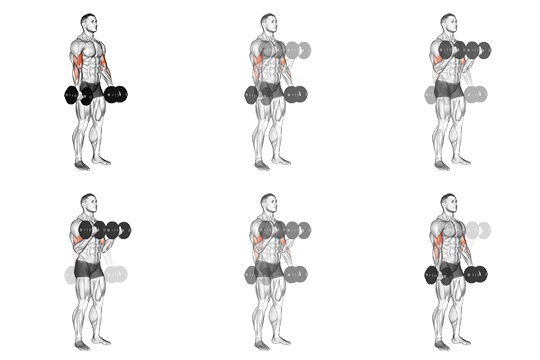
How to Do a Dumbbell Curl
Stand With Dumbbells at Your Sides: Stand up straight with feet shoulder-width apart, holding a dumbbell in each hand with arms fully extended.
Choose Starting Forearm Position: Begin with palms facing forward (supinated) or palms facing your thighs (neutral) depending on your curling variation.
Brace the Torso: Engage your core and keep your back straight, avoiding leaning backward to initiate momentum.
Flex the Elbow: Bend your elbow to raise the dumbbell upward toward your shoulder while keeping your upper arm relatively motionless.
Supinate if Using a Rotating Curl: If starting from a neutral grip, gradually rotate your forearm so your palm faces upward by the midpoint of the curl.
Reach a Controlled Top: Squeeze your biceps firmly at the peak contraction without swinging your elbow far forward.
Lower Under Control: Lower the dumbbell back to the starting position over a 2-second eccentric descent before repeating on the next rep.
Form Check & Technique
DO THIS (Technique Tips)
- Stand or sit with tall, braced posture.
- Start with dumbbells beside thighs.
- Flex elbow while supinating forearm.
- Keep upper arm still near torso.
- Squeeze biceps at top contraction.
- Lower dumbbell under control over 2 seconds.
- Use alternating reps for maximum focus.
- Standardize range of motion on both arms.
AVOID THIS (Common Mistakes)
- Swinging torso — Fix: Reduce weight and keep your core braced tightly.
- Rotating only at the wrist — Fix: Rotate your entire forearm smoothly as part of the arm path.
- Dropping the eccentric — Fix: Lower the dumbbell under full control over 2 seconds.
- Throwing elbow far forward — Fix: Keep your upper arm pinned relatively still near your torso.
- Using different ROM on each arm — Fix: Standardize depth and lockout on both left and right arms.
- Assuming alternating curls are inherently superior — Fix: Choose alternating or simultaneous curls based on training goals.
- Over-gripping unnecessarily — Fix: Hold the dumbbell securely without squeezing so hard that forearms fatigue prematurely.
- Assuming dumbbells automatically fix asymmetry — Fix: Use independent loading as a tool, but monitor technical execution.
About Dumbbell Curl
The dumbbell curl is a versatile elbow-flexion exercise performed with one dumbbell in each hand, allowing each arm to move through its own natural path and control its own load independently. It trains the biceps brachii and underlying brachialis while accommodating custom forearm rotation (supination) throughout the lift. By eliminating bilateral barbell constraints, the dumbbell curl allows lifters to optimize wrist comfort, correct arm strength imbalances, and build symmetrical bicep development across training programs.
Muscles Worked by the Dumbbell Curl
The dumbbell curl isolates elbow flexion while allowing custom forearm rotation.
- The biceps brachii is the primary muscle responsible for both elbow flexion and forearm supination across the repetition.
- The underlying brachialis provides strong flexor assistance, while the brachioradialis and forearm flexors stabilize the wrist and maintain grip control throughout the entire set.
Sets & Reps Guidance
Technique / Learning
General muscle building: 2–4 sets of 6–15 reps with controlled dumbbell weight.
Strength Focus
Higher-rep pump: 2–4 sets of 10–20 reps focusing on strict supination and burn.
Muscle Growth (Hypertrophy)
Strict isolation: 3–4 sets of 8–12 reps taken near muscular failure.
General training baseline. Need.fit automatically adjusts exact sets, reps, and working weight based on your individual fitness level, recovery, and progress over time.
Exercise Variations & Alternatives
Barbell Curl
Bilateral barbell biceps curl.
Hammer Curl
Neutral-grip dumbbell arm curl.
Preacher Curl
Learn preacher curl form, muscles worked, bench and pad setup, bar and grip options, bottom-range loading, common mistakes, comparisons, and sets and reps.
Concentration Curl
Learn concentration curl form, muscles worked, upper-arm and inner-thigh setup, common mistakes, curl comparisons, variations, and practical sets and reps.
Barbell Bench Press
Learn proper barbell bench press form, muscles worked, grip and bar-path cues, common mistakes, and practical sets and reps for strength or muscle.
Dumbbell Bench Press
Learn dumbbell bench press form, muscles worked, setup, range-of-motion cues, common mistakes, and practical sets and reps for controlled chest training.
Should You Rotate Your Wrist During a Dumbbell Curl?
Rotating your forearm from a neutral position at the bottom to a palms-up (supinated) position at the top is a popular, highly effective technique. Because the biceps brachii functions as both a powerful elbow flexor and a forearm supinator, rotating into full supination engages both primary actions of the muscle in one fluid rep.
When Should You Supinate?
Begin rotating your forearm as soon as the dumbbell clears your thigh during the early portion of the curl, completing full supination around 90 degrees of elbow flexion. Avoid twisting your wrist abruptly at the very top of the rep after elbow flexion has already finished.
Alternating vs Simultaneous Dumbbell Curls
Curling one arm at a time (alternating) allows you to focus total concentration on each arm independently while reducing core stability demands. Curling both arms simultaneously speeds up set completion and increases time under tension for the entire upper body.
Should Your Elbows Move?
Your upper arms should remain mostly fixed beside your torso. A subtle forward movement of the elbow near peak contraction is natural, but throwing elbows far forward removes tension from the biceps and transfers load to the front deltoids.
Standing vs Seated Dumbbell Curl
Seated dumbbell curls eliminate body swinging and leg drive, enforcing strict bicep isolation across every rep. Standing dumbbell curls allow slight body posture adjustments and require greater core stabilization.
Dumbbell Curl vs Barbell Curl
Dumbbell curls allow each arm to move independently, preventing a dominant arm from carrying extra load and accommodating custom wrist angles. Barbell curls permit heavier total bilateral weight loading.
Dumbbell Curl vs Hammer Curl
Standard dumbbell curls finish in a palms-up (supinated) position to maximize biceps recruitment. Hammer curls maintain a neutral palms-facing grip throughout to emphasize the brachialis and brachioradialis.
Unilateral Focus and Motor Unit Recruitment
Working with independent dumbbells forces each arm to initiate and maintain its own motor unit recruitment without relying on contralateral assistance. This unilateral focus helps lifters develop equal motor control and tension management in both arms.
Sources & References
- [1]Impact of Forearm Position on Biceps Brachii Muscle Activation During Dumbbell Curls — PubMed (PMID: 36976950)View Source
- [2]Electromyographic Comparison of Biceps Brachii and Brachioradialis in Dumbbell and Barbell Curls — PMC (PMC6047503)View Source
- [3]Unilateral vs Bilateral Muscle Activation in Free Weight Resistance Training — PubMed (PMID: 23096062)View Source
- [4]
- [5]
- [6]
- [7]Controlled Eccentric Lowering and Joint Safety in Flexor Training — PubMed (PMID: 34875981)View Source