
Barbell Curl
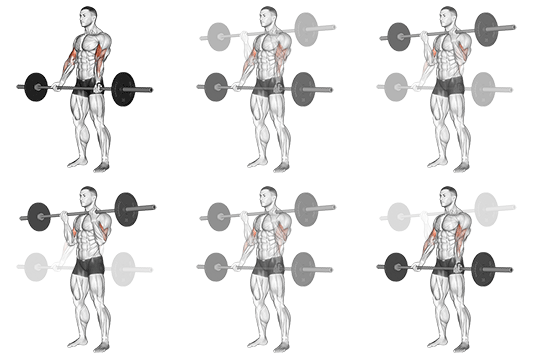
How to Do a Barbell Curl
Choose the Bar and Grip: Select a straight barbell or EZ-curl bar and hold it with a supinated (underhand) grip set around shoulder width.
Stand Tall: Stand up straight with your feet shoulder-width apart, holding the barbell resting near your thighs with arms extended.
Set the Wrists: Maintain a secure, neutral wrist alignment that supports the bar without letting your wrists extend backward.
Curl Through Elbow Flexion: Inhale and flex your elbows to curl the barbell upward, keeping your core engaged and avoiding hip swing.
Keep Upper-Arm Movement Controlled: Allow natural, subtle forward movement of your elbows without swinging your upper arms violently forward.
Reach a Controlled Top: Curl the bar up toward your upper chest until your biceps reach full contraction without resting the bar on your chest.
Lower Under Control: Lower the barbell smoothly back to full arm extension over a 2-second eccentric descent before initiating the next rep.
Form Check & Technique
DO THIS (Technique Tips)
- Grip bar around shoulder width.
- Keep wrists firm and neutral.
- Curl bar using elbow flexion.
- Brace core to prevent torso swing.
- Squeeze biceps at peak contraction.
- Lower bar smoothly over 2 seconds.
- Use EZ bar if straight bar strains wrists.
- Progress loading systematically.
AVOID THIS (Common Mistakes)
- Swinging hips — Fix: Reduce load and keep your glutes and core braced.
- Leaning far backward — Fix: Maintain a strict vertical posture throughout the curl.
- Collapsing wrists backward — Fix: Keep your wrists firm and neutral under the bar.
- Grip unnecessarily extreme — Fix: Start around a comfortable shoulder-width grip.
- Throwing elbows far forward — Fix: Keep your upper arms relatively still near your sides.
- Dropping the eccentric — Fix: Lower the bar under full control over 2 seconds.
- Using a straight bar despite persistent wrist pain — Fix: Switch to an EZ-curl bar for better joint comfort.
- Treating every heavy rep as a strict curl — Fix: Distinguish intentionally programmed cheat curls from strict technique.
About Barbell Curl
The barbell curl is a classic bilateral elbow-flexion exercise performed with an underhand grip on a straight or EZ barbell. It primarily trains the biceps brachii and underlying brachialis while the brachioradialis and forearm flexor muscles assist in joint stabilization. Because both hands grip one rigid implement, the barbell curl allows lifters to progressively overload the arm flexors with heavy bilateral resistance.
Muscles Worked by the Barbell Curl
The barbell curl builds bilateral bicep strength and mass through heavy elbow flexion.
- Both the long and short heads of the biceps brachii generate primary curling force, assisted by the underlying brachialis muscle.
- The brachioradialis and forearm flexors stabilize the wrists and grip, while the anterior deltoid assists during subtle, natural shoulder flexion at peak contraction.
Sets & Reps Guidance
Technique / Learning
Strength-oriented: 3–4 sets of 5–8 reps with heavy controlled barbell weight.
Strength Focus
General muscle building: 3–4 sets of 6–12 reps taken near technical failure.
Muscle Growth (Hypertrophy)
Accessory volume: 2–4 sets of 10–15 reps focusing on peak contraction and stretch.
General training baseline. Need.fit automatically adjusts exact sets, reps, and working weight based on your individual fitness level, recovery, and progress over time.
Exercise Variations & Alternatives
Dumbbell Curl
Unilateral or bilateral dumbbell bicep curl.
Preacher Curl
Supported arm curl on a preacher bench.
Hammer Curl
Learn hammer curl form, muscles worked, neutral-grip cues, cross-body variations, common mistakes, regular-curl differences, and sets and reps.
Concentration Curl
Learn concentration curl form, muscles worked, upper-arm and inner-thigh setup, common mistakes, curl comparisons, variations, and practical sets and reps.
Barbell Bench Press
Learn proper barbell bench press form, muscles worked, grip and bar-path cues, common mistakes, and practical sets and reps for strength or muscle.
Dumbbell Bench Press
Learn dumbbell bench press form, muscles worked, setup, range-of-motion cues, common mistakes, and practical sets and reps for controlled chest training.
How Wide Should Your Barbell-Curl Grip Be?
A grip set right at shoulder width provides optimal leverage and comfortable wrist alignment for most lifters. Placing hands too narrow can strain the wrists and elbows, while an excessively wide grip shortens the comfortable range of motion and forces unnatural shoulder rotation.
Straight Bar vs EZ Bar Curl
Straight barbells force full forearm supination, which maximizes biceps torque but can cause wrist discomfort in lifters with lower wrist supination mobility. EZ-curl bars feature angled handles that ease wrist strain while still heavily recruiting the biceps brachii, brachialis, and forearm flexors.
Should Your Elbows Stay Pinned?
Keeping your elbows tucked near your sides is standard form, but allowing a small, natural forward drift of your elbows near peak contraction is completely acceptable and anatomically normal during heavy barbell curls.
How High Should You Curl the Bar?
Curl the barbell up until your forearms are nearly vertical and your biceps achieve maximum contraction. Avoid lifting your elbows so far forward that the bar rests directly over your shoulder joints, which removes gravitational tension from the biceps.
Close vs Wide-Grip Barbell Curl
Grip width changes forearm angle and wrist comfort under load. While gym lore suggests narrow grips isolate the long head and wide grips isolate the short head, electromyographic evidence shows both heads remain heavily active regardless of grip width.
Strict Curl vs Cheat Curl
Strict curls maintain a still torso against a wall or with rigid core posture to isolate elbow flexors completely. Cheat curls use slight hip drive to pass sticking points with heavier loads, which can be useful when programmed intentionally by advanced lifters.
Barbell Curl vs Dumbbell Curl
Barbell curls allow heavier total weight loading because both hands grip one rigid bar. Dumbbell curls allow independent arm motion and custom wrist supination for each arm, preventing strength dominance between sides.
Strict Bar Path and Lumbar Mechanics
Keeping the barbell trajectory close to your torso reduces lumbar shear stress and keeps mechanical tension centered on the elbow flexors. Avoid leaning your upper body backward at the sticking point, which transfers vertical load onto the lumbar spine instead of the arm muscles.
Sources & References
- [1]Differences in Electromyographic Activity of Biceps Brachii and Brachioradialis While Performing Three Different Biceps Curls — PMC (PMC6047503)View Source
- [2]
- [3]Surface EMG Analysis of Upper Arm Musculature in Resistance Training — PubMed (PMID: 28011412)View Source
- [4]
- [5]Grip Width and Forearm Kinematics in Barbell Resistance Movements — PubMed (PMID: 41335596)View Source
- [6]
- [7]Controlled Eccentric Execution and Muscle Hypertrophy in Flexor Training — PubMed (PMID: 34875981)View Source