
Skull Crusher
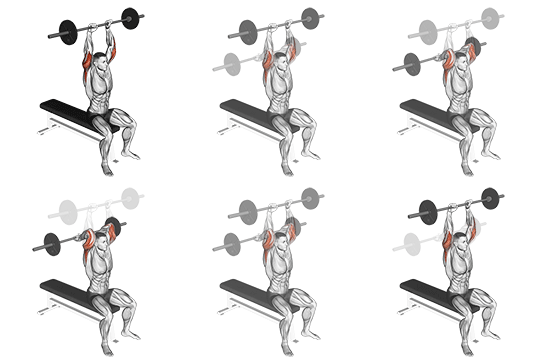
How to Do a Skull Crusher
Set up on a bench or floor: lie back with the feet supported and hold an EZ-bar, dumbbells, or another manageable resistance.
Bring the load into position: extend the arms above the chest or slightly toward the head and stabilize the shoulders before beginning.
Choose a comfortable upper-arm angle: keep the upper arms reasonably still while allowing a small backward angle if that makes the movement smoother.
Lower by bending the elbows: guide the load toward the forehead, top of the head, or slightly behind the head depending on the variation and equipment.
Use a controlled bottom position: stop before the load contacts the head and before the elbows or shoulders move into an uncomfortable range.
Extend the elbows: contract the triceps and return the resistance to the starting arm angle without throwing the upper arms forward.
Repeat with consistent tempo: keep the same lowering path and upper-arm position instead of turning later reps into a press or pullover.
Form Check & Technique
DO THIS (Technique Tips)
- Start with a manageable load.
- Keep the shoulders stable.
- Use a comfortable upper-arm angle.
- Bend mainly at the elbows.
- Lower under control.
- Stop before the load contacts the head.
- Choose a wrist-friendly implement.
- Keep the lowering path consistent.
AVOID THIS (Common Mistakes)
- Dropping the Weight Toward the Head — Fix: use a controlled eccentric and a manageable load.
- Upper Arms Swinging Excessively — Fix: keep them reasonably stable while the elbows bend.
- Turning the Rep Into a Press — Fix: move mainly at the elbows instead of lowering the upper arms toward the chest.
- Forcing Elbows Too Close Together — Fix: use a natural comfortable elbow path.
- Wrists Bent Uncomfortably — Fix: use an EZ-bar or dumbbells if a straight bar feels awkward.
- Using Too Much Weight — Fix: reduce load until the bottom position is controlled.
- Bouncing Out of the Bottom — Fix: reverse direction under triceps control.
- Letting Fatigue Change the Lowering Path — Fix: end the set before the load starts drifting unpredictably toward the face.
About Skull Crusher
The skull crusher, also called the lying triceps extension, is a single-joint elbow-extension exercise performed lying on a bench or the floor. It primarily trains the triceps brachii while the shoulder and forearm muscles stabilize the load. Skull crushers can be performed with an EZ-bar, dumbbells, a straight bar, cables, or bands. Strong form uses a secure start position, upper arms that stay reasonably stable, a controlled bend at the elbows, a lowering path toward or slightly behind the head depending on the variation, and a smooth extension back to the top.
Skull Crusher Muscles Worked
The skull crusher trains the triceps brachii through elbow extension.
- All three triceps heads contribute, while the shoulder stabilizers help hold the upper arm in position and the forearms stabilize the implement.
- The long head crosses the shoulder, so changes in upper-arm and shoulder angle alter its length and contribution.
Sets & Reps Guidance
Technique / Learning
Technique: 2–3 sets of 10–15 lighter reps while learning elbow path, upper-arm stability, and safe load placement.
Strength Focus
Heavier accessory work: 3–4 sets of 6–10 reps using a load you can lower safely and control without changing the upper-arm angle.
Muscle Growth (Hypertrophy)
Muscle growth: 2–4 sets of 8–15 reps with a controlled eccentric and a consistent bottom position.
General training baseline. Need.fit automatically adjusts exact sets, reps, and working weight based on your individual fitness level, recovery, and progress over time.
Exercise Variations & Alternatives
Overhead Tricep Extension
A triceps isolation exercise with the upper arms positioned overhead.
Tricep Pushdown
A cable elbow-extension exercise with the upper arms near the torso.
Close-Grip Bench Press
A compound press that heavily involves the triceps with chest and shoulder assistance.
Rope Pushdown
A cable pushdown variation using a flexible rope attachment.
Tricep Dip
A compound bodyweight press emphasizing the triceps.
Push-Up
A bodyweight compound pushing exercise that engages the triceps and chest.
Should Skull Crushers Go to the Forehead or Behind the Head?
Both are legitimate variations.
- Lowering toward the forehead uses a more vertical upper-arm position, while lowering slightly behind the head increases shoulder flexion and changes the triceps length and resistance profile.
- Choose the path you can control without contacting the head or losing elbow position.
EZ-Bar vs Dumbbell Skull Crusher
An EZ-bar connects both hands to one implement and offers angled grips.
- Dumbbells let each arm move independently and allow a neutral or semi-neutral hand position.
- Neither is universally better; comfort and control should guide the choice.
Should Your Upper Arms Stay Completely Still?
Keep them reasonably stable so elbow extension remains the main action, but small shoulder movement is not automatically a form failure. What matters is avoiding large uncontrolled swings that turn the exercise into a pullover or press.
How Much Should Your Elbows Flare?
Use a natural elbow path that keeps the wrists, forearms, and upper arms comfortable. Do not force the elbows to touch each other or let them drift so far outward that the movement becomes unstable.
Skull Crusher vs Overhead Tricep Extension
Both are single-joint triceps exercises.
- The overhead extension places the upper arm more fully overhead and therefore lengthens the long head more.
- Skull crushers are performed lying down and can use different upper-arm angles depending on whether the load travels toward the forehead or behind the head.
Skull Crusher vs Tricep Pushdown
Skull crushers use a lying elbow-extension position and often free weights.
- Pushdowns use a high cable with the upper arms near the torso.
- The two exercises differ in shoulder position, stability, and resistance profile, so combining them can provide variety.
Bench vs Floor Skull Crushers
A bench allows the load to travel slightly behind the head without hitting the floor.
- Floor skull crushers limit that behind-head range but provide a simple stable setup.
- Use the version that matches your equipment and desired range.
Skull Crusher Benefits and Programming
Skull crushers provide direct triceps loading with relatively little lower-body involvement and can be progressed using load, reps, tempo, or range. They work well after presses or as one of several direct triceps exercises in an upper-body or arm session.
Sources & References
- [1]
- [2]
- [3]
- [4]Effect of Shoulder Position on Triceps Brachii Heads Activity in Dumbbell Elbow Extension Exercises — PubMed (PMID: 28677940)View Source
- [5]Varying the Order of Combinations of Single- and Multi-Joint Exercises Differentially Affects Resistance Training Adaptations — PubMed (PMID: 32149887)View Source