
Overhead Tricep Extension
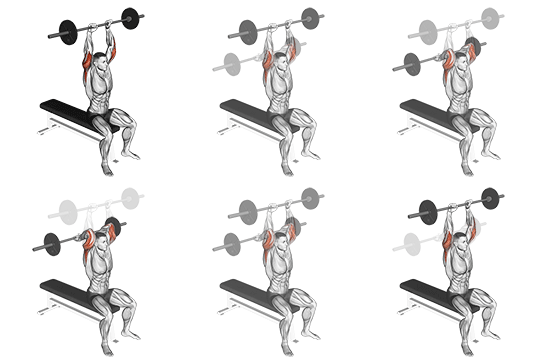
How to Do an Overhead Tricep Extension
Choose your setup: use a dumbbell, cable rope, EZ-bar, or another resistance you can control through an overhead elbow-extension range.
Set your base: sit or stand tall with the ribs and pelvis controlled and the feet stable.
Bring the arms overhead: position the upper arms beside or slightly forward of the head in a shoulder position that feels comfortable.
Brace the trunk: keep the rib cage from flaring and avoid turning the repetition into a lower-back arch.
Lower by bending the elbows: allow the resistance to travel behind the head while the upper arms stay reasonably stable.
Use your comfortable depth: lower until you feel a strong triceps stretch without forcing the shoulders or elbows into a painful end range.
Extend the elbows: contract the triceps to return the resistance overhead, finishing smoothly without aggressive hyperextension.
Repeat with the same arm path: keep the load, range, and tempo consistent instead of letting the elbows and shoulders drift more with each rep.
Form Check & Technique
DO THIS (Technique Tips)
- Brace the trunk first.
- Use a comfortable overhead shoulder position.
- Keep upper arms reasonably stable.
- Lower under control.
- Use a deep but comfortable range.
- Do not force elbow tuck.
- Extend smoothly.
- Choose the implement that best fits your joints and equipment.
AVOID THIS (Common Mistakes)
- Arching the Lower Back — Fix: keep the ribs and pelvis controlled and reduce the load if needed.
- Forcing the Elbows Too Close Together — Fix: allow a comfortable natural upper-arm angle.
- Upper Arms Moving Excessively — Fix: use a lighter load and keep the movement focused at the elbows.
- Using Too Much Weight — Fix: choose resistance that lets you control the bottom position.
- Dropping Quickly Into the Stretch — Fix: lower under control.
- Forcing Maximum Depth — Fix: stop at the deepest comfortable controllable range.
- Snapping Into Lockout — Fix: finish smoothly at full or near-full extension.
- Losing Wrist Position — Fix: choose an implement and grip that keep the wrist comfortable.
About Overhead Tricep Extension
The overhead tricep extension is a single-joint elbow-extension exercise performed with the upper arms elevated overhead. It trains all three heads of the triceps brachii while placing the biarticular long head at a longer muscle length than arm-at-the-side pushdowns. The exercise can be performed with a dumbbell, cable, EZ-bar, or other resistance. Strong form uses a braced trunk, a comfortable overhead shoulder position, upper arms that remain reasonably stable, controlled elbow flexion behind the head, and smooth extension without forcing the elbows into a painful or rigidly tucked position.
Overhead Tricep Extension Muscles Worked
All three triceps heads contribute to elbow extension.
- The long head also crosses the shoulder joint, so raising the arm overhead lengthens it more than keeping the arm near the torso.
- A 12-week cable study found greater growth of the long head and whole triceps when elbow extension was trained in the overhead position compared with a neutral arm position.
Sets & Reps Guidance
Technique / Learning
Technique: 2–3 sets of 10–15 reps with a lighter load while learning comfortable shoulder position, elbow path, and trunk control.
Strength Focus
Heavier accessory work: 3–4 sets of 6–10 reps when the shoulders, elbows, and trunk stay controlled through the full range.
Muscle Growth (Hypertrophy)
Muscle growth: 2–4 sets of 8–15 reps using a load that creates a strong triceps challenge without changing your overhead position.
General training baseline. Need.fit automatically adjusts exact sets, reps, and working weight based on your individual fitness level, recovery, and progress over time.
Exercise Variations & Alternatives
Tricep Pushdown
A cable elbow-extension exercise performed with the arms near the torso.
Rope Pushdown
A rope-based cable pushdown with flexible hand positioning.
Skull Crusher
A lying elbow-extension exercise using a bench or floor.
Close-Grip Bench Press
A compound pressing exercise that heavily involves the triceps.
Tricep Dip
A bodyweight compound pressing exercise for triceps development.
Push-Up
A bodyweight compound pushing exercise that engages the triceps and chest.
Why the Overhead Position Changes Triceps Loading
The triceps long head crosses both the elbow and shoulder.
- Elevating the arm overhead places it at a longer muscle length than a pushdown position.
- This is one reason overhead and arm-at-the-side triceps exercises should not be treated as identical.
Dumbbell vs Cable Overhead Tricep Extension
Dumbbells are simple and widely available.
- Cables provide resistance from a fixed pulley direction and make it easy to use a rope or single handle.
- The same 12-week study showing greater hypertrophy in the overhead condition used cable elbow extensions, so its result should not be overgeneralized as proof that every overhead implement is automatically superior.
Seated vs Standing Overhead Tricep Extension
Seated variations reduce lower-body movement and can make trunk control easier.
- Standing variations demand more active stabilization from the trunk and hips.
- Choose the position that lets you keep the ribs and pelvis controlled.
Do Your Elbows Need to Point Perfectly Forward?
No.
- Keep the upper arms reasonably stable, but allow a natural elbow angle that matches your shoulder and elbow anatomy.
- Forcing the elbows unnaturally close together can be uncomfortable for some lifters.
How Deep Should You Lower the Weight?
Lower through the deepest range you can control comfortably while keeping the trunk and upper arms stable. Do not force the forearms to touch the biceps if shoulder or elbow position breaks down before that point.
Overhead Tricep Extension vs Tricep Pushdown
The pushdown keeps the upper arm near the torso, while the overhead extension places the shoulder in flexion and lengthens the long head more. Both train elbow extension and can be useful in the same program.
Overhead Tricep Extension vs Skull Crusher
Both are triceps isolation exercises, but the overhead extension keeps the arm in a more vertical overhead position.
- Skull crushers are performed lying down with the upper arm elevated but usually not fully overhead.
- The shoulder angle changes the long-head length and resistance profile.
Overhead Tricep Extension Benefits
The exercise provides direct elbow-extension training in a long-head-lengthened position and can be scaled with dumbbells, cables, or bars. It pairs well with pushdowns and compound presses to expose the triceps to different shoulder positions.
Sources & References
- [1]
- [2]
- [3]Triceps Brachii Hypertrophy Is Substantially Greater After Elbow Extension Training Performed in the Overhead Versus Neutral Arm Position — PubMed (PMID: 35819335)View Source
- [4]The Different Role of Each Head of the Triceps Brachii Muscle in Elbow Extension — PubMed (PMID: 29503079)View Source