
Dumbbell Fly
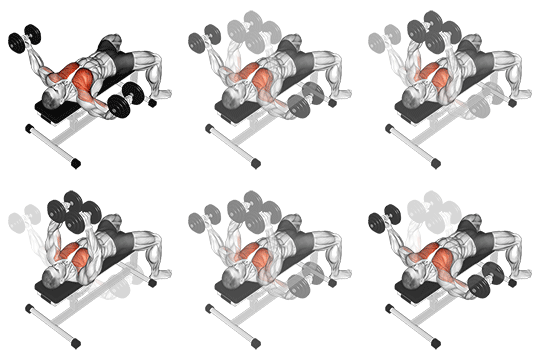
How to Do Dumbbell Fly
Choose considerably lighter dumbbells than you would use for pressing to accommodate the long-lever load.
Sit on a flat bench with dumbbells resting on your thighs, then guide the weights into position as you lie back.
Hold the dumbbells over your chest with a comfortable neutral grip where your palms face each other.
Create a soft, comfortable bend in your elbows and keep that elbow angle quiet and consistent.
Lower the dumbbells outward in a controlled, sweeping arc, keeping the motion centered at the shoulders.
Stop at the deepest position you can control while keeping shoulder and upper-back position stable.
Hug the same broad arc back up to finish over your chest without crashing the dumbbells together.
Form Check & Technique
DO THIS (Technique Tips)
- Keep the elbow bend quiet.
- Light weight, long lever.
- Open the arms — don't drop the weights.
- Control the stretch — don't chase maximum joint extension.
- Own the bottom range.
- Hug the same arc back up.
- Don't turn the fly into a press.
AVOID THIS (Common Mistakes)
- Using Too Much Weight — Fix: Reduce load until the bottom stretch remains smooth and controlled without pressing compensations.
- Turning the Fly Into a Press — Fix: Maintain a quiet elbow bend, sweeping from the shoulder rather than extending the elbows.
- Elbows Too Straight — Fix: Keep a soft elbow bend throughout the arc to protect the elbow and shoulder joints.
- Forcing Excessive Depth — Fix: Stop at your deepest controllable chest stretch without forcing your upper arms far below bench level.
- Shoulders Rolling Forward — Fix: Keep your upper back and shoulder girdle controlled against the bench throughout.
- Changing Arm Shape Every Rep — Fix: Maintain a repeatable elbow angle and arm arc across the entire set.
- Crashing Dumbbells Together — Fix: Finish with dumbbells controlled over your chest without slamming them together.
- Chasing the Top Squeeze — Fix: Prioritize control where the exercise is mechanically demanding at the bottom rather than forcing top contact.
About Dumbbell Fly
The dumbbell fly is a chest-focused single-joint exercise performed on a flat bench that trains the pectoralis major through shoulder horizontal adduction. Use relatively light dumbbells, maintain a soft and stable elbow bend, open the arms only through a range you can control, and reverse the same arc without turning the movement into a press.
Muscles Worked Breakdown
The Dumbbell Fly primarily targets the pectoralis major through shoulder horizontal adduction.
- The anterior deltoids assist in guiding the arm path forward.
- The biceps brachii act as active stabilizers to support the elbow and shoulder joints against the long lever arm, while the rotator cuff and scapular stabilizers preserve joint alignment against the bench.
Sets & Reps Guidance
Technique / Learning
High-Rep Work: 2–4 sets of 12–20 controlled reps for targeted chest volume without joint strain.
Strength Focus
Technique: 2–3 sets of 8–12 controlled reps with a lighter load to establish arm arc stability.
Muscle Growth (Hypertrophy)
Accessory Work: 3–4 sets of 8–15 controlled reps focusing on bottom-range control and smooth arc mechanics.
General training baseline. Need.fit automatically adjusts exact sets, reps, and working weight based on your individual fitness level, recovery, and progress over time.
Exercise Variations & Alternatives
Push-Up
A bodyweight horizontal pressing exercise training the chest, triceps, and core.
Barbell Bench Press
A foundational free-weight press for building chest and upper body pressing strength.
Dumbbell Bench Press
Offers independent horizontal pressing with unconstrained arm paths.
Cable Fly
A cable-based chest fly exercise providing continuous resistance across the arm arc.
Incline Barbell Bench Press
Learn proper incline barbell bench press form, muscles worked, bench-angle guidance, grip and bar-path cues, common mistakes, and sets and reps.
Incline Dumbbell Bench Press
Learn incline dumbbell bench press form, muscles worked, bench-angle guidance, setup, common mistakes, and practical sets and reps for upper-chest training.
Sources & References
- [1]Electromyographic Analysis of Dumbbell Fly vs Barbell Bench Press — PubMed (PMID: 33239937)View Source
- [2]Biomechanical Aspects and Shoulder Kinematics in Fly Exercises — PubMed Central (PMC8877248)View Source
- [3]Progressive Resistance Training Guidelines for Strength and Hypertrophy — PubMed (PMID: 41843416)View Source
- [4]Electromyographic Comparison of Cable and Free-Weight Chest Exercises — PubMed (PMID: 28129277)View Source
- [5]Biomechanical Loading Factors in Upper Body Resistance Movements — PubMed (PMID: 20179649)View Source