
Chest Dip
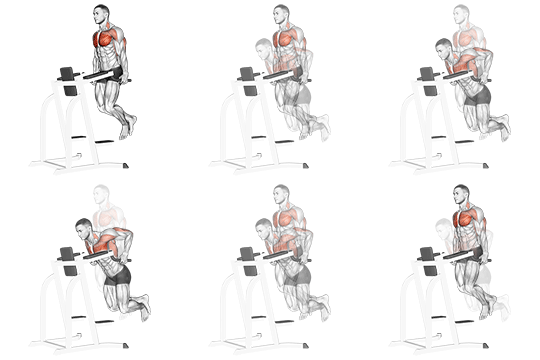
How to Do Chest Dip
Grip the Parallel Bars: Take a firm closed grip on parallel bars, establishing an even wrist position and consistent palm contact to support your bodyweight.
Establish a Stable Top Position: Press up to support your body between the bars with arms extended and shoulders kept down away from your ears before beginning the descent.
Create a Modest Forward Lean: Tilt your torso slightly forward when chest emphasis is the goal, maintaining that repeatable torso angle throughout the repetition rather than chasing one arbitrary degree mark.
Keep the Lower Body Quiet: Brace your core and keep your legs quiet, using a slight knee bend or crossed ankles if needed to prevent swinging or momentum.
Lower Under Control: Bend your elbows and descend under control, allowing your upper arms to travel naturally past your torso without dropping rapidly into the bottom.
Use a Controllable Depth: Lower to the deepest range of motion you can control while maintaining shoulder stability and smooth technique, using upper arms near parallel as a visual checkpoint rather than a rigid requirement.
Press Back to Support: Drive forcefully down into the bars to extend your elbows and return to a stable top support position without bouncing or kicking.
Form Check & Technique
DO THIS (Technique Tips)
- Own the top support: lock in shoulder stability before descending.
- Lean — don't fold: maintain a rigid, modest forward torso angle.
- Lower under control: avoid dropping quickly into shoulder extension.
- Use your depth, not someone else's: respect individual shoulder mobility.
- Keep shoulders away from your ears to prevent shrugging at the bottom.
- Press back to a stable support without swinging or kicking.
AVOID THIS (Common Mistakes)
- Jumping Into an Unstable Support — Fix: Establish balance and shoulder stability at the top before starting the repetition.
- Forcing an Exact Lean Angle — Fix: Maintain a repeatable modest forward lean rather than trying to match a rigid 30-degree or 45-degree prescription.
- Shrugging Into the Bottom — Fix: Keep shoulders controlled and drawn away from your ears throughout the descent.
- Dropping Too Deep for Stretch — Fix: Stop at your deepest controllable shoulder-extension depth without overloading the shoulder joint.
- Every Rep Too Shallow — Fix: Descend through adequate range of motion when shoulder control and strength permit.
- Swinging or Kicking the Legs — Fix: Brace your trunk and keep the lower body quiet to eliminate momentum.
- Changing Torso Angle Every Rep — Fix: Choose a consistent forward-lean angle and maintain it across the entire set.
- Adding Weight Too Early — Fix: Master repeatable bodyweight repetitions before adding external load via a dip belt.
About Chest Dip
The chest dip is a compound bodyweight press performed on parallel bars that trains the pectoralis major, triceps, and front deltoids while demanding significant shoulder and trunk control. For a chest-focused dip, use a modest forward torso lean, lower through the deepest range you can control, and press back to a stable top position without swinging or bouncing.
Muscles Worked Breakdown
The chest dip is a compound bodyweight press that heavily targets the pectoralis major.
- The triceps brachii extend the elbows to lock out the press, while the anterior deltoids assist shoulder flexion.
- Supporting muscles including the serratus anterior, trapezius, latissimus dorsi, forearms, and core work dynamically to stabilize the shoulder girdle and hold torso alignment.
Sets & Reps Guidance
Technique / Learning
Advanced Strength & Endurance: 3–5 sets of 3–6 weighted reps once bodyweight reps are strong, or 2–4 higher-rep sets.
Strength Focus
Technique & Assisted: 2–3 sets of 4–8 controlled reps using an assisted machine or band.
Muscle Growth (Hypertrophy)
General Strength & Muscle: 3–4 sets of 6–12 controlled reps.
General training baseline. Need.fit automatically adjusts exact sets, reps, and working weight based on your individual fitness level, recovery, and progress over time.
Exercise Variations & Alternatives
Push-Up
A horizontal bodyweight press that trains the chest and triceps while maintaining a moving plank position.
Barbell Bench Press
A free-weight horizontal press that allows precise load progression for chest and triceps strength.
Dumbbell Bench Press
Uses independent implements for horizontal pressing, allowing an unconstrained hand path.
Incline Dumbbell Bench Press
Shifts horizontal pressing load toward the upper pectoralis and anterior deltoids.
Incline Barbell Bench Press
Learn proper incline barbell bench press form, muscles worked, bench-angle guidance, grip and bar-path cues, common mistakes, and sets and reps.
Cable Fly
Learn proper cable fly form, muscles worked, pulley-height and range-of-motion cues, common mistakes, variations, and practical sets and reps.
Sources & References
- [1]Kinematic and Electromyographic Comparison of Dip Exercises — PubMed Central (PMC9603242)View Source
- [2]Progressive Resistance Training Guidelines for Strength and Hypertrophy — PubMed (PMID: 41843416)View Source
- [3]Neuromuscular Activation and Adaptations in Bodyweight vs Free Weight Pressing — PubMed (PMID: 31508485)View Source
- [4]Biomechanical Loading Factors in Upper Body Weight-Bearing Exercises — PubMed (PMID: 20179649)View Source
- [5]